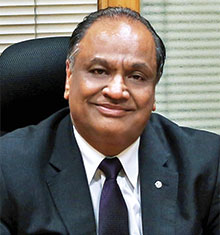
As a new President of iCEMA, what are your plans and agenda for the next two years?
iCEMA, as an association of Construction equipment suppliers, Manufacturers, Associate members, and other stakeholders, is growing in stature, and has become a credible voice of the industry. India has come of age and as an association, we want to take the industry to the next level of growth by improving our quality, reliability, and service. So my focus would be on progress.
I would like to continue the good work that we have been doing over the last few years, and take it to its logical conclusion. For instance, we are working with the Government on the CEMM Act. We are looking at skilling initiatives for which we are working with IESC for trained manpower in the industry, and are also looking at safety aspects, new emissions norms, etc. Overall, we want to ensure that the quality of goods supplied to customers and the practices that we follow are at par with those of the developed countries. iCEMA jointly with CII will be bringing out an industry report during EXCON 2017, based on feedback from all stakeholders, which will give deep insights into the current status of the CE industry and its growth prospects over the next few years.
How responsive is the Government to representations by iCEMA?
The Government can help shape the policies that govern our industry for further growth, progress, and sustenance. But, we have to work with them in a manner that is congruent with their goals of Make in India, Skill India, and other initiatives of the Honourable Prime Minister, at the same time, balancing the needs and concerns of our industry.
The current government is very progressive. We are working with them on many issues and have received their unstinted support; for instance in the matter of the Supreme Court’s imposition of BS IV norms that affected some of our machines, we received their support for an early redressal of the issue.
We have discussed with MoRTH and DHI our need for having a Test Centre and the CEMM Act amongst other things, and they are very receptive to the suggestions. However, we must acknowledge that both the parties will have to work within their respective policy frameworks and we have to find the right balance so that the concerns of both are adequately and reasonably addressed.
Please elaborate on the CEMM Act for rating equipment performance.
It is clear that for different products, the output and the efficiencies will be different. But there has to be a minimum threshold in terms of emission, safety features, quality, etc. We are working with the Government to bring in the CEMM Act, which will primarily address concerns on safety, compliance, noise levels, etc. We have also proposed setting up a Test Center which would certify machines that meet the minimum performance standards and other quality parameters.
Our teams have visited Japan and others to look at the facilities provided in their Test centers, and their compliance standards and regulations that govern the manufacture and supply of equipment. We want that the CEMM Act, just like in other countries, should further the interests of our customers, financiers, manufacturers and other stakeholders. We have held discussions with the Government and with the DHI, following which, a draft was prepared and put up in the public domain for comments. There should be some progress in the near future.
Please tell us about the IESC Council for skill development.
Under NSDC, we have formed our own Equipment skill development council-IESC. In the first phase, we have developed the quality parameters, performance standards for operators & mechanics for some construction equipment products, and many of our members are accredited trainers.
Most companies are actively engaged in training their customers’ personnel, but the training curriculum could vary from one company to another, so our aim is to bring uniformity for a set of products, and include both operators and mechanics. We have thousands of machines working at jobsites manned by operators who may not have undergone formal training. So, we want to ensure that the existing operators and mechanics are trained and certified, and that new trainees are gainfully employed.
We are also in discussions with insurance companies for lower interest rates for equipment operated by certified personnel as an incentive. All stakeholders, customers, NBFCs, insurance companies and others involved must appreciate the benefits that accrue to them by having trained operators. The Government is also looking into this initiative and has set very ambitious targets for the industry. L&T has set up a simulator in Nagpur for training and many other manufacturers have also taken such initiatives.
How does our equipment meet environ- ment regulation and compliance?
On-road equipment are anyways regulated by the CMVR and we are complying with all the regulations on emission, safety, etc. through homologation by ARAI. Most of the manufacturers in our country have tie-ups with global companies who have incorporated features in the equipment to meet environment compliance regulations or using engines made by reputed manufacturers who have the technology to meet emission norms. So, even off-road equipment is very compliant; the CEMM Act will still look into those aspects.
We have proposed to the Government that iCEMA will act proactively for on-road equipment regulations as well, and also for the next stage of emission norms. A recent notification of MoRTH indicates that sometime in the year 2020, new emission norms governing On Road Construction Equipment will apply, which will be at par with BS VI standards for automobiles and other equipment. The industry is taking a lead already and is working with the Government to ensure that our equipment is absolutely contemporary, meets various environmental regulations, and is at par with machines in the rest of the world. In fact, very few of our machines are non-compliant today, and most would come out with flying colors!
What is the Association’s view on second hand imports?
We had some discussions (on cranes specifically) with the Government and we felt that for equipment that is manufactured in India, there is not much need for import of used equipment. We also hold the view that used machines being imported into our country must comply with the same regulations that govern new equipment sold in the country. India is a developing country and has the ambition of becoming one of the global leaders, so we don’t want to be a recipient of old machines from developed countries. Also, the Government is propagating Make in India to encourage local manufacture. This entails improving the skills of our people and giving jobs to them. So, it may not make much sense to bring in used equipment.
However, one could definitely look at import of equipment that is not manufactured in India, or if an imported machine is not readily available (large size mining equipment, for instance). But the imported machine must not be old beyond a certain life. If its economic life is 10 years, then it should not be more than 5 years old when imported, so that it can work for the next 4-5 years, and be economically viable. We don’t want old-gen imports; we want modern, contemporary equipment with telematics, diagnostics, safety and fuel-efficiency features because we want to be efficient as an industry.
What do you see the current focus in infra development?
There is a lot of all-round activity in the infra sector - some of which is high profile and therefore, very visible, while some are taking time because of archaic laws like land acquisition and other dated systems that need to be overhauled.
Roads have been leading the CE industry; railways and even ports (the Sagarmala project, for instance) are seeing a lot of activity. When Shri Gadkari took the responsibility of Waterways, his first announcement was on linking the rivers; the PM has been talking of using waterways for internal transportation. All of this will create a huge opportunity for the CE industry.
If you look at our infrastructure today, there is a big deficit, no doubt. Now, with the ability to get more people into the formal sector, improve collection of taxes, and contain the fiscal deficit, the Government will have more funds. They are also looking at innovative methods like the Hybrid model for PPP infra projects and at tolling. They have found solutions for issues that were impeding growth like the S4A scheme for infra developers with strained financials, and the results will begin to show in the next few quarters. The proposed IPO of NHAI will also bring in a lot of funds which will help accelerate the Road building activity and will be a big positive for the industry.
What has been the impact of GST on the CE industry?
In my view, GST is a strong enabler for the country as it is necessary to have a large set of people in the formal sector. However, the GST rate for our construction equipment is extremely high at 28%. Since the primary entity that commissions building of infrastructure is the government, it is counter-productive to levy such a high tax rate. We have requested the concerned ministries for reconsideration of the same.
I feel that an appropriate rate of 12-18% would bring more OEM investors and customers into the CE business. Customers of smaller machines such as the backhoe loaders, which are mostly new entrants, and customers who are in the retail segment and are first-time buyers (but who play a vital role in infra development), have been the most affected. The input (tax) credit may not be available to them, and while the government has said that Rs.2 million (Rs.20 lakh) turnover per year customers will be able to take the benefits, I think this is still too small. We would like the Government to reduce the GST to earlier levels. Earlier, one would pay excise duty of 12.5% and most of the equipment (especially from manufacturers) was sold with a concessional sales tax (CST) of 2% - This resulted in taxes of around 15 – 16%. Raising the tax from these levels to 28% under the GST regime has been a big damper of demand in the short term.
The last 2-3 months have seen a considerable slowdown in demand. Last year ended with the industry showing a good growth of 20-25%. We are hoping that it would be sustained at (at least) 15% this year, but the current scenario is not so favorable for an industry that was seeing shrinkage for many years, and the capacity utilization of all manufacturers is at a low.
In a price-conscious country like India, how can customers be coerced into using new technologies?
Technology is valued when it brings benefits to customers. However, value may not be in monetary terms; it could be in ease of operation, diagnostics, quick repair, and uptime. Everything revolves around ensuring the lowest cost of carrying out work and the technology adopted should aid that process.
End-users will not pay for technology unless it results in some benefits. There is the price-conscious section of customers who have just entered the CE business, and there is the value-driven class of customers who understand and appreciate the difference technology can bring to their business and are keen to graduate to the next level.
I see a definite movement of customers adopting newer technology in our CE industry. But a lot depends on our capability to explain the benefits to the end-users and address their apprehensions on whether they really need a high-tech machine, will they ever use it, will the cost of maintenance/repair be too high? As an industry, we must encourage and inform our customers to look at the lifecycle cost and savings of the equipment, and demonstrate the uses so that they can experience the benefits in real time.
How focused is the CE industry on R&D?
In the Indian context, there are some companies which are doing a lot of improvement work. I’m not sure whether basic R&D is being done in the development of products on a big scale, but if a product is available, then the ability to look at it, its applications, bring about improvements in it, make it suitable for use in India, is an ongoing process.
One must also recognize the fact that our markets are small in comparison to global leaders like Caterpillar, JCB, Komatsu, etc., whose revenues run into billions of dollars, of which 2-3 percent is spent on R&D. This is more than the revenue we would generate as a company in India. Despite this challenge, I see a lot of Indian companies bringing out new products and constantly making improvements in their products based on customer feedback.
Developing something revolutionary and radically different will take time and will only happen when we begin to view the world as our market. There needs to be better interaction and collaboration between Academia, the Technology Institutes like IITs and the industry to bring about this change. The Government will also have to consider incentivizing such efforts.
What will be iCEMA’s agenda at Excon 2017?
There will be a one-day conference with three sub-sets: One session will be on Government policies and their future plans that may impact the industry, and the opportunities that will arise over the next few years. The second session will involve various segments of customers including retail and strategic partners to know their expectations from the industry, and the areas where we need to do more.
The third session will showcase disruptive technologies from across the world, such as remote-controlled machines for use in hazardous areas, hybrids, and drones for mapping, etc. There is a lot of IT going into machines to reduce the effects of operator interface and make them more cost-effective. This is the first time that such a session is being organized with India-based companies such as Hitachi, JCB, Komatsu, Volvo and a few others.