
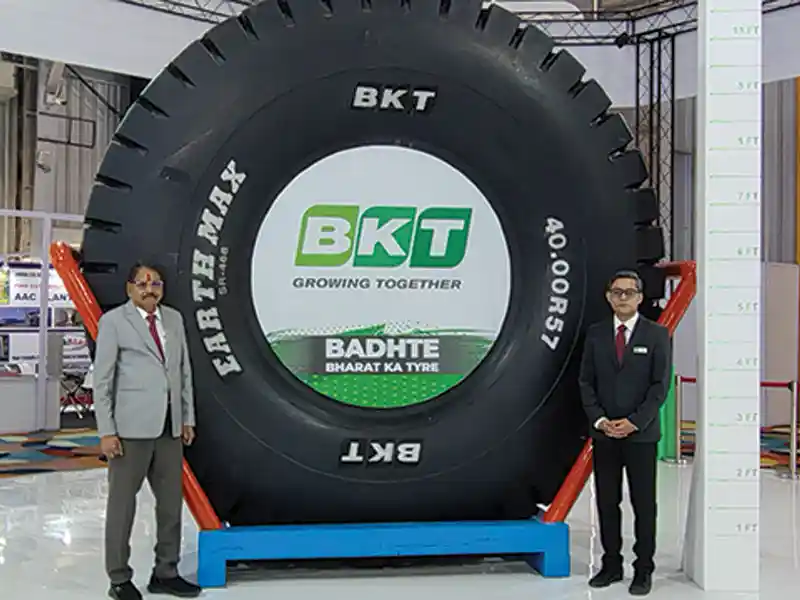
BKT Matching Tyre Performance with Equipment Requirements, Operating Conditions, and Sustainability Goals
How is BKT’s mining tyre portfolio shaping up for 2026?
Ashok Chhajer: The mining sector is experiencing a slight moderation compared to 2024, driven by a broader shift toward project-based equipment hiring and more efficient utilization of existing or refurbished machinery, in line with global trends. Looking ahead to 2026, we anticipate a recovery in equipment sales, which should also support tyre demand.BKT has a strong global position, and a key reason for this success is our core philosophy of offering the right tyre for the right application. This approach, engineering tyres precisely for the machine, terrain, and operating conditions, has helped us consistently deliver superior performance, safety, and efficiency across construction, mining and industrial sectors.
With sustainability becoming a purchase factor, how is BKT reducing its tyre footprint?
Carbon black is a critical raw material, making up nearly 30% of a tyre’s composition significant progress was made in the use of carbon black in our processes. The tail gas generated during carbon black production is now reused for tyre curing, helping to reduce emissions and improve overall energy efficiency. These integrated practices demonstrate how responsible manufacturing and vertical integration deliver performance, lower production emissions in OTR tyre manufacturing, and create long-term environmental value.
The company has made strong and forward-looking investments in renewable energy, and we have announced plans to increase manufacturing and expanding carbon black production by an additional 360,000 metric tonnes per annum (MTPA) and adding 24 MW of cogeneration power at our flagship plant in Bhuj.
Please elaborate on BKT’s lab and field validation capabilities, and tests for thermal aging, endurance etc?
Rishi Raj Singh: Innovation lies at the heart of BKT’s product development, guiding every aspect of our design and manufacturing process. Our tyres integrate advanced technologies to ensure superior performance and extended service life. Our radial tyre range is engineered to deliver uniform wear and enhanced heat dissipation, factors that collectively minimize downtime and extends equipment longevity. Additionally, we continue to invest in research and development, enabling us to improve compound formulations, enhance material grades, and develop new products with superior performance and durability.From raw material formulation to the finished tyre, every step is driven by precision engineering and sustainability, resulting in products that consistently deliver reliability, and long-term value for our customer In addition to our in-house laboratory testing, we work closely with government-approved testing and validation agencies to conduct rigorous laboratory and field evaluations. All necessary certifications obtained through these accredited bodies are readily shared with customers whenever required, underscoring our commitment to transparency, reliability, and trust in every product we deliver.
How strong is BKT’s aftermarket readiness and what is its export roadmap from India?
Rishi Raj Singh: BKT has a strong global position, and a major reason for this success is our core philosophy of offering the right tyre for the right application. This approach, engineering tyres precisely for the machine, terrain, and operating conditions, has helped us consistently deliver superior performance, safety, and efficiency across construction, mining and industrial sectors.In addition, after-sales service has become a decisive factor for both OEMs and contractors, often influencing the final purchase decision. With a presence in more than 163 countries, it is critical to maintain a robust and responsive aftermarket ecosystem. At BKT, we provide strong on-site service support to ensure tyres deliver optimum performance throughout their lifecycle. Our commitment to proper after-sales assistance helps customers maximize product utilization, reduce downtime, and achieve significant cost savings.
What connected features Is BKT developing for pressure/ temperature monitoring, predictive wear alerts, digital dashboards, etc?
Rishi Raj Singh: Our objective is to be among the pioneers in connected tyre technology. We are actively working with several reputed organizations on the development of advanced connected tyre solutions such as Tyre Track Pro and the SPOTECH system, which are continually evolving. We are also strengthening our in-house digital and simulation capabilities, enabling us to create virtual environments where tyres can be tested and validated through simulations. These simulations help replicate real-world operating conditions, including temperature, load, and performance variables.What compound, casing, and bead innovations are being used in BKT tyres to handle higher loads, heat cycles, and cuts across different terrains?
Rishi Raj Singh: When OEMs introduce new equipment, it is rated for a specific payload. As operational demands increase, payloads are often elevated, placing additional stress on tyres, which are then required to accommodate 10–20% higher loads.To address these demands, we engineer tyres with reinforced casings, strengthened bead areas, and advanced compound formulations. Cut-resistant compounds are applied to tread surfaces for challenging operating conditions, while heat-resistant compounds are used for high-speed and continuous-running applications. A thorough understanding of the application, terrain, and duty cycle is essential, and tyre designs are accordingly adapted to ensure optimal performance.
In construction equipment, we work closely with OEMs to align tyre performance with equipment specifications and operating conditions. In the mining sector, the approach is highly application specific. Variations in underfoot conditions, haul road design, abrasiveness, and operating cycles necessitate distinct compound chemistries for different sites. Our specialised experts conduct detailed site studies, after which we formulate customised compounds tailored to each mine’s requirements.
By collaborating closely with distributors, dealers, fleet operators, and industry bodies worldwide, we gain real-time insights from the field—how machines are being used, the challenges operators face, and where performance gaps exist. These inputs directly inform our application-specific design process across 3,600 SKUs, enabling us to refine tread patterns, compounds, and construction types to meet evolving demands.
Which sectors are driving the highest demand for BKT tyres?
Ashok Chhajer: BKT has maintained a strong growth trajectory, driven by consistently healthy volume expansion, and we are committed to carrying this momentum forward into 2026.Agriculture continues to be a strong and stable foundation for BKT. However, with India’s infrastructure and construction sector witnessing unprecedented growth, we anticipate this segment to drive stronger demand for our products over the next three to five years. This year, tractor production in India is expected to reach around 1.3 million units, and the sector is projected to grow at a CAGR of 3.5–5% year-on-year until 2030. This presents tremendous potential for the agriculture market, and BKT is well-positioned in terms of capacity, product range, and readiness to meet the requirements of both OEMs and the aftermarket.
Agriculture, contributing nearly 18% to India’s GDP, remains a cornerstone of the economy, while the infrastructure and construction sector is expanding rapidly under the government’s Viksit Bharat 2047 goals. Both sectors are crucial for us, with agriculture provides steady, long-term strength, and infrastructure and construction are poised to drive stronger demand for our products.
To tap into this momentum, we are expanding our carbon black production by an additional 360,000 MTPA and adding 24 MW of cogeneration power at our Bhuj facility. These investments not only strengthen our vertical integration and boost energy efficiency but also enhance supply reliability and support our broader sustainability goals. It helps us ensure we are well prepared to meet rising demand across both agriculture and India’s fast-growing infrastructure landscape.
How do you protect quality and brand trust while staying price competitive, especially in high-volume segments?
Ashok Chhajer: Every BKT tyre is developed with a deep understanding of field challenges, resulting in products that contribute directly to operational efficiency and cost savings for our customers. A consistent commitment to high-quality tyre manufacturing ensures that equipment fitted with BKT tyres experiences minimal downtime, resulting in enhanced productivity for both OEMs and equipment owners. As the country’s only All Steel radial tyre manufacturer, BKT is uniquely positioned to lead with confidence and support the growing needs of our customers with solutions that are stronger, more reliable, and built for the future.This philosophy has shaped our success over the years and earning customer preference through enduring performance, reliability, and trust.
Published on:
11 February 2026
Published in: NBM&CW FEBRUARY 2026
Share:
We Value Your Comment