Samit Surendra Singhai, CMD, Kasturi Metal Composite Limited (KMCL), discusses the advantages of using Steel Fibre Reinforced Concrete during rehabilitation of critical infrastructure, and why it should become a standard solution for the longevity of structures.

What key challenges in conventional reinforced concrete such as cracking, leakage, fatigue, and long-term maintenance are driving demand for alternative reinforcement solutions like Steel Fibre Reinforced Concrete?
Traditional reinforced concrete performs well in compression but remains vulnerable to micro-cracking, fatigue, leakage and long-term maintenance issues, especially under repetitive or dynamic loads. In infrastructure such as tunnels, pavements and industrial floors, cracks often develop early due to shrinkage, thermal stress, and impact loading, which then lead to corrosion of rebars and high lifecycle costs.In Steel Fibre Reinforced Concrete (SFRC), fibres act at the micro-crack level, arresting crack initiation and controlling crack propagation from the very beginning. This typically results in improved toughness, better fatigue resistance, and can even help reduce lifecycle maintenance requirements, making SFRC particularly attractive for long-life infrastructure.
How does SFRC fundamentally differ from conventional rebar-based reinforcement in terms of structural behaviour, crack control, load distribution, and durability and in what types of infrastructure applications does SFRC deliver the greatest engineering advantage?
While conventional rebar provides localized, bi-directional reinforcement, steel fibres create a multi-dimensional reinforcing network throughout the concrete matrix. This fundamental difference leads to more uniform stress distribution and superior crack control. What’s more, SFRC delivers much improved post-crack load-carrying capacity as compared to rebar. It also has better energy absorption and ductility, and can help reduce crack widths with enhanced durability.
Ultimately, SFRC offers the greatest advantage in tunnels, pavements, industrial floors, precast elements and overlays, where distributed reinforcement and crack control are more critical than peak tensile strength alone.
SFRC is being increasingly used in tunnel linings and shotcrete applications. How do steel fibres enhance energy absorption capacity, ductility, and fatigue resistance in sprayed concrete, particularly under dynamic loading conditions encountered in road and metro tunnels?
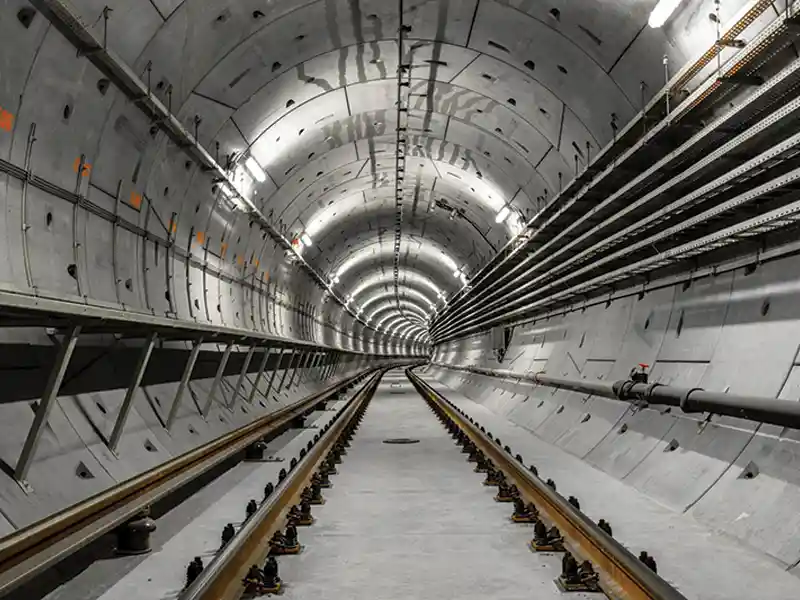
In tunnel shotcrete, the concrete is subjected to impact energy, vibration, and cyclic loading. Steel fibres mixed with concrete significantly enhance energy absorption capacity and ductility, reducing the likelihood of sudden brittle failure.Fibres help to bridge the cracks immediately after formation, providing residual strength even after cracking, which is essential for tunnel safety. This makes SFRC particularly suitable for road tunnels, metro tunnels and NATM (New Austrian Tunnelling Method) applications, where deformation tolerance and fatigue resistance are critical.
What are the most common mistakes contractors or project teams make in specifying, mixing, placing, or testing fibre-reinforced concrete, and how can these risks be mitigated?
Some of the most common mistakes include incorrect fibre dosage or type selection, poor mixing leading to fibre balling, inadequate quality control and testing, and treating fibres as a “replacement” rather than an integrated design component. However, these risks can be mitigated through performance-based design specifications, proper mix design trials, on-site quality checks and third-party testing, and most importantly, early involvement of steel fibre manufacturers during design and execution stages.From your experience, how mature is the Indian market today in terms of awareness, acceptance, and correct application of SFRC across sectors such as tunnels, bridges, highways, and heavy-duty industrial flooring? Where is adoption strongest, and where does it still need confidence-building?
In recent months and years, India has moved from awareness to an early adoption stage. Currently, SFRC acceptance is strongest in tunnelling, metro projects and industrial flooring, where performance benefits are well documented. However, in highways and bridges, adoption still requires confidence-building through design guidelines, standardization, and successful case studies. In my view, education of consultants and contractors is key to wider penetration.Standards, design guidelines, and testing protocols play a critical role in mainstream adoption. How important are performance-based specifications, certification, and third-party testing in ensuring confidence among designers, consultants, and asset owners when using SFRC in critical infrastructure?
At the same time, third-party testing plays an essential role in ensuring that fibres consistently deliver the required residual strength, toughness and durability, which is especially important in safety-critical infrastructure such as tunnels and bridges.
From an industry standpoint, manufacturers also have a responsibility in enabling this transition. At Kasturi Metal Composite, this is addressed through application-specific testing and validation of fibres in concrete, carried out in collaboration with NABL-accredited laboratories and other engineering or academic institutions. These studies help understand fibre performance across different end applications, mix designs, dosages and concrete grades, and support more accurate specification, and the resultant confident adoption of SFRC by designers and asset owners.
How has SFRC technology evolved in recent years in terms of fibre design, consistency, and performance reliability? How do these advancements help engineers design more efficient, durable, and maintenance-friendly concrete structures?
The SFRC technology has evolved significantly over the years in terms of fibre geometry and anchorage design, tensile strength consistency, and manufacturing precision. Advances in process control and quality assurance have improved performance reliability, enabling fibres to deliver predictable residual strength and toughness in concrete.These developments allow engineers to design more efficient and durable structures, optimize material usage, and reduce over-reinforcement, resulting in concrete structures that are maintenance-friendly over their lifecycle.
At Kasturi Metal Composite, this evolution has been supported by continuous upgrades in manufacturing technology, tighter process controls, and data-driven quality monitoring, ensuring consistent fibre performance aligned with modern performance-based design requirements.