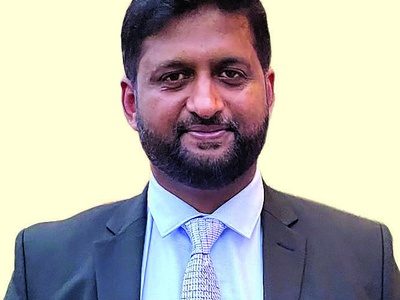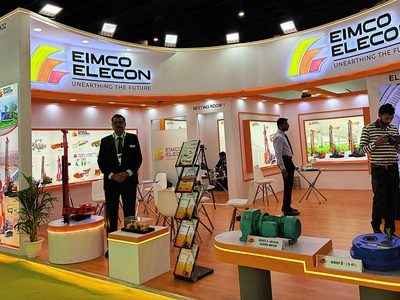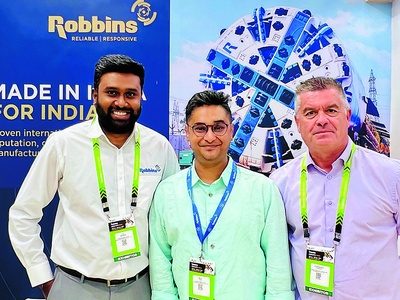
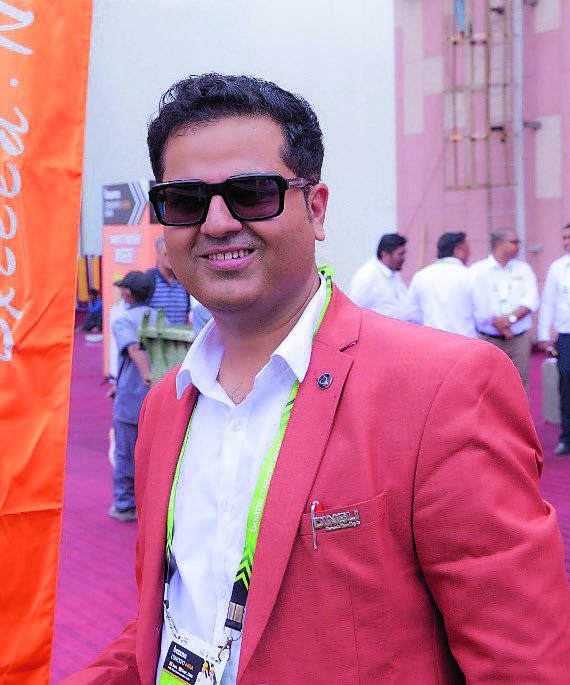
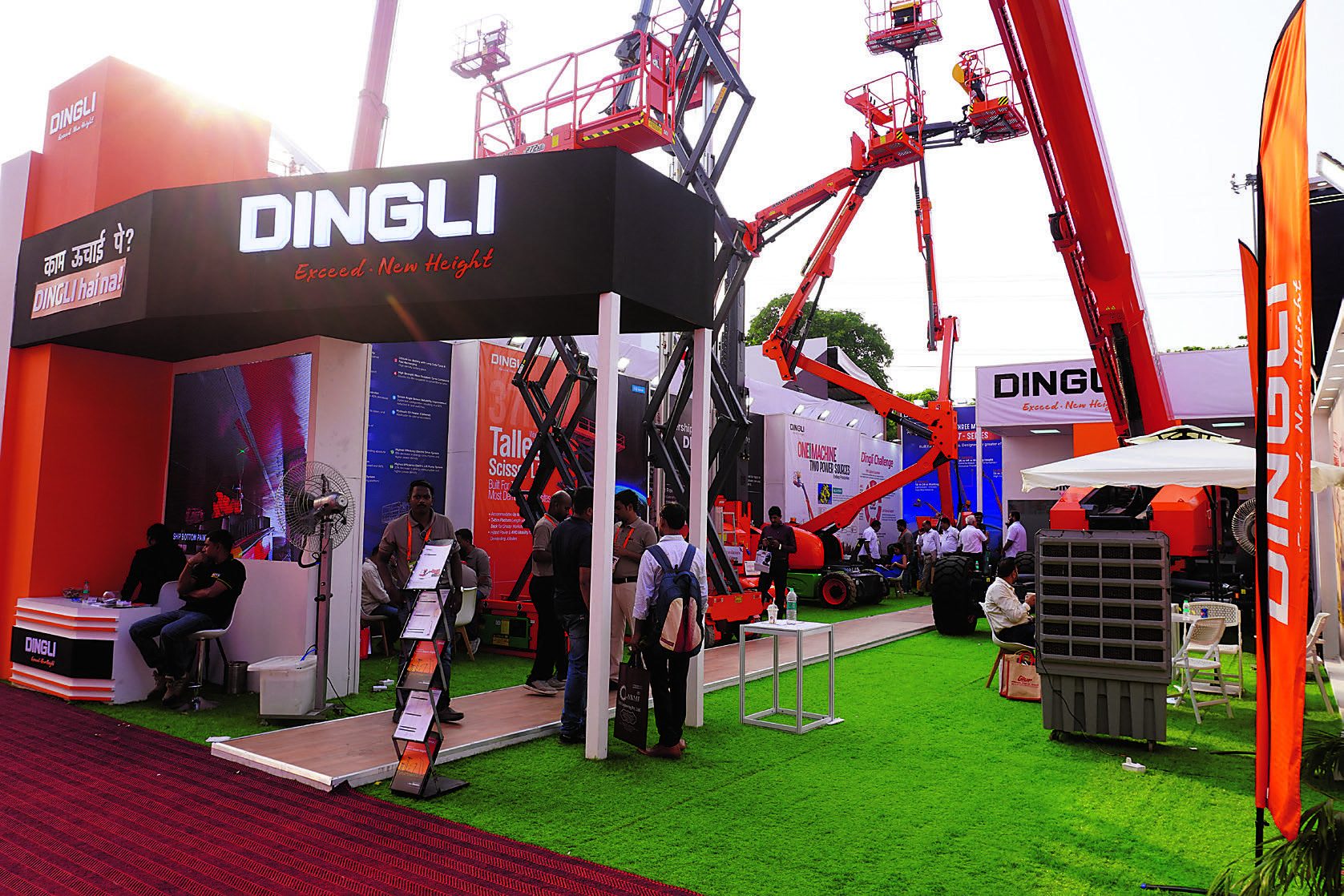
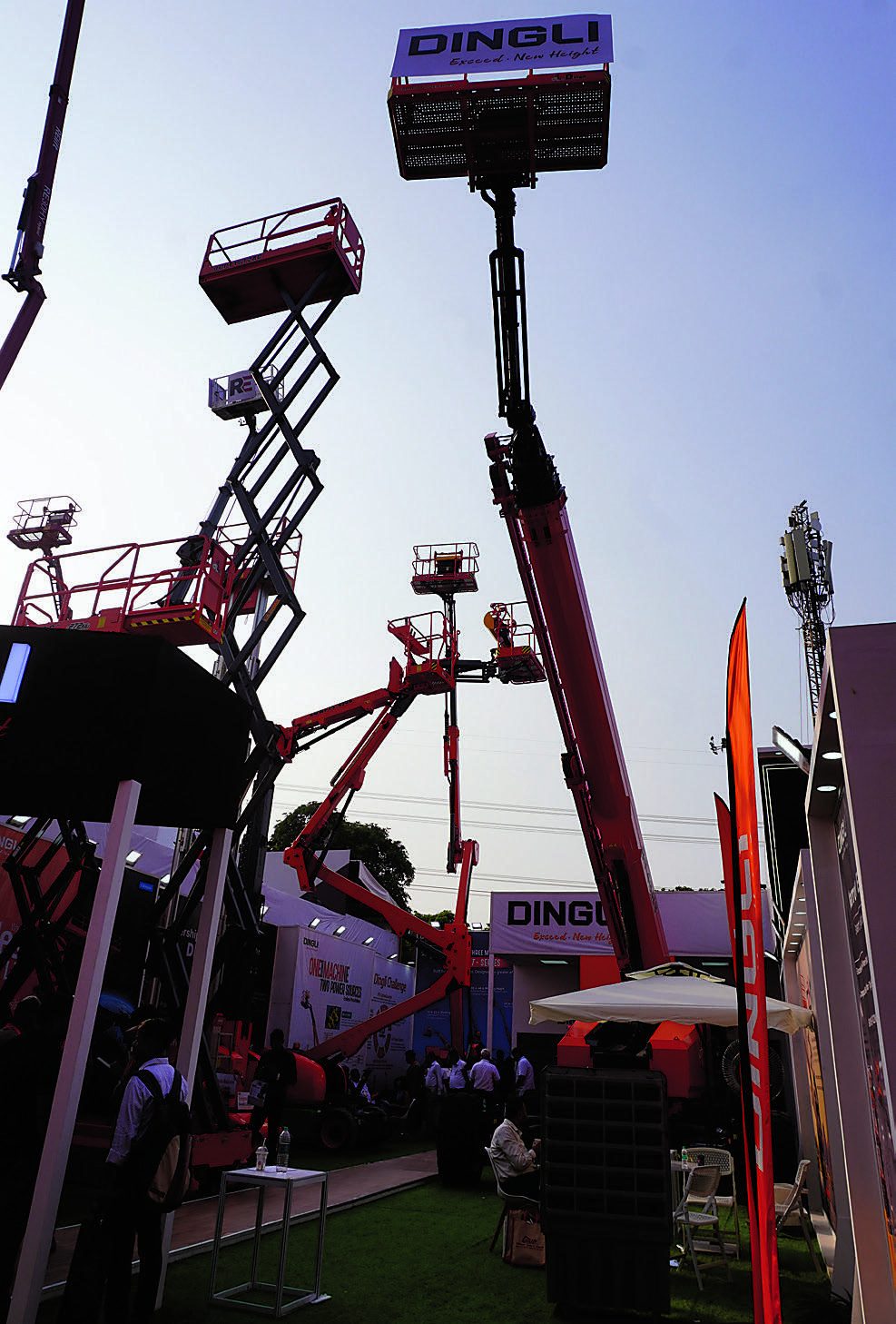
As demand grows in India for safer, more efficient and application-focused access equipment, Dingli is widening its aerial work platform (AWP) portfolio across electric, hybrid and extreme-height solutions. At bauma CONEXPO INDIA 2026, the company put safety, productivity and lifecycle value at the centre of its stand. Sawlani talks to us about battery technology, new products, rental economics, service support and the case for building awareness.
What are Dingli's key products and technologies, and what sets them apart?
Innovation sits at the very core of our product philosophy. As a globally recognised brand, we hold more than 300+ patents, and that spirit of invention runs through everything we build. Our foremost priority today is electric AWP technology. Customers are increasingly seeking machines that lower their carbon footprint and satisfy sustainability mandates, and we see this most vividly at airports and on major infrastructure projects, where clients operate under stringent environmental and ESG requirements.Our battery architecture is built on lithium iron phosphate chemistry – the same family of technology found in leading electric vehicles. Compared with conventional battery systems, it delivers a longer operating life and demands far less frequent charging, giving customers greater uptime with less downtime spent at the plug. Alongside our electric range, we continue to offer diesel and hybrid machines, so customers can select whichever technology best suits their application and infrastructure.
But our ambitions extend well beyond conventional access equipment. We are also developing a new generation of smart, robotic AWPs purpose-built for specialised industries — machines engineered for shipbuilding, for precision painting and surface resealing, and for tunnelling and drilling applications that demand robotic accuracy in the most demanding environments. We are extending that same engineering discipline into the hospitality sector as well, with dedicated product lines such as our Stavula range, designed for the elevated access needs of that industry.
This breadth reflects our belief that innovation shouldn't be confined to a single category of machine. It should follow the customer wherever their work takes them — whether that's forty storeys up on a construction site, deep inside a tunnel, or on the deck of a ship under construction.
How broad is the portfolio and where are you heading in extreme heights?
Our range spans scissor lifts, boom lifts and vertical mast machines, covering a wide spectrum of AWP platforms built for different heights, reach requirements and working environments. Our scissor lift range begins at approximately 5 metres and extends all the way to 37 metres, where our JCPT3730HRT holds the distinction of being, to our knowledge, the world's tallest scissor lift. Our boom lifts, meanwhile, start at around 12 metres and currently reach 44 metres, which remains our highest model to date.We are now pushing further into the extreme-height segment with a new 60-metre boom lift, which we plan to unveil at bauma CHINA in Shanghai this November. It represents a significant leap forward in our capabilities at the very top end of the market.
Our vertical mast machines occupy a distinctive niche within the range. They draw on characteristics of both scissor and boom equipment: where a scissor lift is built primarily for vertical access and a boom lift for horizontal outreach, a vertical mast machine delivers both in a single compact footprint. This makes it especially valuable in settings where space is tight and manoeuvrability is paramount. Ultimately, the breadth of our portfolio means customers can select equipment by height, reach, working environment and application — rather than being confined to a single machine category.
Safety is critical in access equipment. What technology do your machines carry?
Safety is engineered into every layer of our machines not added as an afterthought. Our platforms are equipped with sensors and anti-collision technology designed to prevent accidents. If an obstacle appears in the machine's path while the operator is driving, the system intervenes automatically and brings it to a halt — a critical safeguard, since an operator cannot always see what lies behind or around the platform.At height, a second layer of intelligence takes over. Dedicated anti-collision sensors monitor the machine's proximity to beams and other overhead obstructions, halting further movement once it reaches a pre-set threshold. That threshold is fully adjustable, ranging from as little as half a metre to a full metre, depending on the demands of the application. Together, these systems give operators an additional, and often decisive, margin of safety while working at height.
India's conditions vary enormously. How are the machines adapted?
Our machines are built to a single global standard, using components rated to operate across an extreme climatic range of -20°C. But hardware alone isn't enough. Operators and customers also need a clear understanding of correct operating procedures, the machine's limitations, and its maintenance requirements. That's why we place strong emphasis on education — training operators in proper use and preventive maintenance, so the machine performs reliably throughout its working life.With diesel, electric and hybrid on offer, how should Indian customers choose?
Diesel remains the dominant choice in India, largely because no blanket government regulation makes electric construction equipment mandatory. Adoption instead follows the client, the contractor or the specific project. Government contracts, data centres and facilities bound by ESG or LEED requirements often specify electric machines outright, and customers comply when that requirement comes from the top. For now, though, the shift remains project-driven rather than compulsory.Dingli covers the full spectrum. Diesel continues to dominate globally and comes with a distinct advantage in our range. Every diesel machine is powered by a Deutz engine, among the best in its class. Electric adoption is accelerating steadily. Hybrid technology bridges the gap for regions where charging infrastructure isn't yet universal — the machine draws on diesel where electricity is unavailable and switches to electric power wherever charging exists.
A fourth option, our mild-hybrid, was designed specifically for markets like India. Here, the diesel engine charges the battery rather than running the machine directly, and the fuel savings are substantial. A conventional machine consuming around 20 litres of diesel a day can run on as little as 7–8 litres with mild-hybrid technology, cutting both fuel costs and emissions significantly.
Full electric adoption will likely take longer to reach scale, even as most major manufacturers roll out electric models. The upfront investment is higher, but the payoff shows up over time. We estimate maintenance costs run more than 20% lower than diesel, depending on the application. Return on investment ultimately hinges on utilisation. All contractors do not recover that extra investment at the same pace, so customers should weigh not just the purchase price but fuel, maintenance, operating conditions and the specific demands of the job. As sustainability targets tighten and project requirements shift, demand for electric is climbing, and the trend is steadily improving the payback curve.
Rental companies worry about uptime, maintenance, component quality and ROI. How do you answer?
For us, quality is not defined by the machine on day one. It is defined by performance sustained across its entire working life, backed by consistent service, maintenance and uptime support. We believe firmly in total cost of ownership as the true measure of value, and Dingli's is significantly lower than the market average because we build with world-class global components from the outset.We have a six-challenge, under which we aim to deliver around 95% uptime. If downtime exceeds 5%, the customer can claim a penalty under the rental arrangement. It keeps us accountable and reflects our confidence in the quality and reliability of the machines.
This philosophy extends to how we protect against corrosion. At our Future Intelligent Factory in Zhejiang, Dingli employs automated robotic spraying and coating technology built for precision and environmental responsibility. Dedicated Boom Spraying Workstations apply automated coatings across complex boom and scissor structures, while our proprietary internal arm spraying method reaches the hard-to-access internal cavities of boom structures, ensuring corrosion protection where it matters most. The entire curing process is VOC-free and generates zero emissions, using non-toxic, water-soluble coatings. Any resulting wastewater passes through advanced filtration before discharge, meeting strict environmental standards.
Naturally, customers scrutinise return on investment closely. Our experience shows that scissor lifts typically achieve payback faster than boom lifts, though this varies by application and depends heavily on utilisation.
Transport between jobs is a major cost for rental companies. What are you doing about weight, loading and handling?
We keep working to make handling and transport easier. Our scissor lifts can be picked up by forklifts and handled as stackers, which makes loading and moving them simple. For boom lifts, we use a specially developed steel that cuts weight while keeping the strength the machine needs.What sales and service support do you offer, and how do you protect lifecycle and residual value?
We believe in just-in-time service. We run 24/7 toll-free support, including overnight, with engineers and service partners across India. We're also building touchpoints roughly every 500 kilometres, so help is always within reasonable reach, and we can deploy people overnight when needed.Our approach is built on long-term support. We offer a buyback programme running up to five years and beyond, depending on the machine and the customer's needs. The policy is simple: the machine depreciates based on usage, and if it hasn't suffered physical damage or a major accident, Dingli can take it back after three or four years, subject to conditions, with the value adjusted for depreciation. This gives customers greater confidence in residual value.
We also guide customers on choosing the right machine and operating it well, so it lasts longer. We believe strongly in preventive maintenance over waiting for a breakdown, and our 24/7 support is part of that promise.
Will Dingli manufacture in India?
Not at present. Our smart manufacturing facility, operated by Zhejiang Dingli Machinery Co., Ltd., is located in Zhejiang, China. It is a leading manufacturer of intelligent aerial work platforms in the world, covering a total area of 710,000 square meters following Industry standards (mention). Around 95% of the manufacturing process is robotic, with only about 5% labour. That makes for very high production efficiency: one of our scissor lifts can be built in about 10 minutes, and a boom lift in about 25 minutes, ready for shipment.White-label machines are a growing concern. What is your view on OEM authenticity in safety-critical equipment?
In safety-critical equipment, OEM authenticity is not a branding issue — it is a matter of accountability and traceability. Before purchasing a white-label or private-label machine, customers should be able to clearly establish who designed it, where it was manufactured, what standards it was engineered and tested against, and who stands behind its safety and performance throughout its lifecycle, with certification verified against both Indian and global standards.White-labelling makes that clarity difficult to obtain. It obscures the machine's real source, its engineering pedigree, its component specifications, and the long-term support structure behind it — gaps that become especially dangerous when the equipment carries an operator at considerable height, where there is very little room for uncertainty.
Established OEMs, Dingli included, invest heavily in research and development precisely to close those gaps. We believe a genuine global OEM should stand behind its machines end-to-end — from design and manufacturing through certification, delivery, service, genuine parts and lifecycle support. Ultimately, the customer should always know exactly who is responsible for the machine they operate. That responsibility should never be hidden behind a label.
Which industry practices worry you most?
What concerns me most are practices that compromise safety, transparency and long-term accountability. In this industry, a machine is never just a piece of equipment — it is directly tied to the safety of people working at height.Inadequate inspection, poor maintenance, the use of non-genuine or unverified components, insufficient operator training, and a lack of clarity about a machine's true origin and specifications — each of these, individually, creates risk. Together, they compound it.
The industry needs to shift from a "machine supply" mindset to a complete lifecycle safety mindset, one where OEM engineering, certification, training, genuine spares, preventive maintenance and after-sales support are treated not as add-ons, but as inseparable parts of the product itself.
What can OEMs and industry associations do to build awareness and adoption of AWP technology?
The industry needs to shift from simply selling access equipment to actively educating the market on why professional AWPs are essential for safe, productive work at height.OEMs carry a direct responsibility here — to demonstrate the technology through live demonstrations, operator training, safety seminars, application workshops and broader customer education. It isn't enough to show what a machine can do; we need to show where it should be used, how it should be operated, and how it improves both safety and productivity in practice.
Industry associations play an equally vital role. APAOI, for instance, is developing common safety guidelines, promoting operator certification, running awareness campaigns, and bringing OEMs, rental companies, end-users and regulators onto a shared platform.
India has a significant opportunity to accelerate AWP adoption across construction, infrastructure, manufacturing, warehousing, facility management and industrial maintenance. The goal should be a culture where working at height automatically means using the right equipment — not improvising with unsafe alternatives.
Ultimately, wider adoption will come when safety, productivity and lifecycle economics are understood, as one connected case rather than three separate arguments. Professional AWP equipment should become the standard choice for working at height, not an afterthought considered only once an incident occurs or a project specifically demands it.
Finally, how do you see the future of
India's AWP market? India's AWP market holds significant potential. Continued growth in infrastructure, construction, data centres, manufacturing, warehousing and industrial projects — paired with a growing focus on workplace safety and productivity — will create strong opportunities for the industry in the years ahead.But growth won't come simply from putting more machines on the ground. Building a truly sustainable AWP ecosystem will depend just as much on awareness, correct equipment selection, rental penetration, professional service support, operator training, and genuine confidence in authentic OEM products.
Electric and hybrid technologies will keep evolving too, though the pace of that shift will vary by application — shaped by charging infrastructure, operating environment, duty cycle and individual project needs. No single technology will fit every use case; the right choice will always depend on the job at hand.
Rental companies, I believe, will be one of the biggest forces behind this transformation. As their customers increasingly demand newer, safer and more productive equipment, rental fleets will have to evolve in step. We've already seen this play out in mature markets like China, where large-scale AWP adoption helped build a strong secondary market and gave rise to new ways of extending equipment life — including converting certain diesel machines to run on electric power.