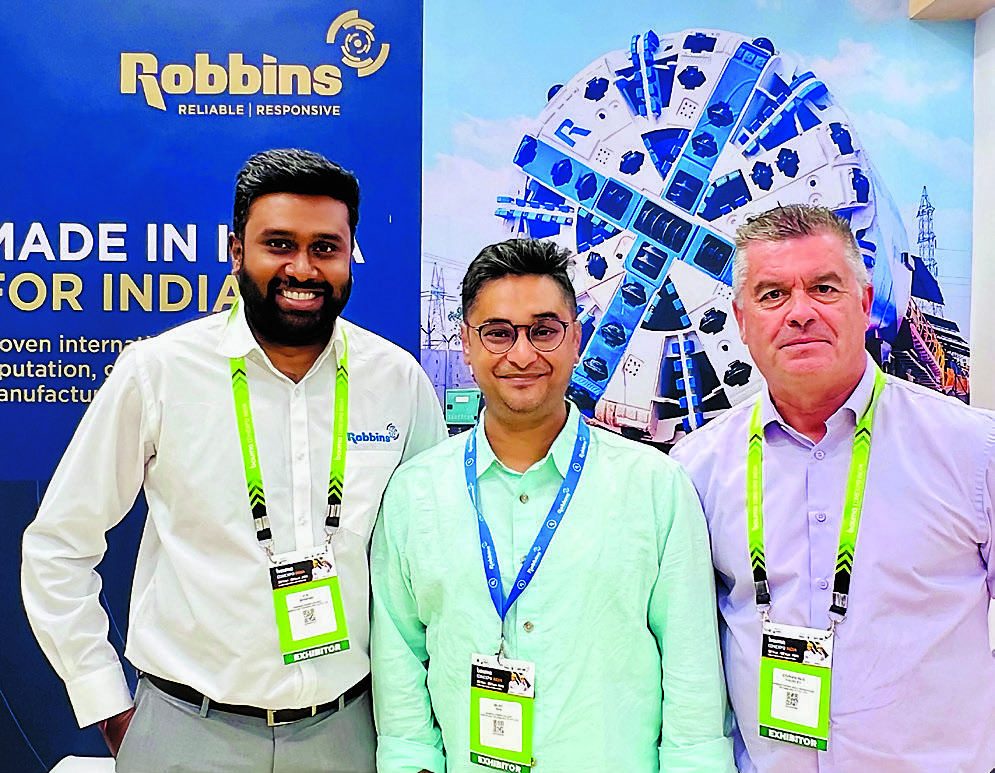
Customers are increasingly looking beyond individual machines towards complete tunnelling solutions. How is Robbins evolving from a TBM manufacturer into a technology and project-support partner across the tunnel lifecycle?
Robbins has been following this approach since the beginning. We have never been limited to simply supplying TBMs; wherever required, we also support the operational phase of a project.Typically, we supply the machine and provide support for a certain period or number of meters of tunnelling, helping the customer operate the machine and eventually handing it over. On the Bangalore Metro project, however, our team took complete responsibility for the operations and successfully completed the tunnel.
Our role extends beyond manufacturing. We provide the solutions required to operate and maintain the TBM, including day-to-day operations, maintenance and technical support.
When I first came to India in 2007, we supplied 10-meter-diameter machines for an irrigation project near Srisailam, Hyderabad. We brought around 20–30 expatriate personnel because the required experience was not available in India.
Over the past two decades, we have trained and developed local teams, including hydraulic, electrical, management and operational personnel, giving them the knowledge and confidence to work on these machines independently.
How would you describe the evolution of India's tunnelling industry and the potential that the segment holds for Robbins’ TBMs?
Earlier, tunnelling in India was largely associated with metro projects. There was some hesitation initially, but irrigation projects subsequently began adopting mechanised tunnelling on a larger scale.Today, we are seeing significant demand from highway projects and high-speed rail. Following the rapid expansion of metro tunnelling, highways are emerging as another major opportunity. Larger-diameter TBMs, including machines of up to 15 meters, are being considered and deployed. Mumbai has seen the deployment of 10- and 12-meter-class machines, while Bangalore is planning projects involving TBMs of around 15 meters.
There is greater acceptance of mechanised tunnelling, with increasing demand for smaller boring units for culverts, pipelines, drainage and other utility tunnels. However, India’s tunnelling market is still relatively young. Although hundreds of machines are operating in the country, we are only at the beginning of developing its underground infrastructure.
Approximately 60–70 TBMs are operating across metro projects, including machines from different manufacturers. Irrigation projects are also using larger-diameter machines, typically in the 6–10-meter range.
We believe there is significant potential over the next 10–15 years, with potentially thousands of machines required across different applications. The market could grow by at least five times. The number of machines used for metro projects could reach 100–120, while larger-diameter applications could require 20–30 machines or more.
Delhi Metro alone has developed a network of around 600 km, while Chennai and Bangalore are expanding their metro networks. Major road-tunnelling projects, RRTS corridors and high-speed rail are creating opportunities. We are still largely operating in Tier-1 cities; whereas Tier-2 and Tier-3 cities have yet to fully develop their underground infrastructure.
Which upcoming projects do you see deploying TBMs in the near future?
Mumbai Metro Line 11, with its substantial underground component, is one of the projects being planned. RRTS corridors connecting Delhi with neighbouring regions are also expected to generate significant demand for TBMs.As projects in the pipeline move into tendering and construction, we anticipate a requirement of approximately 80–100 TBMs between the 2026-end and 2027-end.
What changes have you seen in customer requirements over the past few years?
Customers increasingly want automation across TBM functions. Several systems that were previously manual have progressed through semi-automatic to fully automated operation.Our newly introduced automated TBM technology, including automated steering and control is among the first in India. Customers are keen to understand how it can be integrated into their TBMs to improve efficiency and control.
Precision requirements have also changed. Earlier, tolerances in segment erection could be around 50 mm. Today, customers may expect 10 mm or even lower in certain applications. As more tunnels are constructed, and underground space becomes more constrained, making precision and alignment will become increasingly critical.
Contractors and clients are demanding greater accuracy, quality and overall performance. This is a natural progression as the industry matures.
As projects become more complex, how is Robbins balancing standardised TBM platforms with project-specific customisation, particularly in terms of cutterhead technology and rock-cutting performance?
Contractors approach us with the geological information available for a project. Based on that, we recommend the appropriate cutterhead design, opening ratio, cutting pattern and spacing between tools to optimise rock cutting and maximise production.
Every project is different, so the machine and cutterhead can be designed for its geological conditions. Even when a customer proposes a configuration, we may recommend an alternative based on our experience and explain how it could improve performance. Ultimately, the customer makes the final decision.
Project-specific design is one of Robbins’ strengths. We work with contractors and suppliers to configure the machine according to the ground conditions and project requirements. A standard machine can be more economical to manufacture, but we are willing to develop machines that meet customers’ specific requirements.
Geological conditions can change significantly during tunnelling. How does Robbins identify and respond to such changes?
Geological changes are a reality in tunnelling. The key is to have experienced personnel on the machine who can recognise changes in ground conditions and immediately raise a flag.We work closely with the customer and provide advance information when we identify changing conditions. Machine parameters and the operating approach may then need to be adjusted to avoid excessive cutter wear or other problems.
Data logging and ground-investigation technologies can help identify changes ahead of the machine. Seismic profiling can provide information over a relatively long distance, (potentially up to a kilo meters or so depending on the application). Radar, sonar and resistivity methods can provide information over shorter distances.
Where information is limited to a shorter range, we may recommend probe drilling and core sampling ahead of the machine. The objective is to maintain a safety window ahead of the TBM and continuously monitor ground conditions. Our automated TBM systems can also use available data to adapt machine parameters, maintain optimum production and protect the machine.
Robbins has achieved significant records in hard-rock tunnelling. What is the company's particular strength in this area?
Hard-rock boring has been one of Robbins’ core areas of expertise since 1957. We hold numerous world records for performance in difficult geological conditions.Hard-rock boring differs from EPB or slurry tunnelling; the machines and technologies are different. In Mumbai, for example, we achieved production of up to approximately 950 meters per month under challenging conditions. Such rates also involve significant logistical challenges, particularly when material must be transported from deep underground to the surface.
India is increasingly focusing on localisation. How much progress has Robbins made in localising TBM manufacturing and critical components in India?
We began remanufacturing machines in India around 2019. At that time, we manufactured five machines for Delhi Metro and two for Agra Metro, with approximately 55–60% of the machines made in India.We developed our Indian supply chain and increased local procurement. We worked with Indian vendors, sent our personnel to manufacturing facilities and established quality-control processes. By around 2024–25, localisation had reached approximately 70%. More recently, we built two machines for the Bhopal and Patna Metro, taking localisation to approximately 80–85%. Our target is around 90–92% in the near term.
We are working with Liebherr to manufacture bearings in India and with other partners to manufacture gearboxes and variable-frequency drives. Critical TBM components are increasingly being manufactured here. A TBM manufacturer may appear to be an assembler of large sub-assemblies from different sources. Our focus, however, is on developing a stronger manufacturing ecosystem in India. I believe India has the potential to become an export base for TBMs, supplying machines manufactured here to other markets.
How has Robbins' investment in Indian technical talent strengthened its capabilities both in India and overseas?
Several types of construction equipment are already manufactured in India and exported. The same opportunity exists for tunnelling equipment as India’s manufacturing ecosystem develops.Indian technical talent has also grown. Earlier, we brought expatriates here to support projects. Today, Indian engineers and technicians work on projects around the world. They have also gained manufacturing experience in Robbins’ international workshops, including in China, and brought that knowledge back to India. So, we now have a strong team of highly qualified technicians and engineers whose expertise can support both Indian and global markets.
As tunnelling projects become more challenging, what needs to change in the way tunnels are planned, designed and executed?
India is undertaking increasingly difficult tunnelling projects, including those in the Himalayas with high overburden and squeezing ground conditions. These require specialised knowledge and close coordination among stakeholders.The client, contractor and TBM manufacturer need to work together transparently to complete the project on time and within budget. We want to work with customers as partners and make their projects as successful as possible. There must be collective ownership: the contractor and client need to own the project, while the TBM manufacturer must own the machine and its performance. When everyone works as one team, the chances of addressing challenges successfully improve significantly.
How is Robbins helping customers evaluate TBMs based on productivity, uptime, maintenance and total lifecycle economics rather than simply the initial machine cost?
This begins at the design stage. We collect the customer’s contractual requirements and geological data, then design the machine to suit the project as closely as possible. We consider cutting performance, production, safety and anticipated ground conditions, incorporating additional systems where appropriate to improve safety and reliability while considering cost.Machine availability is also important. We analyse operational data daily to identify downtime, including mechanical or electrical breakdowns. We work with the customer to find the root cause and provide training or technical support where needed. The customer also needs to take ownership of operational aspects within its control.
Continuous monitoring of production data helps us identify improvements and maintain optimum machine performance throughout the project lifecycle.