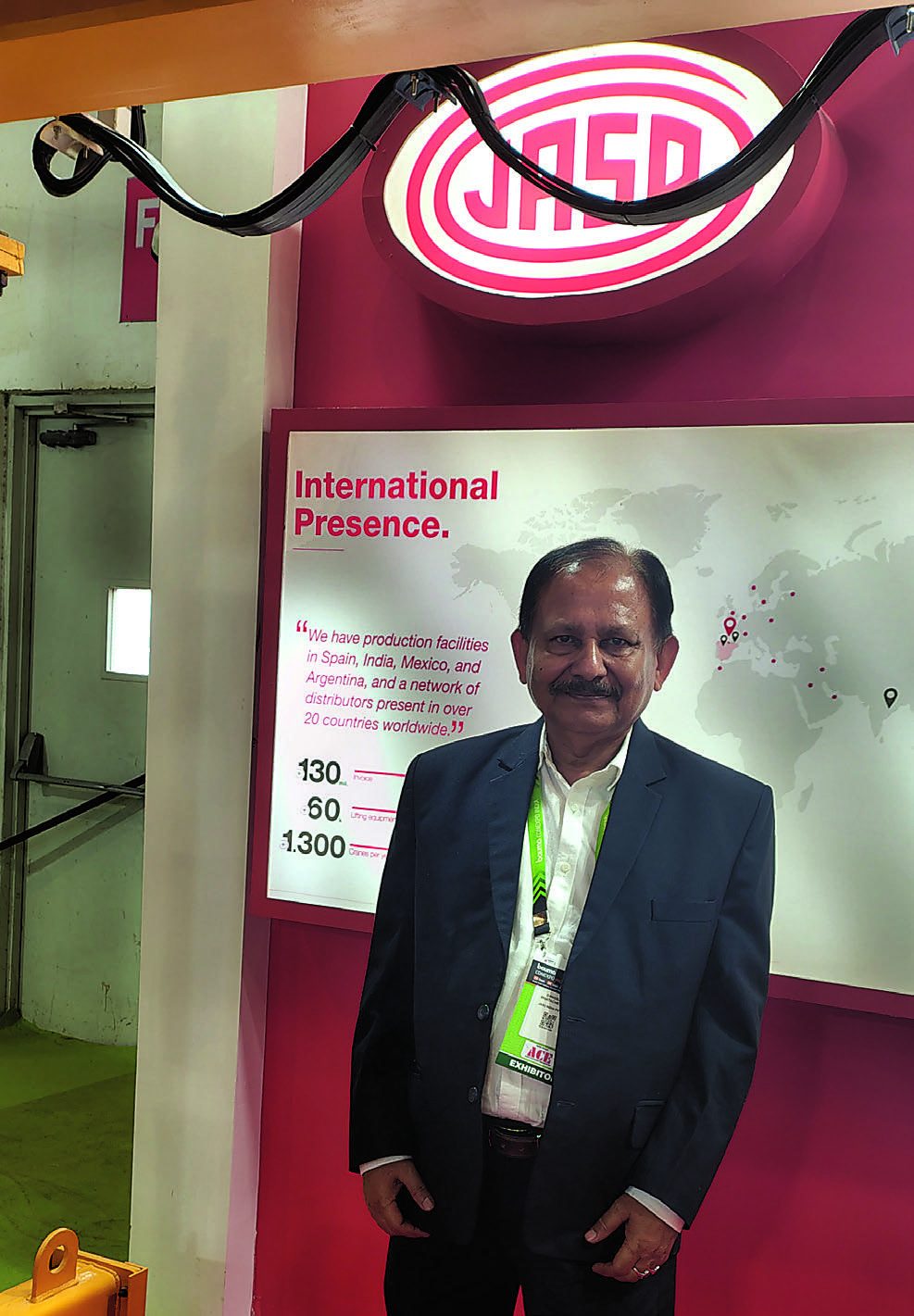
D Bhattacherjee VP- Sales & Marketing (South) Jaso India
What are the key features and applications of your 3.2-tonne gantry crane showcased in the exhibition?
Our 3.2-tonne gantry crane is a smaller variant of the real gantry cranes that customers require. Gantry crane is one of our key products, designed to provide a practical and efficient lifting solution for a range of industrial applications. It is particularly suitable for facilities where there is no provision for an EOT crane. In such applications, rails are installed on the ground, allowing the gantry crane to operate along them for material handling, lifting, loading and unloading operations. The crane can be used for both indoor and outdoor applications.What are the company’s strengths?
JASO group is a renowned name worldwide in the material handling industry. It has been in this segment for over 6 decades and has made a mark for itself. We do about 1300 plus cranes each year and have an annual revenue of about INR 1100 crores. We have 6 manufacturing plants worldwide and 20 business centers. The company is backed by its strong R&D department, with more than 100 design engineers working in it. We manufacture cranes up to 500 tonnes and serve a wide range of industries worldwide.JASO Industrial Cranes India brings along with it the same expertise, quality and trust that JASO is known for worldwide. We believe in catering to clients worldwide with the same quality of cranes across nations and that is what we continue to do in India too. This mix of technical expertise, conscious quality management, and a team with a rich experience are the major strengths of JASO.
Which industries are currently driving demand for EOT cranes, and where is JASO seeing the strongest demand?
Today, crane requirements are present across almost every industrial sector, whether for manufacturing, material handling, loading and unloading, or other heavy-duty applications.EOT cranes are now in demand across a wide range of industries, particularly manufacturing facilities like automotive, precast, granite, steel and power. The use of cranes is also expanding in general engineering industries. JASO has been present in India for the past 18 years, and during this period we have seen particularly strong demand from the steel-handling sector. For example, Danieli India has around 66 JASO cranes. Siemens Gamesa has approximately 30 cranes across its units in Tamil Nadu, including facilities at Mamandur and other locations. Windar, based in Halol, has more than 60 JASO cranes, while one of our customers in Coimbatore, Ampowal, has around 32 cranes.
These are just some examples of our installations across India. We have several customers who have continued to use JASO cranes for multiple applications, which we believe reflects their experience with the performance and reliability of our products.
How has demand for EOT cranes evolved over the past few years?
The demand for EOT cranes has been increasing steadily over the years. The primary reason being the expansion of industries and production facilities across the country. The demand also has to do with the adoption of additional safety norms in the industries, because of which manual labors are now not allowed to do certain risky and heavy lifting tasks. With the rapid increase in manufacturing plants as India gets ready to becoming the next significant manufacturing hub for the world, there will be a continuous growth in numbers for material handling equipments.Are you seeing any changes in customer requirements in terms of lifting capacities, spans, speeds or duty cycles?
Yes, there is a significant shift in the customer’s requirement that we have noticed in the recent years. If the trends are to be believed, the mean average lifting capacities has almost doubled in the recent years with customers constantly asking for higher capacities. Also, customers have now become more conscious of the other specifications while ordering cranes. While finalizing their requirement, customers have been asking for cranes with wider spans and speeds that are higher.When it comes to the duty class the customers are increasingly asking for higher duty class and the reason is the increase in working shifts and optimized cycles of operations during the day. Customers are now trying to optimize the crane usage and extract the most from their investments. Our sales and technical teams understand the customer’s requirement in details and inform them of the best possible solutions after evaluating the proposals technically.
What safety features have you integrated into your EOT cranes?
Our EOT cranes incorporate multiple safety features to ensure safe and reliable operation. Features include signal lamps, buzzers and hooters that alert personnel when the crane is in motion, providing a visual and audible warning during operations.Another critical safety feature is the limit switch. Operators may sometimes fail to stop the crane when it reaches the extreme end of its travel. The limit switch automatically stops the crane in such situations, helping prevent accidents. Similar limit switches are provided for hoisting and lowering operations to prevent the equipment from exceeding its safe operating limits.
We also incorporate additional safety mechanisms to address potential electrical or operational malfunctions. For example, if there is a failure in the hoisting or lowering mechanism, the safety system can intervene and stop the operation, preventing further movement and reducing the risk of an accident.
These multiple layers of safety are designed to ensure that the crane operates reliably even in the event of operator error or a component malfunction. Our cranes are also supported by the relevant safety certifications and compliance requirements.
How is JASO integrating AI, telematics and automation into its crane solutions?
When we say AI integration in material handling equipment, we are basically talking about smart devices like IoT. The IoT collects data and warns the user of the faults and errors in advance by predicting the faults and also updating the problems the machine is experiencing in real time operations. Though the AI integrations are not limited to this but we need to understand the learning curve of the users too. We do provide cranes with IoT features and smart integrations, but that is not the default model. It is generally supplied on demand.For advanced automation and AI-enabled systems to deliver their full benefits, operators and maintenance teams need to understand how these technologies work and how to use them correctly. Without adequate training, there is a possibility that operators may bypass or underutilize these systems, which can undermine their purpose and add unnecessary cost.
Therefore, we are currently working with customers to create greater awareness of AI-based crane technologies and demonstrate how these systems can be effectively implemented. We expect the adoption of AI and automation to increase significantly as customers and operators become more familiar with the technology.
What differentiates JASO’s approach to crane products from that of its competitors?
One of our key differentiators is that we offer the same product across all our markets. Whether it is an EOT crane, gantry crane or JIB crane, the product we supply in India is the same as the one supplied in Europe, America, the Middle East and other markets. There is a one-to-one consistency in terms of product design, technology and quality.This gives our Indian customers the confidence that the crane they purchase from JASO India is a global product, built to the same standards as those supplied internationally.
We also focus strongly on the quality of the components used in our cranes. For instance, our electrical panels use Schneider components, while the gearboxes are sourced for their high quality and reliability. These features distinguish our products from many locally manufactured alternatives and contribute to the overall performance and durability of our cranes.
What after-sales service and customer support does JASO provide?
After-sales service and customer support are extremely important to us. We provide a one-year warranty on our cranes, and, after the warranty period, we recommend that customers opt for an Annual Maintenance Contract (AMC).Under our service support programme, our team remains available not only in the event of a breakdown but also for regular preventive maintenance. As part of an AMC, our service team carries out periodic inspections, including health checks of the crane, lubrication and greasing, and checks of various components and systems.
Regular preventive maintenance helps identify potential issues before they lead to breakdowns and can also contribute to extending the operating life of the crane.
We have received several performance and customer satisfaction certificates from our customers. In fact, there have been instances where customers have voluntarily offered to provide performance certificates because they have been satisfied with the performance of our cranes. This kind of feedback is a strong indication that customers value the reliability and performance of our products.
What advice would you give to a potential customer?
I would like to emphasize the importance of choosing the right crane manufacturer. Crane manufacturing requires considerable technical expertise and experience. Customers should therefore look beyond the initial price when selecting a crane supplier and carefully evaluate the manufacturer's experience, technical capabilities, product quality, reliability and after-sales support.The lowest-cost option is not necessarily the most economical solution in the long term. A crane is a critical piece of equipment, and its reliability, safety and operating life are extremely important. Customers should therefore give due importance to quality and technical capability while making their purchasing decisions. Quality should be considered alongside price, rather than choosing a crane based on price alone.