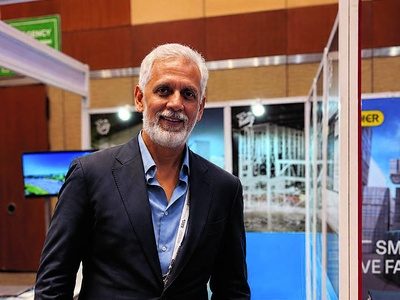
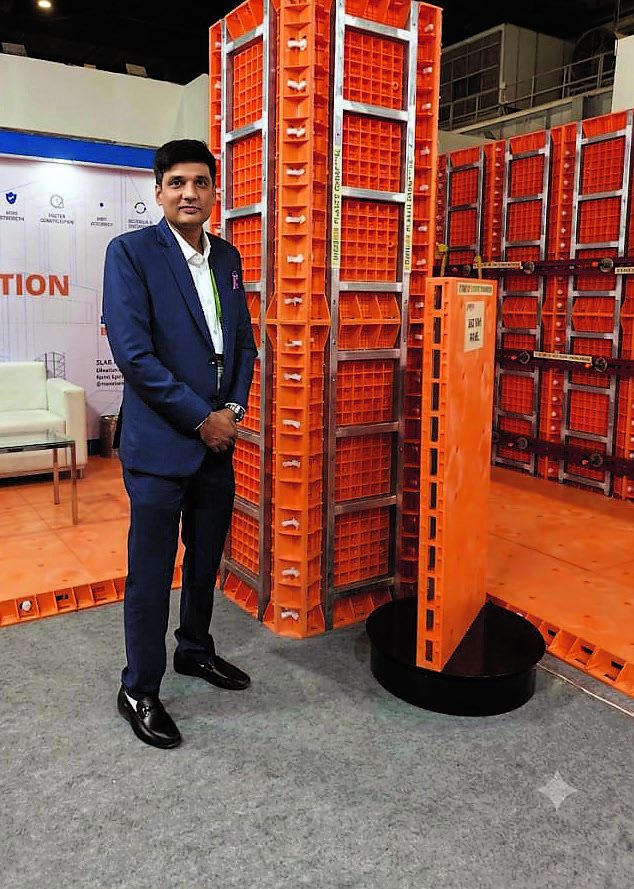
Raahul Sancheti Managing Director PLASTOFORM Solutions
What makes your plastic shuttering system different from the conventional plywood-based shuttering?
Our core offering - the plastic shuttering system - is a highly innovative and efficient alternative to conventional plywood-based shuttering. This traditional method is still widely used in the construction industry, but it is labor-intensive, not particularly eco-friendly, and generates significant material wastage. On the other hance, our system improves efficiency across cost, time, and labor, which together make strong commercial viability.We offer panels in different sizes that can be joined together, much like a Lego set, allowing multiple combinations through mixing and matching. This modularity brings wastage down to almost zero.
Traditional shuttering systems typically rely on metal components: cutting pliers, binding wire, nails, and hammers. With our system, none of this is required on site. There's no need for electricity or cutting machinery either as everything is essentially plug-and-play. You simply rotate the panel clockwise to lock it and rotate it anti-clockwise to unlock it.
How does the cost and reusability of your system compare to traditional plywood shuttering?
Plywood shuttering typically costs around Rs. 1,500 per square meter, whereas our system costs about Rs. 6,500 per square meter, which is roughly four times more upfront. However, when you factor in reusability, plywood shuttering usually allows for only 5 to 10 repetitions, while our system supports more than 100. So, when you look at what we call the ‘lifetime value’ of the product, our system works out to be nearly 30% cheaper than plywood-based shuttering.This cost diff erence is due to the better efficiency, more repetitions, and better material economics overall of plastic shuttering system.
How does this system improve safety on construction sites?
Safety improves significantly for a couple of reasons. First, since the system requires minimal tools and machinery, there's inherently less risk on site. Second, being a plastic-based system, it doesn't conduct electricity. It is also a lightweight system, roughly half the weight of traditional shuttering while offering nearly double the strength. So, it improves safety in two ways: by reducing the overall weight of the panels, and by requiring far less manual labor to handle and install.There's a common perception that plastic products are harmful to the environment. How does PLASTOFORM address this concern?
We understand the concern, which is why we offer a 25% buyback program. Once a customer is done using the material, they return it to us, and we replace it with 25% new material. This means the used material never ends up in landfills; instead, it comes back to us for processing. In fact, 100% of the plastic we use is fully reusable.What makes plastic shuttering suitable for different project types?
One of the biggest advantages of plastic is its flexibility in size and configuration. The panels support a wide range of combinations, which means this product isn't limited to any single category, it works equally well for residential, commercial, and infrastructure projects, especially those without uniform design, such as buildings with columns or piers of varying sizes and shapes.Because it's plug-and-play, you can resize and reconfigure a panel in about five minutes: cast it, de-shutter it, and reuse it for a different column, structure, or size. The panels are also versatile in orientation; the same panel can be used vertically for a wall or horizontally for something like a drain.
How have digital tools like BIM impacted the way your product is used, from design through execution?
With highly efficient products like ours, the real challenge often starts at the design stage. Traditionally, this process was heavily dependent on individual expertise, but with tools like BIM (Building Information Modeling) and other digital systems, efficiency has improved significantly.This makes a real difference: once a structure's design is finalized digitally, it becomes much easier to calculate exactly how many panels are needed, minimizing wastage. As these software tools have become more widely adopted, the entire process, from design, to production, to dispatch, to on-site execution, flows far more smoothly, since discrepancies are caught and resolved much earlier.
What are PLASTOFORM's growth plans, both in India and internationally?
The Indian market is enormous, and we're seeing companies from across the globe set up manufacturing here. Our focus is on expanding into projects pan-India, particularly infrastructure projects, since we expect that segment to see major growth over the next five years.On the international side, we've already begun exporting to markets like South Africa, Middle East, the GCC region, and neighboring countries like Sri Lanka. Going forward, we're looking to grow both domestically and internationally.
How does India's construction industry compare globally and what gaps need to be filled?
Construction speed has improved and efficiency has increased, but labor shortages remain a widespread challenge across the industry. That said, when compared to international standards, India is still well below average across nearly every stage, in product quality, execution, finish, and infrastructure.To close that gap, the entire industry needs to come together. That means adopting new technologies, embracing new methodologies and products, and driving innovation, ideally through platforms that bring together every part of the construction ecosystem, from the smallest nut and bolt to large-scale lifting systems and cranes. The industry, as a whole, needs to look towards integrated platforms and adopt more advanced technologies.