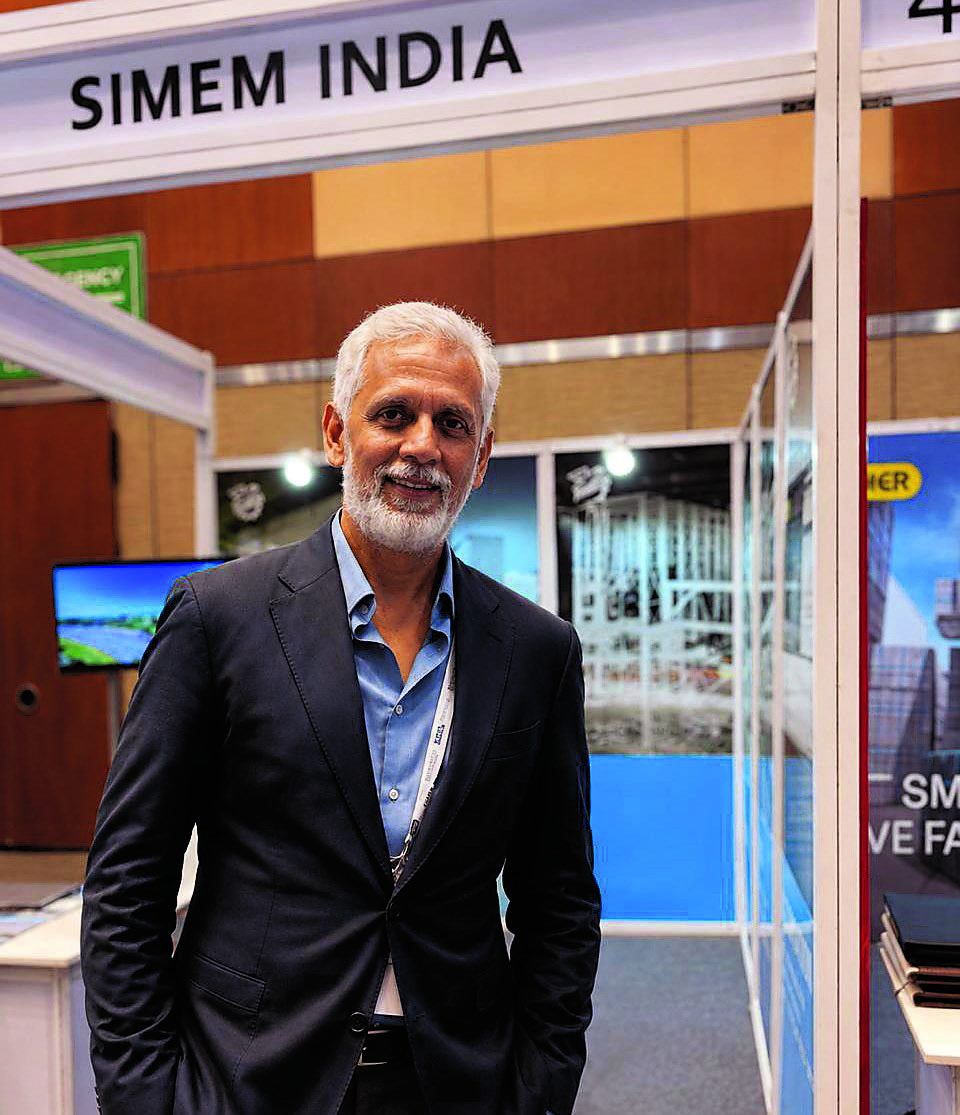
Uday Shankar Country Head SIMEM India
What new products or technologies is the company offering and which emerging customer requirements or applications are they designed for?
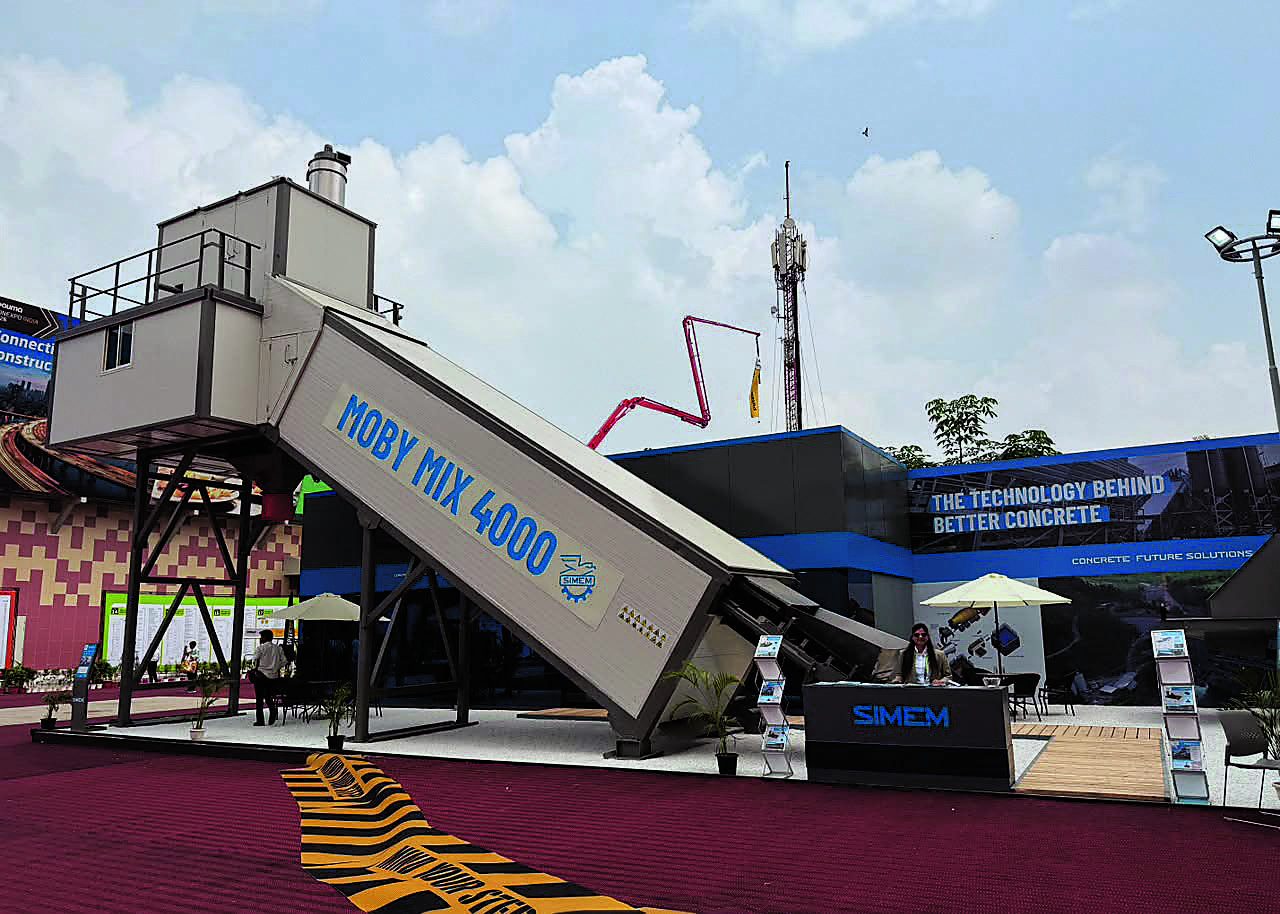
Our solutions are designed to address some of the most important challenges currently faced by concrete producers, including dust and noise control, plant uptime, production accuracy, environmental compliance and ease of maintenance.One of our key developments is the SIMEM MobyMix 4000, a compact, fully enclosed batching plant with a production capacity of approximately 110 m³/hour. The enclosed design helps reduce dust and noise emissions, which are becoming increasingly important in densely populated urban locations, where environmental compliance and space constraints are major considerations.
The plant is supported by SIMEM@TIC automation, which enables precise batching, recipe management, production monitoring and control of the complete batching process. This helps customers achieve greater consistency, traceability and control over concrete production.
One of the recurring challenges faced by customers is extended downtime during seal or wear-part maintenance. To address this concern, we have developed the RHYNO 1500 twin-shaft mixer which is designed to provide easier access to key maintenance areas, helping reduce intervention time and enabling customers to resume production faster.
Another important product is the BETONWASH concrete reclamation system. It separates aggregates and process water from residual concrete generated during transit-mixer and plant washing. For customers seeking a more complete recycling solution, BETONWASH can also be integrated with a filter press system, allowing further treatment of slurry water and enabling greater reuse of water within the plant.
All these solutions reflect the industry's move towards cleaner, more efficient and increasingly sustainable concrete production.
How do your machines reduce fuel or electricity consumption, manpower, material wastage, maintenance and idle time? What would be the typical payback period or lifecycle saving compared with a conventional machine?
At SIMEM, we believe a batching plant should be evaluated on its lifecycle cost per cubic meter of concrete, rather than only on its initial purchase price. Hence, our equipment is designed for long-term operation, high availability and consistent concrete production. The structural components, mixers, weighing systems, drives and automation are engineered to perform reliably in demanding operating conditions.One of the biggest contributors to lifecycle savings is accurate batching. Precise weighing and dosing reduce unnecessary consumption of cement, aggregates, water and admixtures. Even a small improvement in batching accuracy can translate into significant material savings when production volumes are high.
The mixer design also plays an important role. Efficient mixing reduces cycle time and energy consumption while achieving the required concrete homogeneity. Components such as wear-resistant liners, replaceable arms and paddles, automatic lubrication systems, and accessible maintenance points help reduce maintenance time and component replacement frequency.
Plant automation further improves overall utilisation by reducing manual intervention, monitoring production cycles and providing better visibility into plant performance.
Another major factor is equipment life. In many applications, lower-cost plants may require significant refurbishment or replacement after a comparatively short operating period. SIMEM plants are designed as long-term production assets and, in several cases, continue operating for decades, including after relocation from one project to another.
The exact payback period depends on production volume, operating hours, material cost, electricity cost and maintenance practices. However, for high-utilisation RMC and infrastructure applications, the lifecycle benefit comes from higher uptime, lower material variance, reduced maintenance intervention and longer equipment life. Ultimately, the lowest purchase price does not always result in the lowest cost of concrete production over the life of the plant.
How are load cells, moisture measurement, automated batching controls, plant management software and remote monitoring improving batching accuracy, production consistency and plant utilisation? What information can plant owners monitor remotely, and can these digital systems be integrated with or retrofitted to existing plants?
Digitalisation is becoming increasingly important in concrete production because plant owners today require much more than basic batching automation. They need visibility, accuracy, traceability and better control over plant performance.Accurate load cells and weighing systems ensure that cement, aggregates, water and admixtures are dosed according to the approved mix design. Moisture measurement further improves consistency by compensating for changes in aggregate moisture, helping maintain the required water-cement ratio.
SIMEM’s SIMEM@TIC automation platform manages the complete batching process, including recipes, material dosing, production sequences and operational data. This allows operators to monitor production in real time and maintain greater consistency from one batch to another.
Digital systems can also provide plant owners with useful operational information such as production volumes, batching cycles, running time, stoppages, material consumption and production history. This information helps management identify plant idle time, bottlenecks and opportunities to improve utilisation. It can also support better energy management by helping customers understand when the plant is running productively and when energy is being consumed unnecessarily.
Remote connectivity provides another important advantage. Where required, technical teams can remotely access the automation system for diagnostics and support, helping reduce the time required to identify certain operational issues. Data from production hours and operating cycles can also support preventive maintenance planning. Instead of waiting for a component to fail, maintenance activities can be scheduled based on equipment usage and operating history.
Existing plants can also be evaluated for digital upgrades or retrofits. The feasibility depends on the existing electrical system, instrumentation, load cells, controls and overall plant condition.
The objective of digitalisation is to enable better batching accuracy, more consistent production, higher plant utilisation and more informed operational decision-making.
Concrete mixes are becoming more demanding due to high-strength grades, supplementary cementitious materials, manufactured sand, recycled aggregates and admixtures. How has SIMEM’s mixing or pumping technology evolved to handle these materials while maintaining homogeneity, pump ability, output and component life?
Concrete mix designs have become significantly more complex over the years. Today, producers increasingly work with high-strength concrete, manufactured sand, supplementary cementitious materials, multiple admixtures and recycled materials, all of which place greater demands on mixing technology.SIMEM has been continuously developing mixing solutions for more than six decades, with the objective of achieving the required concrete homogeneity while maintaining productivity, energy efficiency and equipment life.
The RHYNO twin-shaft mixer has been designed with an optimized mixing geometry and paddle arrangement that creates intensive material movement inside the mixer. This helps achieve better distribution of cement, aggregates, water and admixtures within a relatively short mixing cycle.
Efficient mixing becomes particularly important with low water-cement ratio mixes, manufactured sand and high-performance concrete, where uniform distribution of fine materials and admixtures is essential. The mixer design also allows adjustments to paddle positioning, enabling greater flexibility for different applications and mix characteristics.
At the same time, component life remains an important consideration. High-wear areas are protected with wear-resistant liners, while individual arms and paddles can be replaced independently. Automatic lubrication of shaft seals also helps protect one of the most critical areas of a twin-shaft mixer.
SIMEM’s mixing portfolio extends beyond conventional ready-mix concrete and includes solutions for applications such as SCC, RCC, precast concrete and other specialised cementitious materials. As concrete technology evolves, the role of the mixer becomes even more critical. The objective is not simply to mix the ingredients, but to consistently achieve the required homogeneity, workability, strength and production output, while controlling energy consumption and wear.
Our development philosophy therefore focuses on finding the correct balance between mixing quality, cycle time, component durability, and lifecycle operating cost.