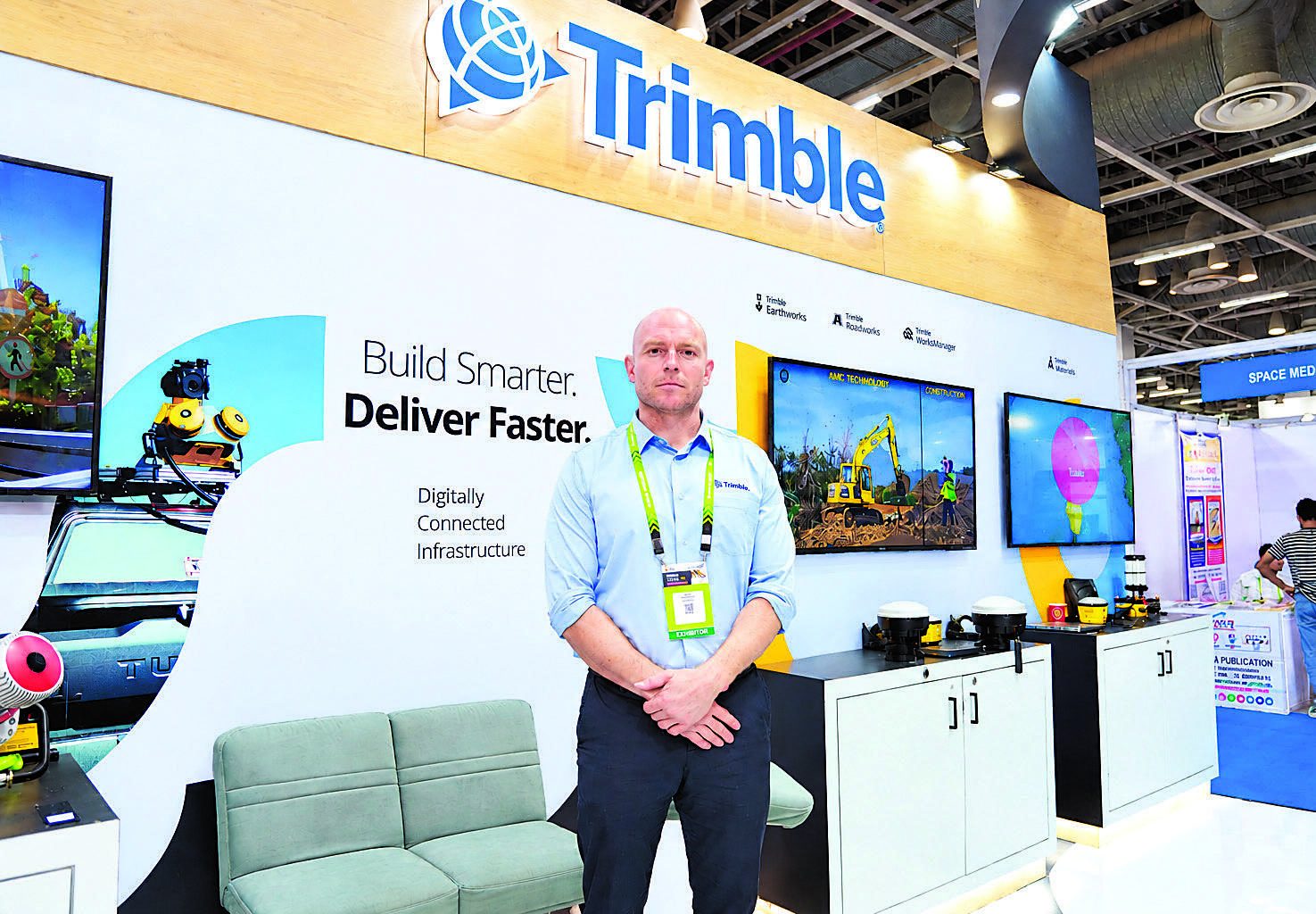
John Whitehead Vice President of Sales, APAC Trimble
What AIMC technologies is Trimble offering and how is it creating awareness of the advantages?
Automated & Intelligent Machine-aided Construction (AIMC) uses digital design data, sensors, GNSS, and automation to guide machines such as excavators, graders, dozers, and pavers with high precision. Our AIMC portfolio includes solutions for compaction, motor graders, and pavers, with some technologies developed specifically for India by our local engineering team.AIMC helps contractors improve productivity, accuracy, and overall project efficiency by reducing manual intervention, material wastage, and rework. By providing real-time machine guidance and precise control, it enables consistent quality and faster execution while optimising equipment, fuel, labour, and material utilisation. It also supports better quality control, progress tracking, and project documentation.
Trimble’s approach to building awareness among Indian contractors is through direct engagement, demonstrations and education. The company is using trade shows and state-level outreach to bring together government officials, contractors and machine operators, helping them understand how the AIMC technology works, how it can be implemented, and what is required at different stages of a project. Trimble is also helping contractors assess the investment required, compatibility with their existing fleets, and the steps needed to achieve compliance.
How do you see contractors in India responding to the growing need to adopt them?
The Indian market is still at a nascent stage, and contractors are currently in an exploratory phase. But they are feeling the pressure to adopt the technology as soon as possible so that they can comply with some of the new regulations announced by NHAI.Though many contractors have started purchasing and implementing our technology, but for many the challenge is managing a jobsite using three-dimensional design and machine-controlled data. This requires a shift in their mindset. Plus, they will have to be prepared for the higher operational cost, the skills required both at project sites and in the back office to manage the data and make decisions based on the information coming in real time.
This will necessitate a change in the contracting company’s management practices, its workflows, and how it operates. Contractors must realise that adopting a new technology will be a positive move as they will be able to use the technology in critical areas such as compaction and grading, and the return on investment will also be faster, There will be more transparency at the job site, which means that if problem comes up, it will be identified quickly so that timely action can be taken fast to resolve it.
We are confident that with the regulations in place and the emerging needs of an evolving market, contractors will sooner or later adapt to the technologies. The Indian market is highly competitive, and they will have to look for a competitive advantage. Technology will give them the competitive edge.
How has your AIMC system been indigenised for the tough Indian working conditions?
The conditions on Indian job sites are not drastically different from other countries, but the ability to make large capital investments is. To address this, we have introduced a low-cost, subscription-based solution for compaction.Compaction is a critical and costly phase of road construction, with significant fuel costs and limited direct ROI for contractors. Our technology helps ensure that the required number of passes are completed, improving the quality and longevity of the road.
The policy changes in India, which make contractors responsible for the quality of roads over the life of the asset, further reinforces the need for better compaction and construction practices. Our technology can help deliver better-quality roads, faster, and cost-effectively.
In a price-conscious market like India, how is Trimble convincing contractors about the value the technology brings to their day-to-day operations?
Looking at the technology purely from a cost perspective is probably the wrong way to assess it. The focus should be on its overall impact on operations and the return it can generate.Customers who have evaluated the business impact and cost-benefit by adopting our technology have seen healthy returns on their investment. Many of them are repeat customers now. This is because it delivers significant value to customers.
Even before the mandate, a significant portion of our business came from existing customers, including those who had adopted the technology five years ago and continue to use it in their fleets.
So, it is not just about the cost of the technology; it is about its impact on the business and the value it delivers. Once this is understood, contractors can make a more informed, cost-benefit assessment. We would not like to compromise the value proposition of our technology simply to match the price points of lower-cost competitors.