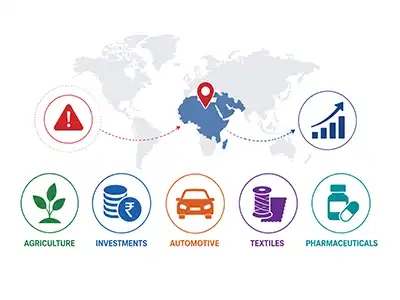
Primus Partners has released its latest sectoral Point of View report, Impact of the West Asia Crisis on Indian Sectors, highlighting how the ongoing geopolitical instability in West Asia is creating significant challenges as well as strategic opportunities for the Indian economy across agriculture, investments, automotive, textiles, and pharmaceuticals.
According to the report, the crisis extends far beyond rising crude oil prices and short-term market volatility. It is fundamentally reshaping global trade routes, capital flows, supply chains, logistics networks, and investment patterns, while exposing long-standing vulnerabilities related to energy dependence, import concentration, and export exposure.
India's agriculture sector has emerged as one of the most immediately affected, with disruptions impacting Basmati rice exports, fruit trade, fertiliser availability, and farm-level cash flows. Export-oriented crops such as mangoes, bananas, and Basmati rice are facing shipment delays, payment uncertainties, and weakening buyer confidence across Gulf markets. At the same time, rising urea prices are increasing cost pressures on farmers ahead of the kharif season.
The investment ecosystem is also witnessing a broader repricing of risk. Rising crude oil prices, widening sovereign spreads, shipping disruptions, and currency volatility are increasing the cost of capital and delaying investment decisions globally. However, amid growing geopolitical uncertainty, India is increasingly being viewed as a relatively stable and credible destination for global capital, particularly in manufacturing, infrastructure, and technology.
The automotive sector is facing supply chain disruptions, longer shipping timelines, higher logistics costs, and renewed pressure on the availability of fuel, gas, semiconductors, and polymers. These developments are expected to accelerate India's transition towards electric mobility, alternative fuels, and domestic sourcing, while underscoring the need for stronger industry collaboration and more resilient supply chains.
India's textile industry, one of the country's largest employment generators, is also under pressure due to delayed shipments, rising polyester and logistics costs, extended payment cycles, and export uncertainties in Gulf-linked markets. While the sector has demonstrated resilience through previous economic disruptions, the current crisis highlights the need for greater market diversification, improved liquidity support, and stronger raw material security.
The pharmaceutical sector remains one of the most globally sensitive industries affected by the crisis. As India is a leading supplier of generic medicines and vaccines worldwide, prolonged maritime disruptions and supply chain bottlenecks could affect not only trade but also healthcare access across several developing countries that rely on Indian pharmaceutical exports.