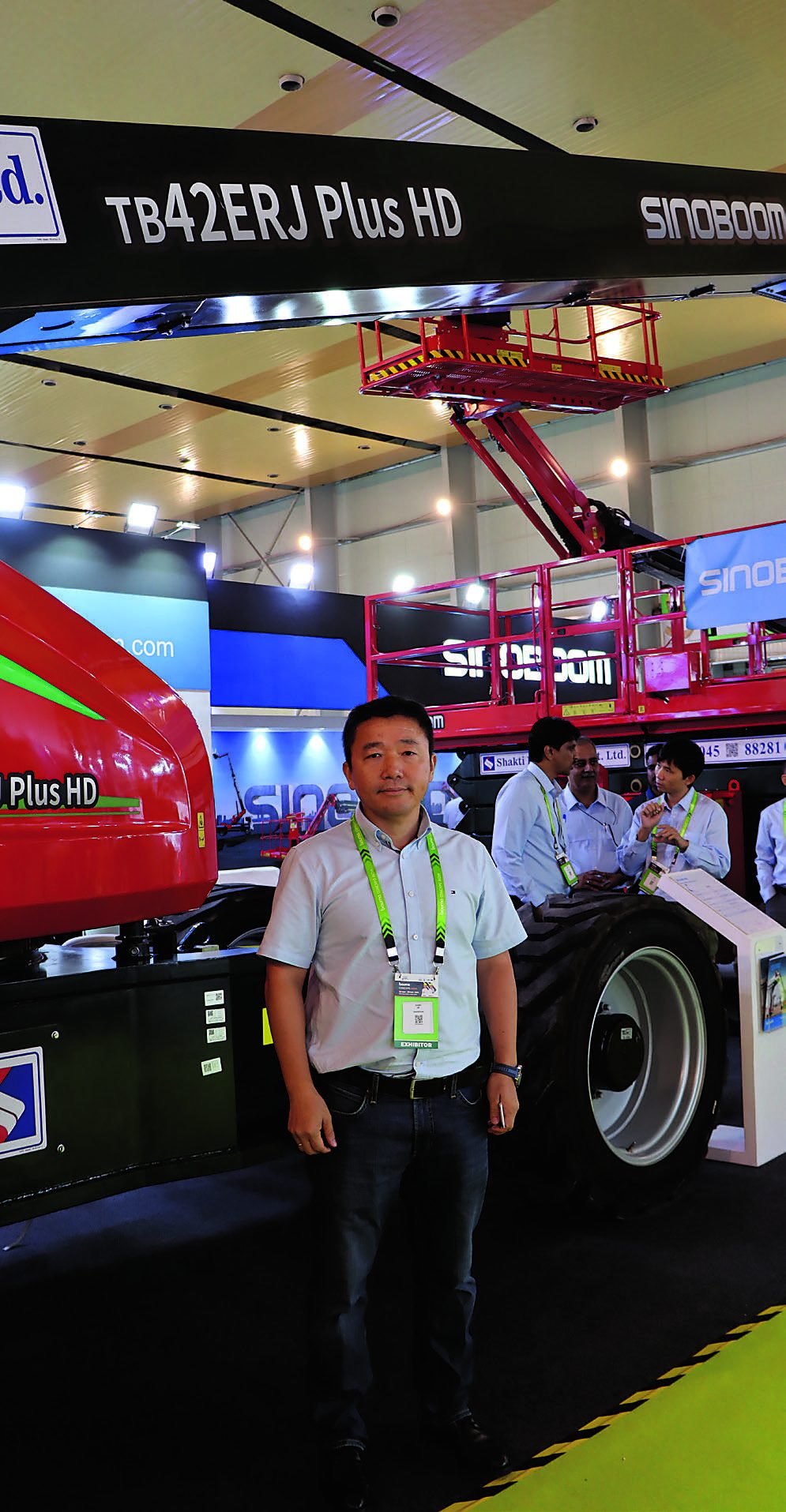
What differentiates Sinoboom products from competing brands, and what benefits do they bring to equipment owners and rental companies?
Sinoboom is a specialist AWP manufacturer with almost 20 years of experience, dedicated to access equipment and is particularly strong in boom lifts. We have continuously invested in product development and innovation. Our products have been proven in China as well as in international markets.India is experiencing rapid infrastructure growth, where reliability, quality and high product standards can contribute significantly to construction efficiency. For rental companies, higher reliability translates into better uptime, which further supports higher ROI and profitability.
We already have three generations of products that have been well tested and proven in the market. When customers or rental companies in India resell the machines after eight or 10 years, the products potentially retain a higher residual value. Therefore, when customers look at the total cost of ownership, the overall economics makes more sense.
Although Sinoboom has been in the AWP industry for almost 20 years, why has the company strengthened its presence in India only recently?
Sinoboom has had some presence in India for some time, although it was not as strong as it is today. Previously, we developed the market through a local distributor, and considering the size of the market, the distributor was doing reasonably well.However, as the Indian market grew, it became increasingly difficult for the distributor to keep pace with the investment required for market exposure, product support and customer support. Over the past two years, Sinoboom has reassessed the seriousness and potential of the Indian market and made a clear decision to invest in India itself.
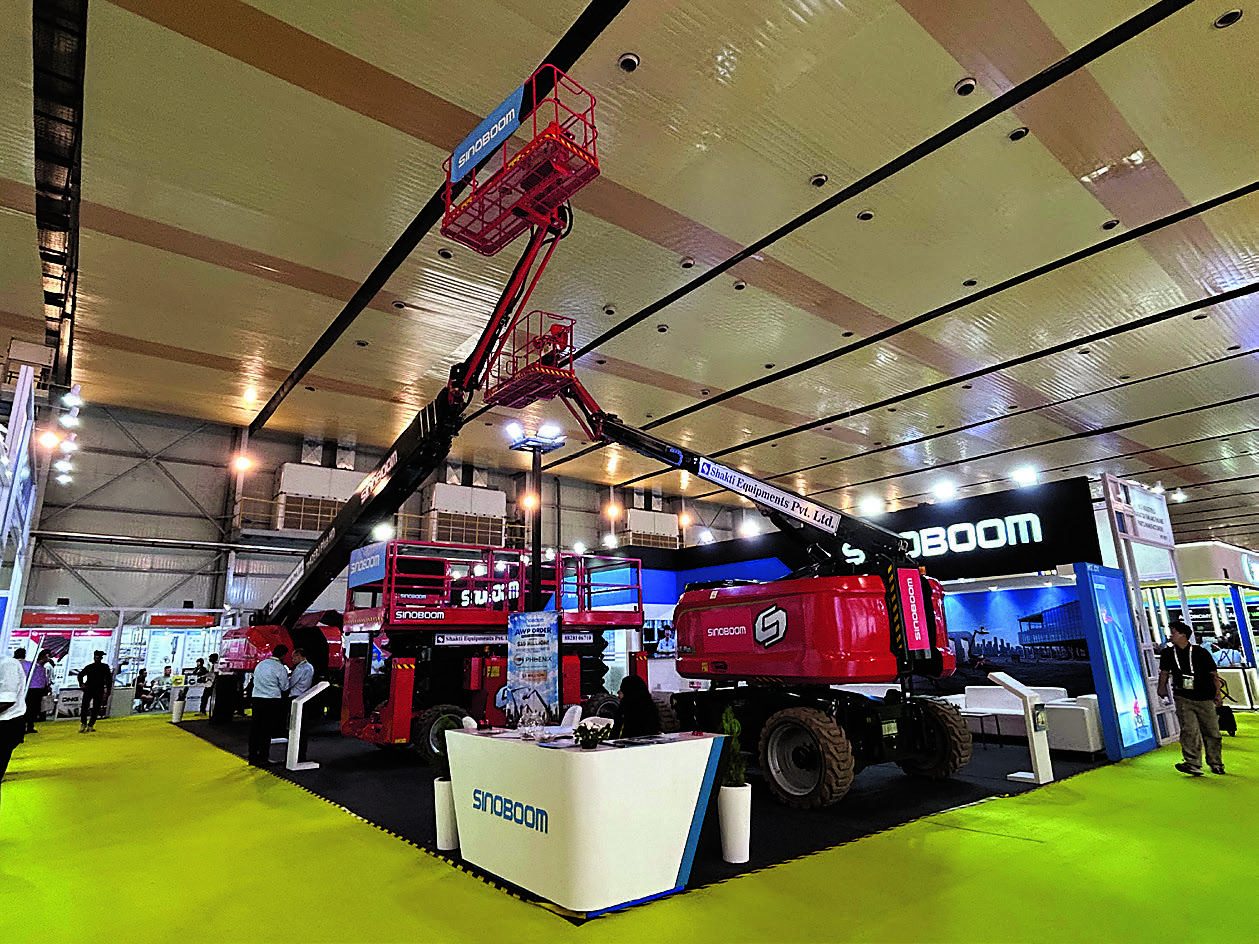
We now consider India a strategic market and have invested in a local team and local operations. The US$10 million AWP order from Phoenix Infracon Solutions, announced at bauma Conexpo India, with US$5 million already executed, reflects the growing confidence in our products and our long-term commitment to the Indian market.
With local operations and a local team now in place, is Sinoboom considering manufacturing in India?
We see significant potential for the Indian market in the coming years. Our focus is on localised operations, and there is a possibility of moving towards local supply in the future. However, this will depend on factors such as volume growth and cost leverage. When these factors come together, the time may be right for local supply. It is part of our long-term strategy.At present, supply-chain efficiency in China remains competitive, and we do not want to burden customers with higher costs or lower efficiency.
The Indian AWP market has significant demand for boom lifts and scissor lifts. Which product segments will Sinoboom focus on in India?
Each product line and each market have different characteristics. We see potential for both scissor lifts and boom lifts, as well as for niche products such as spider lifts.We have a full product line tailored to the Indian market, including scissor lifts, boom lifts, spider lifts, truck-mounted platforms and telehandlers. We also offer both new and used equipment, giving customers multiple options. Boom lifts are one of our biggest strengths, as this is an area in which we have particular expertise. Ultimately, the choice depends on customer requirements, and our objective is to provide a broad portfolio of options.
What is the maximum working height of Sinoboom's machines?
Our maximum working height is 60 meters. We have been developing the 60-metre telescopic boom lift for more than fi ve years. They are being used in many international markets, including Asian countries, the Middle East, Latin America, Australia and China.The US$10 million Phoenix Infracon Solutions order marks a significant milestone for Sinoboom, reflecting growing customer confidence in our access equipment portfolio and reinforcing our long-term strategy for the Indian market.So, Sinoboom is bringing products to India that have already been approved, proven and tested in international markets. We do not want to test our products in the Indian market. We want to provide customers with proven, plug-and-play solutions.
Indian jobsites can be extremely demanding, with high temperatures, dust and varying climatic conditions. How does Sinoboom design its machines for such environments?
Sinoboom started differently from many other AWP manufacturers who entered the AWP market with scissor lifts because they are comparatively easier to develop. But Sinoboom started with the more complicated boom lifts. Our owner is also the chief engineer of the company and has extensive technical knowledge.Initially, we developed boom lifts for shipyards, which are very tough working environments due to exposure to rust and other demanding conditions.
We believe that if a machine can survive the shipyard environment, it can handle many other tough working conditions. Our machine design therefore considers protection for tough conditions and extreme weather, including both extremely hot and extremely cold environments.
For extremely high temperatures, our machines have a cooling system to keep them operating. This is particularly relevant in markets such as the Middle East. For extremely cold environments, including Arctic regions such as Canada, the machines have a heating system to sustain their operations.
What commercial sense do electric, hybrid and diesel AWPs make in India? How do factors such as runtime, charging infrastructure, battery replacement, operating and maintenance costs and resale value infl uence their choice? And how can Sinoboom’s ETM Smart Technology improve the efficiency and endurance of electric boom lifts?
This is a very important and critical question. It depends on both the short term and the long term. For the long term, I believe electric models will make more commercial sense because electricity is much more economically aff ordable compared with fuel. In India, fuel prices are also infl uenced by importation, and fuel costs are comparatively high.However, the availability of charging infrastructure is an important factor. If charging facilities are available and can reliably supply power, electric models make commercial sense. With fi xed working hours and regular access to charging, the average cost of electricity is favourable. Diesel models also have additional service and maintenance costs. When all these costs are considered together, electric equipment can make more commercial sense.
For the long term, electric models will make more commercial sense, while hybrid technology can serve as a transition solution until charging infrastructure becomes more widely available.Hybrid equipment can be considered a transition solution. Where suffi cient charging infrastructure is not yet available, hybrid machines can provide greater fl exibility because they can operate in applications where charging is available as well as where it is not. Once full charging infrastructure is established, the need for hybrid equipment may reduce. But during the transition period, hybrid technology can make sense because it gives customers more options and fl exibility.
Sinoboom’s ETM Smart Technology is a specifi c program on which we have spent around two years. In general terms it is a combination of hydraulic and electronic control. The objective is to maximise the utilisation of available power. It has proved to be very successful in saving energy.
Charging infrastructure is developing at different rates across India. How do you see the mix of electric and hybrid AWPs developing over the next few years?
My personal forecast is that the majority of the market will still depend on the gradual establishment of power availability over the next few years. Over the three- to fi ve-year period, I believe hybrid equipment can supplement the transition. Electric models are likely to be introduced and take around 10–15% share of the market.India is a very large country, and different regions have different levels of development and different power structures. At the same time, some rental companies and national contractors need to take responsibility for introducing more environmentally friendly solutions and controlling carbon emissions. Therefore, I believe electric units need to be introduced in the market.
At realistic Indian rental rates and utilisation levels, what kind of payback can a fl eet owner expect from an AWP? How do maintenance cost, machine life and utilisation infl uence the return on investment?
It depends on the market: different markets have different stages of economic development, living standards and price levels. For emerging markets in the early stage, scissor lifts and boom lifts have different return-on-investment periods. Basically, for scissor lifts, it can take around two to three years to recover the investment. For boom lifts, it can take around three to fi ve years to recover the investment.In India, as I understand it, rental rates have dropped somewhat at the moment. Therefore, based on this reference, the return period can be extended slightly.
Rental companies in India have also raised concerns about rental rates and the ability to invest in higher-quality, higher-technology equipment. How do you view this challenge?
I believe the industry association needs to take some responsibility to encourage rental companies to maintain healthy competition rather than simply reducing prices. If prices continue to be reduced without considering jobsite service and quality, ultimately, the quality of the whole industry can suff er, and nobody benefi ts. This is an important responsibility for the association and the industry as a whole.How does Sinoboom approach total cost of ownership when designing and developing AWP products?
When we develop a machine, we always focus on total cost of ownership. This includes not only service and maintenance, but also logistics, which can be a significant part of the overall operating expense.When we design our products, we consider transportation costs from the beginning. We have a container in front of our R&D centre, and for every machine we design, we consider how it can be packed into the container and how to minimise loading and unloading costs.
We also collect data on trailer decks in major markets such as Europe and Asian countries. We consider traffi c height limitations and weight limitations. Within these height and weight restrictions, we maximise the engineering design. This is how we develop products according to transportation requirements and logistics costs.
How is Sinoboom supporting the lifecycle and residual value of AWP fl eets? Do you offer refurbishment, extended warranties, buyback programs or other solutions that can give rental machines a profi table second life?
As I mentioned, we already have three generations of products in the market. Residual value basically depends on several factors. The first is the installed population. Sinoboom has a large population of machines around the world and a global network to distribute and support the machines.The second factor is the brand. The brand needs to be well known.
The third is spare-parts availability, which is very important. With these three factors in place, used machines can be well accepted and distributed in the market.
We have these three factors in place. We have a global network and spare-parts support around the world, and Sinoboom is already a recognised brand in the market.
In addition, customers need to maintain their machines properly to improve residual value. We cannot control how customers maintain their machines, but we give them friendly reminders to carry out proper maintenance so that the machine can retain better residual value fi ve or eight years later. If there is an opportunity for a customer to buy back the machine or provide a residual-value guarantee, we are open to such possibilities.