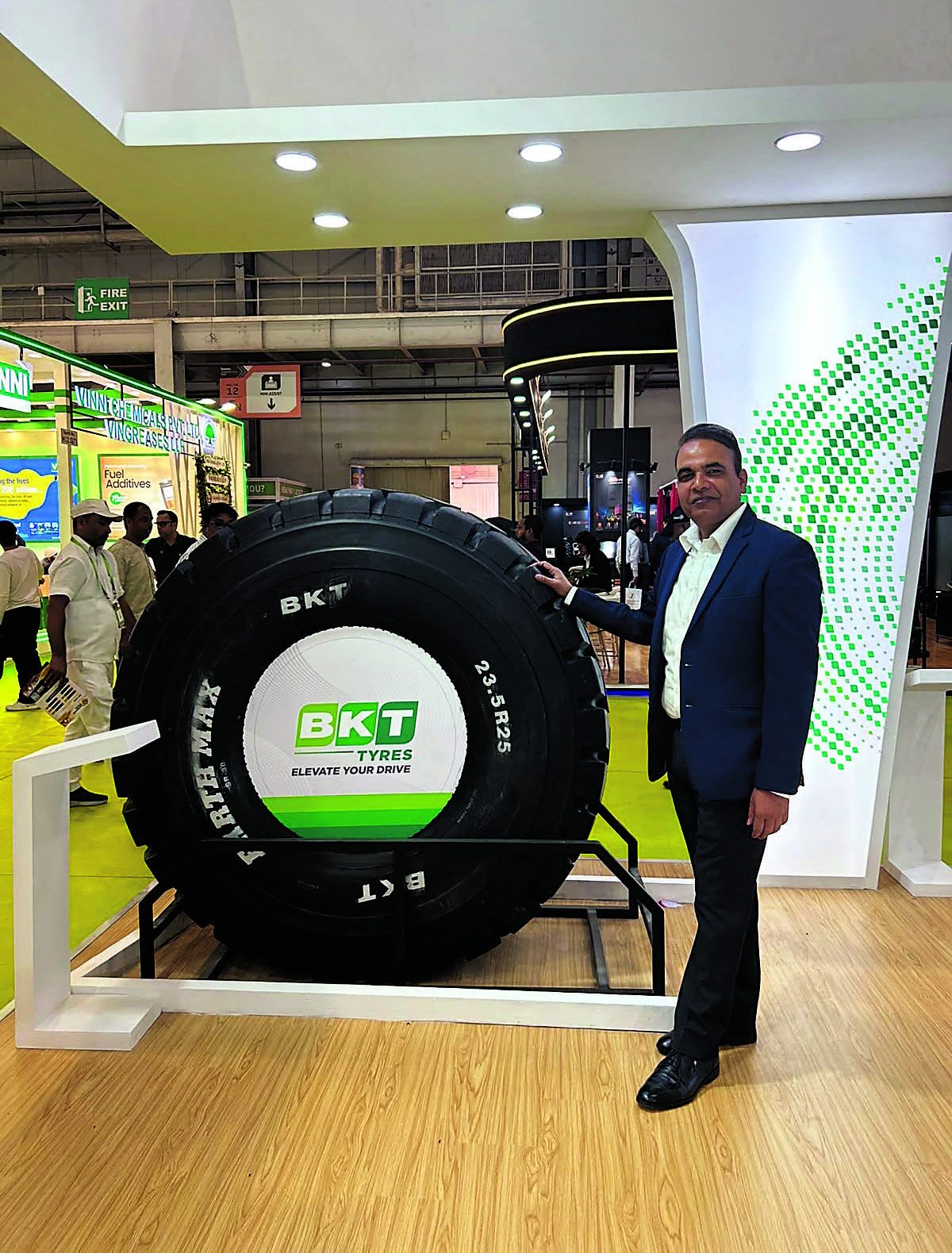
Farid Ahmed Head, Product Management (OHT), Asia Pacific, Middle East & Africa, BKT
Please tell us about some of BKT's latest tyre offerings for demanding project sites.
Our product development at BKT is closely aligned with the changing requirements of construction, mining and industrial applications, where productivity, equipment uptime and operational efficiency are increasingly important.At bauma Conexpo India 2026, we showcased a portfolio that includes EARTHMAX SR 30, developed for loaders and articulated dump trucks, and AIROMAX AM 27, engineered for mobile cranes with enhanced stability and load-carrying capability. The showcase also included MINE FORCE, EARTHMAX EXPERTO GD1, XL GRIP NEO, DYNA HAUL, CONSTEER and EARTHMAX SR423, addressing a range of demanding operating environments.
Within this portfolio, we have also developed specific solutions for the tipper mining segment. DYNA HAUL is designed for higher loads and longer distances, with a focus on uptime, fewer puncture and downtime-related issues and longer service life. EARTHMAX EXPERTO GD1, meanwhile, is a true Mining Truck Radial (MTR) developed specifically for mining applications. It is designed to support severe overloads, higher speeds and longer haul distances, while its compound and tread design support smooth, even wear and extended tyre life.
The broader objective is to develop application-specific solutions that help customers enhance equipment uptime, reduce operational disruptions and achieve reliable performance in demanding environments.
What specific products have BKT developed for extended-distance haulage and for specialized applications like port operations?
Longer haul distances bring greater demands on tyre performance, particularly in terms of heat management, durability and service life. XL GRIP NEO, an extension of the XL GRIP ULTRA series, has been developed for longer haul distances, with improved heat dissipation to support reliable operation over extended periods. This is particularly relevant where tyres are exposed to sustained operating cycles and heat buildup.For specialised port and logistics applications, CONSTEER has been developed for container trailers operating between ports and warehouses within approximately a 200-km radius. The focus is on durability, longer service life and minimising downtime.
We also have AIROMAX AM 27, a high-speed crane tyre designed for very heavy loads and already well established in the market. Together, these solutions demonstrate our approach of developing tyres around specific applications and operating requirements, rather than taking a generic approach to tyre development.
What is BKT doing in terms of material research and development to address heat buildup and durability challenges?
Material innovation is a continuous focus within BKT’s R&D. We work across new materials, tyre and tread designs, steel cores, reinforcement techniques and chemical treatments, with inputs from customers, field engineers and OEM partners feeding directly into the development process.Our design and simulation teams work alongside internal testing capabilities to understand how tyres perform under demanding conditions and develop solutions that can withstand higher heat, perform effectively on rough terrain and dissipate heat more efficiently.
This becomes especially important in applications involving continuous or multi-shift operation, where managing heat buildup can have a direct impact on tyre fatigue, service life and downtime.
For us, engineering excellence is ultimately about translating these technical capabilities into reliable performance in the field. Since the tyre is the only part of the machine in contact with the ground, it has an important role to play in overall productivity, project efficiency and operating economics.
Why has the pace of radialization increased across different segments?
Radialisation is gaining momentum because equipment is becoming increasingly demanding in terms of speed, load, operating hours and productivity. In India, radial tyres already account for more than 50% of the truck market, and we are seeing a similar transition in construction and mining, although the pace differs by application.The shift has been fastest in high-performance applications such as large dump trucks above 100 tonnes, loaders operating in demanding mining conditions, underground machinery and high-speed cranes. These applications involve higher loads and speeds or continuous operation, where effective heat dissipation becomes particularly important.
The larger OTR segment, particularly 49-inch and above, has therefore radialised faster, while crane tyres are now fully radial. Tipper tyres remain predominantly bias, with radialisation currently around 20–30%, but adoption is progressing.
Radial technology offers benefits including better heat dissipation, higher speed and load capability, improved fuel efficiency, traction and braking. BKT has built strong expertise in radial OTR technology, supported by an extensive portfolio of tread patterns, star ratings and compounds, as well as field engineers who work closely with customers and distribution partners to identify the right solution for each application.
How is BKT responding to electrification in the machinery segment?
Electrification is becoming increasingly relevant across construction, mining and material-handling equipment. We are seeing electric dump trucks, electric reach stackers at ports and trials of electric heavy machinery as customers assess their potential impact on operating costs and working hours.BKT has already developed EV-ready versions of many of its key products, allowing products supplied for conventional combustion-engine machines to also be available in versions suited to electric equipment.
We are also tracking the wider technology ecosystem, including sensors and pressure-management systems, through our internal R&D programmes. The objective is to ensure that our tyre technology keeps pace with changes in equipment architecture and customer requirements.
As machinery becomes more connected and technologically advanced, our focus is on ensuring that tyre development remains closely aligned with these changes while continuing to deliver the fundamental requirements of performance, reliability and uptime.
What support does BKT extend to customers in Tyre care and maintenance?
Tyre performance is closely linked to how the product is selected, maintained and operated. This is why customer support extends beyond the tyre itself to include tyre care, maintenance practices and application guidance.We work with fleet owners on correct tyre pressure, inspection frequency, monitoring cuts and damage, tyre rotation and machine-specific SOPs. These practices can help maximise tyre life and productivity while supporting fuel efficiency, which is particularly important as fuel and tyre costs remain major cost centres for fleet operators.
Through our dedicated tyre care and maintenance programme, and our field engineers, service teams and OE teams conduct training and workshops with customers, including workshop and management teams, to ensure that appropriate maintenance practices are understood and followed.
This field engagement also gives us valuable insight into actual operating conditions, allowing customer feedback to inform our broader approach to product development and service support.
How has BKT's collaboration with OEM partners evolved over time?
Our engagement with OEMs has evolved significantly as we are working alongside them, from the early stages of machine development.Today, OEMs share technical specifications, intended applications and target markets as part of the RFQ process. Based on these requirements, BKT recommends the appropriate product and size, after which our technology teams work together to determine the best-fit tread pattern and compound. We then share our designs and drawings for review against the OEM’s engineering specifications before commercialisation.
This approach helps ensure that the tyre is appropriately matched to the machine from the outset. That is important because tyre performance directly influences machine productivity, fuel efficiency, traction and steering.
It also creates a valuable feedback loop. Our involvement from development through field performance gives us a better understanding of how the product performs in real-world conditions and enables us to continuously refine our solutions. By the time a product reaches the aftermarket, it has therefore benefited from a much more comprehensive development process.
What is BKT's growth outlook for the Indian tyre market, and how does it fit into its broader 2030 vision?
The Indian tyre market is expected to grow by around 5–6% over the next four to five years, supported by continued infrastructure development and demand across mobility, construction and industrial applications.BKT has established a clear Vision 2030, with an ambition to grow from approximately INR 11,000 crore, in current turnover to INR 23,000 crore, by 2030.
OHT will remain the foundation of the business and is expected to contribute around 70% of revenue, while our newer categories, including TBR, PCR and two-wheelers are expected to contribute around 20%. The third pillar is the expansion of our in-house Carbon Black business, expected to contribute the remaining 10%.
Within OHT, our focus will remain on strengthening our technology and application capabilities as customer requirements evolve. Radialisation, electrification, material innovation, application-specific engineering and closer engagement with customers and OEMs will continue to be important areas of focus.
Our objective is to build on BKT’s strong OHT foundation while continuing to develop solutions that support productivity, equipment uptime and operational efficiency.