Gainwell has expanded its product portfolio under the ‘Make in India’ initiative with the launch of road-saver equipment and, more recently, concrete pumps. What prompted you to enter the concrete-pump segment?
Our aim is to address the entire construction chain – from the quarry where stones are crushed and excavation takes place to transportation of the crushed stones and earthwork, using dumpers, tippers, etc. We provide customers with a complete end-to-end manufacturing solution by supplying products of Caterpillar and other partners, and also products manufactured by us.With increasing construction of metro systems, taller buildings, larger bridges and flyovers, demand for pumping concrete to greater heights is growing. Our InfraServe Global (ISG) machines are deployed at construction sites, including concrete and asphalt batching plants. The new concrete pumps complement our concrete batching plants.
We have launched two variants of 70 cum and 50 cum. They were designed, prototyped and manufactured completely in-house over just three months, which was certainly not easy. Our pumps are designed, engineered and produced based on advanced technology. So, these are not basic machines, which are already common in the market. The pumps have been tested several times, and every pump has undergone 200 hours of testing.
As a Cat dealer, Gainwell is often associated with premium equipment. How are you reaching and educating the mid-sized and smaller contractors who work on major projects, and what solutions are you offering to make mechanisation affordable for them?
We are not focused only on large contractors, although they are obviously very significant customers for us. We are catering extensively to retail customers with a product range that makes commercial sense to them. Today, Gainwell has around 13,000 customers, of whom approximately 9,500 are retail customers.For instance, our SEM products manufactured by Caterpillar in China, are more competitively priced. We provide very cost-effective solutions to small customers who have short-term projects and cannot afford to purchase expensive equipment. We also offer options such as rental, buy back, refurbishment, and financing (through CAT Financial). The key is to understand their requirement and design a solution accordingly.
We reach and educate our customers through digital platforms, advertising and through direct interaction. We have 108 branch offices and 13 retail workshops in addition to our major workshops in different regions. Our group-wide sales force of around 500–600 provides solutions to customers across different regions. Once a customer buys a product from us, they remain connected to us digitally.
We believe that tomorrow’s India will be built not only by large contractors but also by 30,000 to 50,000 new and smaller contractors.
A challenge for smaller contractors is uncertainty over future projects. Could refurbished or rebuilt machines, backed by guarantees, provide a solution?
Absolutely. We regularly buy back machines from customers and rebuild them. We cater to both small players operating backhoe loaders or excavators, as well as large mining companies such as Hindustan Zinc. We undertake rebuilds of surface mining machines, construction machines and underground mining machines. Their underground loaders, dumpers, trucks are also rebuilt by us.This year, we expect to carry out more than 250 machine rebuilds of machines of OEMs and make them available to new retail customers at an affordable price.
TIL has a long history in specialised equipment, but its share of the truck-crane market has fallen. How do you plan to rebuild its position in India, and which products will drive growth?
In its 82-year-old history, TIL has never been a mass-market company. It has traditionally responded to unique customer requirements with highly engineered products designed for specific applications. A decade ago, the company had a 90% market share in truck cranes, which has declined to the current single-digit level. To scale up the business, we are working on a range of truck cranes that will be introduced in India for different applications and also specialized machines.TIL machines manufactured in the 1980s are still operating. A customer recently reached out to us to rehabilitate his TIL crane which he had bought in 1982. There is still considerable recall value of the TIL brand, and we will continue to maintain TIL’s value proposition of long-lasting, reliable products.
TIL products have a unique positioning in the market. For example, its small crane CK 515 has the capabilities of a conventional pick-and-carry crane along with transportation and unloading, as a single solution. Customer trials and feedback from various application segments have been very positive.
We believe India will emerge not only as a very large demand market but also as a manufacturing base capable of serving global demand.We have expanded our all-terrain and rough-terrain crane range and higher-capacity models will also be introduced, both for the domestic market and for export. We are also looking at ultra-large truck cranes for applications in railways, ports, metros and high-speed rail. Our defence portfolio is also growing. We are working with various government agencies, as well as the Indian Air Force, Indian Navy and Indian Army, for providing re-engineered solutions.
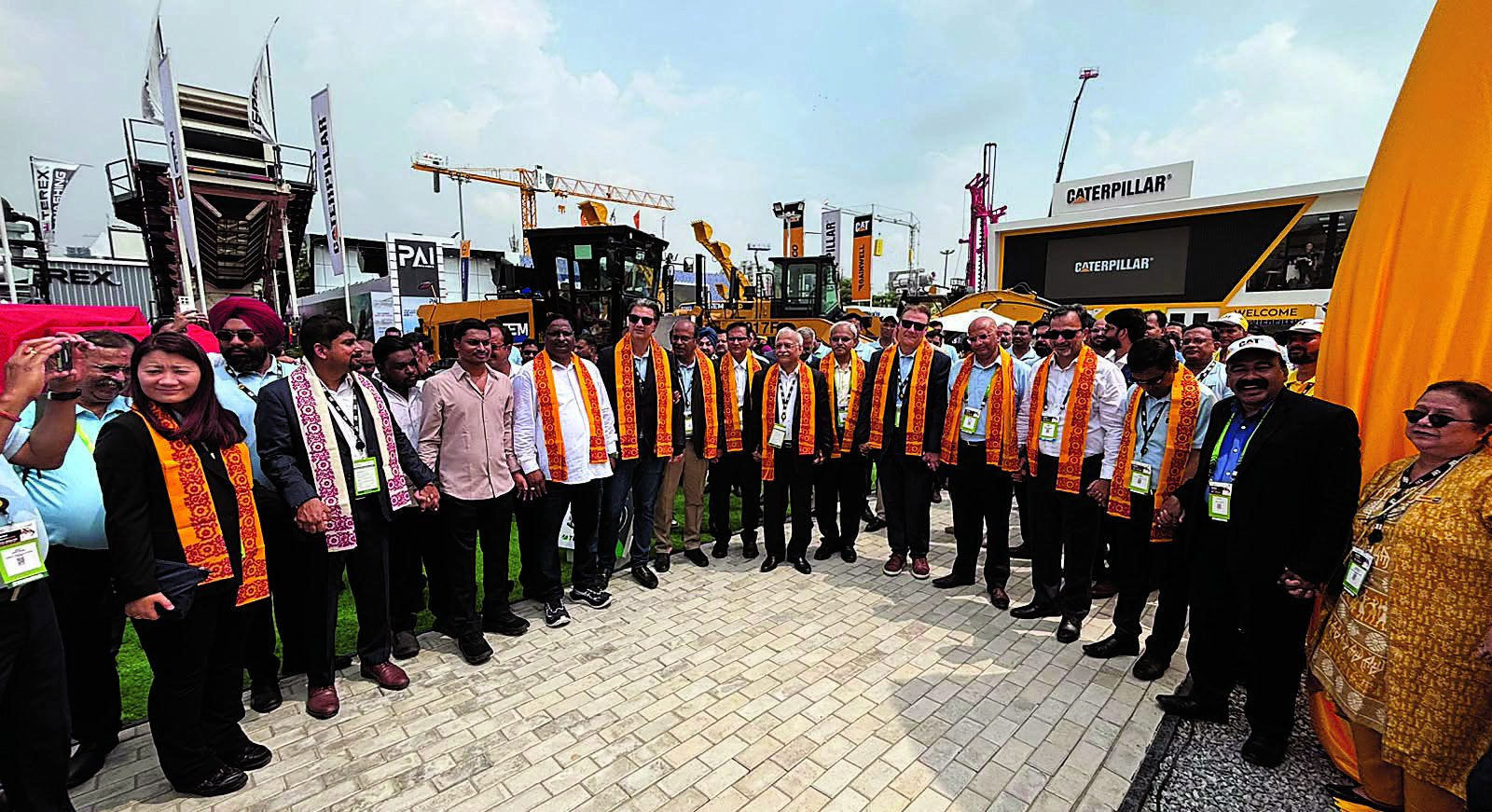
Our partners Grove, Manitowoc and Hyster are very keen on bringing the latest products to India and, at the same time, sourcing the latest products manufactured by TIL for their respective territories. After TIL introduced the very efficient empty container handler at Excon 2025, we are seeing interest from different markets. What’s more, TIL’s acquisition of Tulip Compression will add a new energy-related segment to our product portfolio.
What is Gainwell’s export strategy, particularly for markets such as Asia, the Middle East and Africa?
Gainwell Engineering, our underground mining equipment company, is already exporting to the US and Australia. The volumes are not yet substantial, but we expect them to build significantly. In the construction and mining space, as well as in new-energy products, we are seeing significant interest in exports.Tulip Compression is already exporting compressor packages to Africa which are also attracting interest from countries in Central Asia, Kazakhstan, and other markets in the region. Our ISG business is exporting components and subsystems for road-maintenance machinery to the US and exporting asphalt and concrete batching plants to Africa.
We believe India will emerge not only as a very large demand market but also as a manufacturing base capable of serving global demand. Different products will follow different export routes and strategies.
We are confident that within five years, around 25% of the Group's turnover will come from exports.
Looking ahead over the next 10 years, how do you see Gainwell and the Indian market evolving?
The Government has already made it clear that India is targeting a $7 trillion economy by 2030. Currently, the Gainwell Group's size is a little shy of $1 billion. This growth has happened over the last 10 years despite disruptions such as introduction of GST, Covid pandemic, demonetisation, and other changes.We believe the next 10 years are going to be extremely exciting. Our current estimates suggest that the Group could grow to ~ $2.5 billion by 2032. That is the level of growth we are working towards.