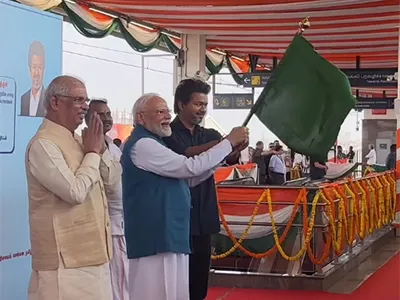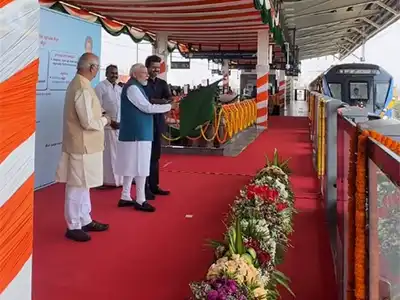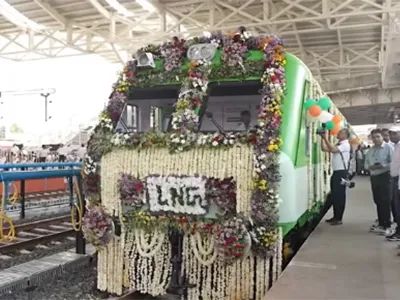
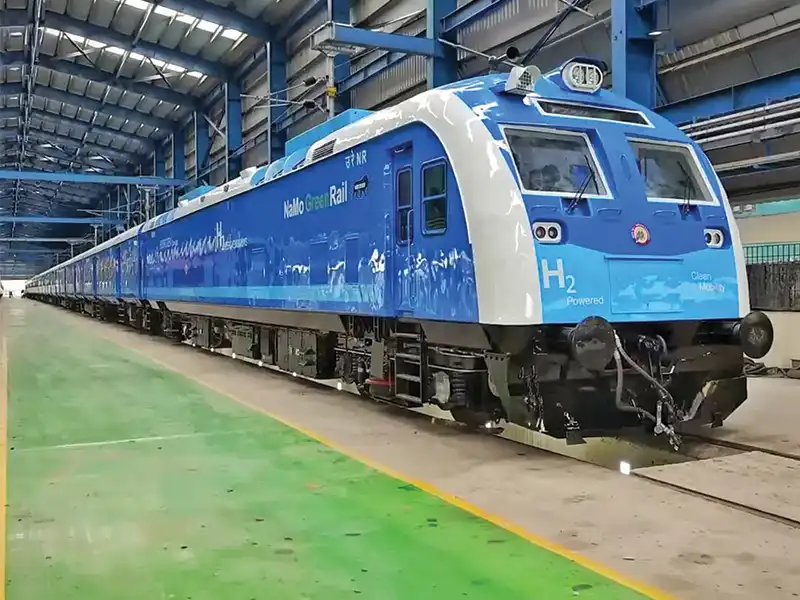
The launch follows Indian Railways' rapid electrification programme, under which more than 99 per cent of the Broad Gauge network has been electrified. Unlike conventional electric trains that draw power from overhead lines, the hydrogen-powered train produces electricity onboard through a chemical reaction between hydrogen and oxygen, eliminating the need for external power supply while producing near-zero emissions.
The trainset comprises two Hydrogen Driving Power Cars (DPCs) and eight trailer coaches, offering a capacity of around 2,600 passengers. Each power car generates 1,200 kW (1,600 hp), enabling the train to operate at a maximum speed of 75 kmph on the Jind-Sonipat section, with a design speed of 110 kmph.
To support operations, Indian Railways has established the country's first integrated hydrogen railway ecosystem at Jind, Haryana. The facility includes hydrogen production through electrolysis, storage, compression and dispensing infrastructure. Hydrogen is compressed to 500 bar and dispensed at 350 bar through two independent dispensers, allowing both power cars to be refuelled simultaneously. The facility can store nearly 3,000 kg of hydrogen and has received approval from the Petroleum and Explosives Safety Organisation (PESO).
The hydrogen-powered train has been developed using indigenous technology under the leadership of Indian Railways. The Research Designs and Standards Organisation (RDSO) prepared the technical specifications and design approvals, while Medha Servo Drives integrated the trainset and Integral Coach Factory (ICF) contributed to its exterior design.
Indian Railways has incorporated multiple safety systems to monitor hydrogen storage and operations. The train and refuelling facility are equipped with hydrogen leak detectors, heat, flame and smoke detection systems, automatic hydrogen shut-off mechanisms and continuous ventilation systems. The project has been designed in accordance with international safety standards, including NFPA-2 and the ISO 19880 series, and has undergone an independent third-party safety assessment by TÜV SÜD, Germany.
Before being cleared for passenger operations, the train successfully completed load box testing, radio frequency trials, oscillation tests, emergency brake distance trials and statutory safety inspections.
Globally, hydrogen-powered passenger trains are currently deployed on a limited scale, primarily as two- to four-coach regional trains in countries such as Germany, France, Italy, China and Japan. With its 10-coach configuration and integrated hydrogen infrastructure, the Indian Railways project represents one of the largest hydrogen-powered passenger train deployments and demonstrates the scalability of hydrogen technology for high-capacity rail operations.
Indian Railways is also exploring the deployment of hydrogen-powered trains on heritage routes, including the Kalka-Shimla railway, as part of its long-term strategy to expand clean rail mobility under the National Green Hydrogen Mission and India's Net Zero objectives.