
Shubhabrata Saha From AJAX Engineering shares insights on Next-Gen, Sustainable & Competitive Construction Equipment
The Ajax School of Concrete is leading the way in R&D in material science, which is crucial to ensure the scale and speed of 3D Concrete Printing.
Shubhabrata Saha
Managing Director & CEO

What are the advantages of 3D Concrete Printing over traditional construction methods?
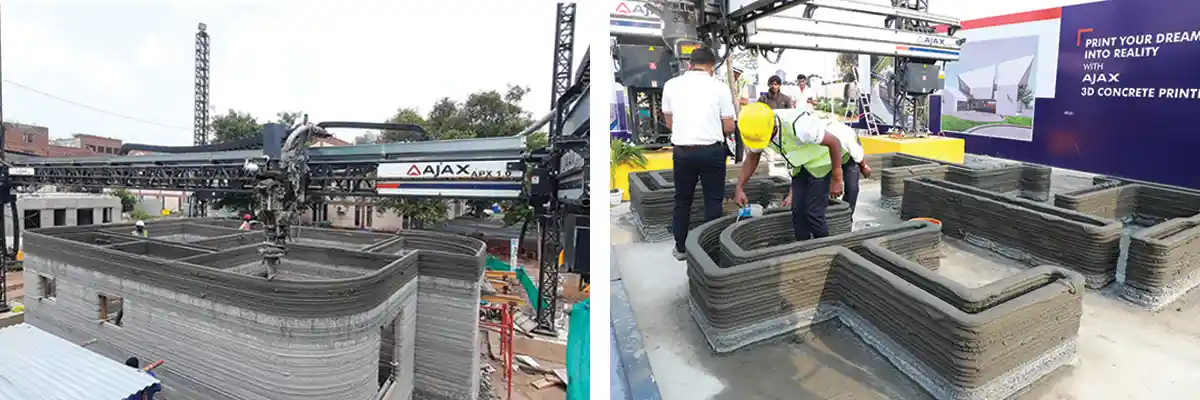
3D Concrete Printing (3DCP) offers transformative advantages over traditional construction methods. It drives significant cost savings by reducing material waste and eliminating formwork, and minimizing the requirement for additional construction equipment. The technology ensures enhanced accuracy and precision, enabling intricate designs with improved structural integrity. It also supports environmental sustainability by minimizing waste and incorporating eco-friendly materials, paving the way for greener, more efficient construction practices.Advantages:
- Material optimization since only the necessary amount of material is used, minimizing waste and lowering costs.
- Structures can be printed much faster than traditional methods, significantly shortening project timelines.
- Continuous operation as 3D printers can work round the clock, unlike labor-intensive methods that are constrained by shifts.
- Flexibility in design facilitates the creation of intricate, multidimensional designs that would be challenging or impossible to achieve with conventional methods, offering greater flexibility in shaping complex forms across multiple dimensions.
- Enables highly customizable, tailor-made structures that can adapt to diverse requirements, without significant increases in cost or time, providing flexibility to adjust designs in multiple dimensions to meet specific needs.
- Sustainability is achieved through precision in material usage which minimizes wastage.
- Can incorporate recycled or sustainable materials, reducing the environmental footprint.
- There is reduced on-site risks as automation reduces manual labor in hazardous conditions.
- Components can be produced off-site and assembled later, enhancing worker safety.
- Scalability and Accessibility makes 3D printing method of construction ideal for low-cost housing projects, particularly in developing regions.
- Enables rapid construction of shelters and infrastructure after natural disasters.
- Structural efficiency is achieved through optimized strength as structures are produced with enhanced strength-to- weight ratios through advanced designs like lattice patterns.
- Durability is achieved through use of innovative materials tailored for specific environmental conditions.
- Portable 3D printing systems allow construction in remote or inaccessible areas.
In which ways can 3D concrete printing reduce overall project cost?
3D Concrete Printing offers significant advantages in terms of time, labor, and design flexibility, making it a transformative approach in construction. By enabling continuous, automated printing, 3DCP drastically reduces construction timelines, cutting down the duration of projects that would typically take months. This not only speeds up delivery but also reduces associated costs, such as rentals, scaffolding, and labor accommodations. The automation of tasks reduces the need for labour, directly lowering labour costs by minimizing reliance on specialized workers and training. With fewer workers required, 3DCP streamlines operations, reduces errors, and limits rework, further enhancing cost-efficiency.3DCP offers unparalleled design flexibility, allowing for complex, intricate structures that traditional methods cannot easily achieve. Architects and designers can experiment with innovative shapes and materials, without the limitations of conventional construction techniques. Overall, 3DCP revolutionizes the construction process by cutting time, reducing labour-related costs, and providing greater design freedom, leading to substantial savings and enhanced efficiency.
What are some of the innovations that AJAX Engineering is currently working on to further develop this technology?
AJAX Engineering is driving innovation in 3D Concrete Printing through a comprehensive focus on advanced material development, including optimized concrete mixes, recycled aggregates, and fiber-reinforced options that enhance both strength and sustainability.Through the Ajax School of Concrete, the company is also pushing the boundaries of hardware by developing larger, scalable printers capable of multi-storey construction and portable units for use in remote locations. Automation and robotics are enabling autonomous printing and performing critical tasks such as reinforcement and utility installation. The integration of advanced software and automation technology streamlines these processes, ensuring high precision and efficiency.
Structural dynamics are considered throughout the design and printing process to ensure that each printed structure meets the required standards of stability and safety. Sustainability remains a key priority, with AJAX focusing on carbon-neutral processes and eco-friendly materials.
Additionally, AJAX is advancing digital construction technology by embedding IoT sensors for real-time monitoring and predictive maintenance, as well as leveraging digital twins to enable smarter, more efficient infrastructure solutions. This integrated approach to hardware, software, robotics, and structural design is setting new standards in 3DCP, making construction faster, more sustainable, and technologically advanced.
How do you see future developments and applications of 3D Concrete Printing impacting the construction industry?
The future of 3D Concrete Printing lies in continued advancements in automation, materials science, and construction efficiency. As the technology evolves, 3DCP will reduce costs by eliminating formwork, cutting material waste, and optimizing designs. Automation will further reduce labor needs, helping address workforce shortages and improve safety.Moreover, 3DCP’s ability to scale at speed with lower costs is a significant advantage, enabling faster construction timelines and more efficient resource use. The increased use of sustainable materials, such as recycled aggregates and geopolymers, will minimize the environmental footprint of construction.
Innovations in robotic systems and software integration will allow for more complex, precise structures to be built with enhanced efficiency. This capability to scale quickly and cost-effectively will be a key factor in transforming construction practices.
3DCP has the potential to disrupt the industry by revolutionizing how buildings are designed and constructed, driving greater efficiency, sustainability, and cost-effectiveness. It is poised to become a central component of future construction, influencing demand for specialized concrete equipment and shaping the future of the built environment.
Published on:
01 December 2025
Share:
We Value Your Comment