India is building one of the world’s largest infrastructure programmes, but the way we specify materials has not evolved at the same pace. Cement grades are changing. Concrete grades are changing. Structural demands are rising. The question is: are our material specifications keeping pace? This is where Supplementary Cementitious Materials (SCMs) can make a difference.
Abinash Mishra
The country's commercial infrastructure is moving to high-performance concrete grades – whether the structural engineer specifies it or not. Metro viaducts, data center slabs, airport terminal structural cores, long-span bridges on the Bharatmala corridor, super-tall residential towers in Mumbai and Hyderabad, port infrastructure under Sagarmala, industrial warehouses serving the PLI scheme manufacturing belt –– each of these structures require concrete performance that standard Ordinary Portland Cement mixes cannot deliver reliably.
M50, M60, and above M80 grades are not exceptional anymore. In organised commercial construction, they are becoming the baseline. And the only way to produce M50 and above ––– consistently, economically, and durably in India's climatic and construction conditions is with Supplementary Cementitious Materials (SCMs) added to the mix.
Though the structural specification has changed, the ingredient it depends on is still being treated as optional. This contradiction is what the article reveals.
What SCMs Actually Are and Why the Category Matters More Than Most People Realise
SCMs are inorganic materials that contribute to concrete performance through hydraulic activity, pozzolanic activity (or both) when used as partial replacements for portland cement clinker in a concrete mix.The category is not new. What is new is the scale of structural performance now being demanded from concrete in India, and the realisation that SCMs are not an optional upgrade to the performance. Rather, they are the enabling ingredient.
Each SCM type has a distinct chemistry, a distinct performance profile, and a distinct role in the concrete mix. Understanding the differences is not academic. It is the difference between a structural specification that performs over a 50-year design life and one that begins showing distress in the twelfth year.
Fly Ash is the most abundantly available SCM in India and also the most widely used. India generates approximately 230 million tonnes of fly ash annually from its 200-plus thermal power plants. Class F fly ash, the low-calcium variety produced by bituminous coal combustion, is a pozzolanic material which does not hydrate on its own. It reacts with the calcium hydroxide released during cement hydration to form additional calcium silicate hydrates that fill the pore structure of the concrete matrix. The result is a denser, less permeable concrete with superior long-term strength gain, reduced heat of hydration, and improved resistance to sulphate attack and alkali-silica reaction. The performance advantage is most visible in large-pour structural elements, marine exposure zones, and foundation concrete in aggressive soil conditions.
Ground Granulated Blast Furnace Slag is a latent hydraulic material. Unlike fly ash, it can react directly with water in the presence of an alkaline activator, typically calcium hydroxide from cement hydration. GGBS produces concrete with significantly lower heat of hydration than OPC, making it the SCM of choice for mass concrete pours in dams, thick raft foundations, and bridge pier caps where thermal cracking from the exothermic hydration reaction is a primary durability risk. GGBS also produces denser paste microstructure with superior resistance to chloride ingress, making it the specified material for coastal and marine infrastructure where rebar corrosion is the dominant failure mechanism. India's steel industry produces approximately 12 to 13 million tonnes of granulated blast furnace slag annually, and the GGBS processing capacity from this raw material remains substantially under-utilised relative to the concrete demand that could absorb it.
Silica Fume is the highest-performance SCM in common use and the one that most dramatically changes what concrete can achieve. A byproduct of the silicon and ferrosilicon alloy manufacturing process, silica fume consists of amorphous silicon dioxide particles approximately 100 times finer than OPC particles. This extreme fineness, combined with a silicon dioxide content exceeding 85%, produces a pozzolanic reactivity that is several times higher than fly ash. Silica fume at 5 to 10% replacement of cement by weight, fills the space between cement particles at a scale no other SCM reaches, creating a concrete matrix of exceptional density. Compressive strengths above M80 are achievable. Chloride permeability drops to levels that extend reinforced concrete design life in aggressive environments from 30 years to 100 years and beyond. Silica fume is why the structural cores of today's 50-plus storey towers in India's commercial centres look different from the structural cores that failed precociously in 20-storey buildings built 30 years ago.
Metakaolin is the under-appreciated SCM in India's specifications. Produced by calcining kaolinite clay at 700 to 800 degrees Celsius, metakaolin is a highly reactive aluminosilicate pozzolan with performance characteristics that bridge between fly ash and silica fume. Its particle size is intermediate, its reactivity is high, and its availability is geographically distributed in a way that fly ash and GGBS are not. For regions of India beyond the coal belt and steel plant corridors, where fly ash and GGBS supply is limited or inconsistent, metakaolin represents a locally producible SCM that can enable high-performance concrete without long-distance supply chain dependence. This geographic independence is the specific attribute that makes metakaolin strategically important for India's construction ambitions in the Northeast, in hilly states, and in coastal regions in the absence of proximate steel or coal infrastructure.
Rice Husk Ash deserves inclusion in any honest Indian SCM taxonomy because India produces 22 million tonnes of rice husk annually, of which a fraction is currently converted to high-silica ash through controlled combustion. When burned at controlled temperatures below 700 degrees Celsius, rice husk produces an amorphous silica with pozzolanic activity approaching that of silica fume at a fraction of the cost. The agricultural geography of India, with rice cultivation concentrated in Andhra Pradesh, Telangana, Punjab, Haryana, West Bengal, and Odisha, places this SCM feedstock directly adjacent to significant construction demand. The supply chain exists. The processing infrastructure does not, at scale, and that is an entirely solvable industrial problem.
The Ultrafine SCM Frontier: The Category Nobody in India Is Talking About Yet
Beyond the conventional SCM types described above lies a performance frontier that Indian structural specifications have not yet formally addressed but which the highest-performance commercial projects are already touching.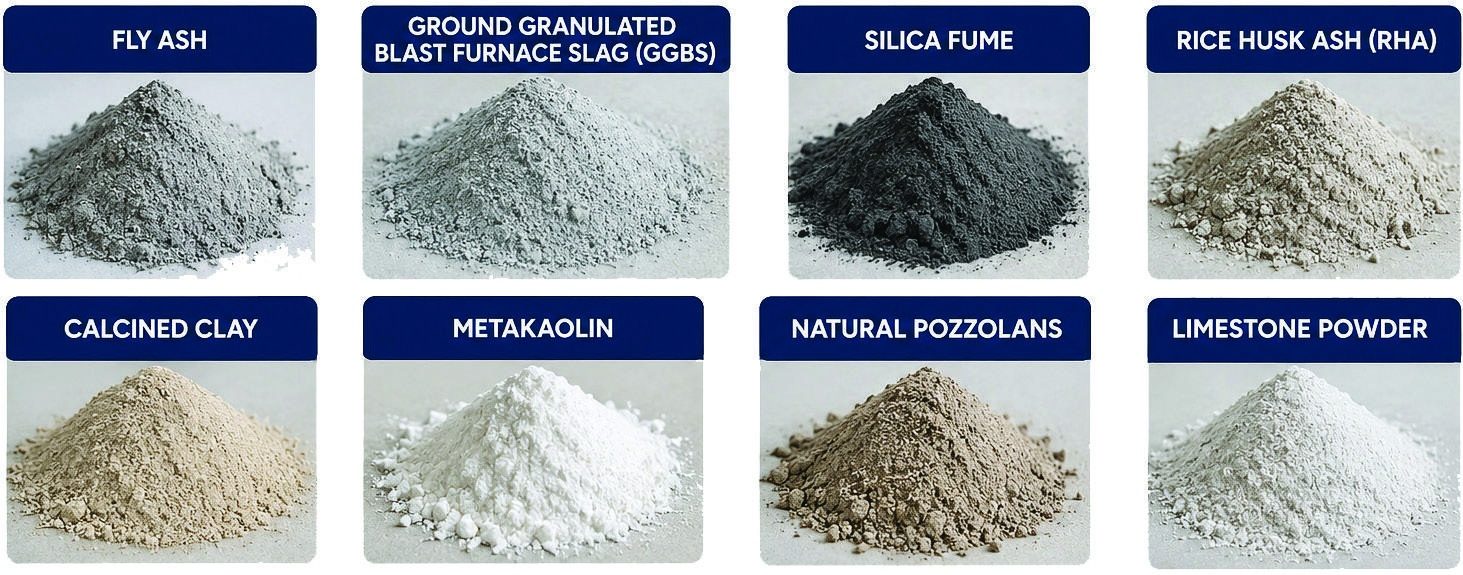
Ultrafine SCMs are materials processed to particle sizes below 5 microns, and in some cases below 1 micron. At these particle sizes, the pozzolanic and filler mechanisms that conventional SCMs exploit are amplified dramatically. The specific surface area available for reaction increases by orders of magnitude. The packing density of the cementitious system approaches the theoretical maximum. The concrete produced from systems incorporating ultrafine SCMs at optimised replacement levels achieves characteristics that are qualitatively different from anything producible with conventional materials alone.
Nano silica, synthetic amorphous silicon dioxide particles in the 5 to 100 nanometre size range, is the most commercially advanced ultrafine SCM. At dosages of 1 to 3% by cementitious binder weight, nano silica accelerates early hydration, fills nano-scale pores that silica fume cannot reach, and produces a concrete matrix of extraordinary density. Compressive strengths above M120 are routinely demonstrated in laboratory conditions. Chloride diffusion coefficients at 28 days are an order of magnitude lower than standard HPC mixes. The structural implication is a reinforced concrete element whose design service life in aggressive marine or industrial exposure environments extends beyond anything the current IS code durability tables were calibrated to predict.
Ultrafine GGBS, ground to Blaine fineness values above 600 square meters per kilogram against the standard 400 to 450, delivers hydraulic reactivity at a rate that begins approaching Portland cement while retaining the thermal and durability advantages of conventional GGBS. For thick structural elements in coastal India where both heat of hydration control and chloride resistance are simultaneously required, ultrafine GGBS in ternary blend with OPC and silica fume produces a concrete system that addresses both requirements without compromise.
Calcined Clay at controlled fineness, the material that LC3 (Limestone Calcined Clay Cement) technology has brought into mainstream research attention through the work of IIT Delhi and the EPFL in Switzerland, represents a different kind of frontier. India has abundant kaolinite clay deposits. Calcination at 700 to 800 degrees Celsius produces a reactive aluminosilicate that, when combined with limestone powder in the LC3 cement system, can replace 40 to 45% of Portland cement clinker without strength penalty at 28 days. At 90 days, the pozzolanically activated system typically surpasses OPC at equivalent mix designs. The carbon intensity of LC3 is 30 to 40% lower than standard blended cement. The structural performance meets or exceeds IS 456 requirements at the grades where most structural specifications currently sit.
India has everything required to produce LC3 at scale: the kaolinite clay, the limestone, the calcination technology, and the construction demand to absorb it. The ingredient missing is the IS standard that validates it and the NBC mandate that requires it.
How High-Performance Concrete Is Already Reshaping India’s Commercial Infrastructure
The shift to high-performance concrete in India's organised commercial construction sector is not a future prediction. It is a present reality that the structural specification ecosystem has not yet formally acknowledged.India's ready-mix concrete market stood at Rs 6,68,000 crore (USD 80.5 billion) in 2024 and is projected to reach Rs 13,86,000 crore (USD 167 billion) by 2033 at a CAGR of 9.56%. The commercial segment accounts for 31% of current demand and is growing faster than residential at 7.06% CAGR through 2031. Every major category of commercial construction is driving concrete grade escalation.
Data centers are the most demanding structural application in concrete specification. A hyperscale data center slab must carry floor loads of 10 to 15 kN per square meter from server racks, support raised access floor systems, resist vibration to protect electromagnetic-sensitive equipment, and deliver all of this while maintaining dimensional stability over 30-year operational lifetimes without visible cracking. The concrete grade for these slabs routinely runs M50 to M60 with silica fume at 7 to 10% addition and high-range water-reducing admixtures to achieve the water-cement ratio below 0.35 that the permeability requirement demands. Bengaluru's data center power capacity is projected to jump 65% by 2030. Every megawatt of that capacity sits on a concrete slab that would fail its structural brief if specified at M30 with standard OPC.
Airport terminal structures present a different HPC design driver: span. Long-span roofs and concourse structures in the new terminal buildings at Delhi, Mumbai, Hyderabad, Bengaluru, and Navi Mumbai are being designed with structural elements spanning 20 to 40 metere without intermediate columns to create the column-free architectural interiors that airport terminal programs require. At these spans, the depth of prestressed or post-tensioned structural members is the architectural constraint. Reducing depth requires increasing the compressive strength of the concrete so that higher prestress can be applied. Every 10 MPa increase in concrete grade at equivalent geometry reduces the required structural depth by 15 to 20%. The terminal architects get their column-free space. The structural engineer gets the required depth-to-span ratio. The concrete mix that delivers this performance invariably includes GGBS for thermal control in thick members and silica fume for the chloride and permeability performance that external exposure demands.
Metro viaduct concrete is the application where SCM specification has been most systematically embedded in Indian infrastructure practice, and therefore the application that most clearly shows what is possible when specification culture is aligned with material capability. Bharatmala's highway program alone is estimated to consume 15 million tonnes of fly ash per year for road construction and bridge infrastructure. Metro rail projects across Delhi, Mumbai, Bengaluru, Chennai, Hyderabad, Pune, and Kochi are producing structural specifications that mandate fly ash at 25 to 35% replacement by cementitious content for all elements with design service lives above 50 years, and GGBS at 40 to 50% for marine-proximity viaducts. These specifications are not experimental. They are standard practice in organised metro procurement.
The commercial residential tower segment is where the grade escalation is newest and most commercially significant. A residential tower of 30 floors and above in Mumbai, Pune, Hyderabad, or Bengaluru is typically being specified at M40 to M50 for columns and core walls. The structural loading from 30 floors concentrated into column sections of 600 to 900 millimetre dimension cannot be safely resolved in M30 at reasonable column sizes without compromising the lettable floor plate. As towers push to 40, 50, and above 60 floors, the column concrete grades routinely reach M60 to M80, and the mix design at these grades is impossible without silica fume and a high-range water reducer. The structural engineer does not specify these grades because silica fume is fashionable. They specify them because the column cannot be smaller and meet the loading requirement with lower-grade concrete.
Government-Level Gaps That Are Slowing Everything Down
India has the SCMs. It has the construction demand for the concrete that SCMs enable. The structural performance case is established beyond reasonable argument. So why is SCM adoption still fragmented, inconsistent, and geographically concentrated in organised commercial construction, while the vast majority of India's structural building stock continues to be specified and built with standard blended cement or OPC at M25 to M30?The answer is five specific governance failures that compound each other:
- The first and most consequential is the absence of mandatory prescriptive SCM minima in structural specifications for public infrastructure. The National Building Code 2016 provides guidance on durability exposure categories and corresponding water-cement ratios, minimum cement content, and minimum concrete grades. It does not mandate minimum SCM replacement levels for specific exposure categories in the way that, for example, Singapore's Building and Construction Authority mandates minimum slag content for marine-exposure structures. An engineer designing a coastal bridge in India's Corrosion Zone 4 or 5 must demonstrate durability compliance against the IS 456:2000 durability requirements. But there is no code provision that says the only practical way to meet those requirements at reasonable cost and without extraordinary cover depths is to specify GGBS at 40 to 50% replacement. The engineer who specifies M40 OPC at 70mm cover is technically compliant with the code. The engineer who specifies M40 with 40% GGBS at 45mm cover produces a structure with three times the chloride resistance at equivalent material cost. The code does not differentiate them. The market rewards neither over the other.
- The second gap is the absence of a nationally harmonised SCM quality testing and certification framework that a structural engineer can rely on from any source in any geography. Fly ash quality from different thermal power plants varies enormously in carbon content, particle size distribution, loss on ignition, and pozzolanic reactivity index. A structural engineer who specifies IS 3812 Part 1 Class F fly ash is specifying a standard. Whether the fly ash that arrives at the RMC batching plant was tested against that standard in the batch that actually went into the pour is a different and unanswered question in most projects. The BIS certification system for SCMs is not mandatory in the way it is for cement. A fly ash supplier who does not hold BIS certification can still supply to a construction site. This is the fly ash equivalent of the TMT rebar grey market problem. The specification says one thing. The material that arrives may or may not be that thing. Without mandatory certification and documented quality trails from power plant to batching plant to pour, the structural engineer who specifies SCMs has no reliable assurance that the specified material was what was used.
- The third gap is the geographical mismatch between SCM supply and construction demand. India's fly ash is concentrated in the coal belt: Chhattisgarh, Odisha, Jharkhand, Madhya Pradesh, Telangana, Maharashtra, and Rajasthan in the vicinity of large thermal power stations. GGBS production is concentrated near the integrated steel plants: Bhilai, Bokaro, Rourkela, Burnpur, Visakhapatnam, and Jamshedpur. Silica fume production, a by-product of silicon and ferrosilicon manufacturing, is concentrated in Meghalaya and Himachal Pradesh. The construction demand is in a completely different geography: Mumbai metropolitan region, Delhi NCR, Bengaluru, Hyderabad, Pune, Chennai, and the Tier 2 cities growing fastest under urbanisation pressure. The supply chain distance from SCM source to concrete batching plant in most high-demand construction markets adds Rs 1,500 to Rs 4,000 per tonne in logistics cost that reduces the economic advantage of SCM use relative to locally available cement. No policy mechanism currently incentivises SCM supply infrastructure development in consumption-adjacent locations rather than in production-adjacent locations.
- The fourth gap is the complete absence of structural engineer education and specification support for SCM mix design in organised professional development. The Indian concrete community has IS 456, IS 10262 for mix design, and the BIS series of SCM standards. What it does not have is a nationally available, professionally accredited training and certification programme for concrete technologists and structural design engineers covering SCM-inclusive mix design, durability modelling, and site quality assurance. The engineer who graduated 15 years ago and has been specifying M30 OPC for slabs since then has no institutional mechanism compelling them to update their specification practice. The result is a profession where a small number of high-performance specialists serving the organised commercial sector use SCMs confidently and correctly, while the large mass of practicing structural engineers in India's Tier 2 and Tier 3 markets continue to produce specifications that the material science of the last 30 years has established as suboptimal for durability.
- The fifth gap is the one that most directly enables the demand bubble that is about to burst: the National Building Code 2016 and the Structural Use of Concrete IS 456:2000 have not been revised to reflect the performance requirements and material options that 2026 structural engineering best practice demands. The structural code revision cycle in India runs to 10 to 15 years. IS 456 was last revised in 2000. A structural specification written against IS 456:2000 durability requirements is technically compliant with a code that was written before most of the research on SCM-enabled durability prediction models, nano-scale pore structure characterisation, and long-term field performance data was available. The code is not wrong. It is incomplete. And its incompleteness creates the specification vacuum into which suboptimal concrete continues to be placed in structures that India expects to last 50 to 100 years.
The Shift From Cement Buyers to Concrete Buyers: The Regional Market Story Nobody Has Written
Here is the insight that the Indian building materials industry has not yet fully absorbed, and that the SCM market is waiting for.India's individual house builder, the person building their own home in a Tier 2 or Tier 3 city, is beginning to shift from being a cement buyer to being a concrete buyer. For three generations, the Indian self-builder's primary construction material decision was which cement to buy. The cement brand was the quality signal. The purchase was of 50-kilogram bags. The concrete was mixed on site by a mason whose recipe was calibrated to his experience rather than to any structural design. The SCM question was irrelevant because no SCM was in the mix. The structural quality delivered by this process is what is now presenting itself as the India-wide low-rise residential structural failure pattern: buildings of 3 to 5 floors in Tier 2 and Tier 3 cities that are showing rebar corrosion, plaster spalling, and structural cracking at year 8 to 15, but which the owners expected to last for 50 years.
But the shift is happening now. A meaningful and growing fraction of India's self-builders are switching to ready-mix concrete for their foundation and structural frame elements. The RMC plant that has arrived in their city, typically as a satellite batching facility of a larger organised RMC operator, offers them a product that the mason with a concrete mixer cannot: a documented, grade-certified, mix-designed concrete delivered in a transit mixer and placed by a boom pump. The self-builder who moves from site-mixed concrete to RMC is not primarily making a quality decision in the material science sense. He is making a convenience and accountability decision and a bill of lading that says M30; not a mason who says it looks right.
But here is the structural consequence of this shift that the SCM market should be planning for: The RMC plant that is now serving the Tier 2 self-builder produces its M30 with whatever cementitious system that optimises its cost at the batching plant. In states with nearby fly ash supply, a well-managed RMC plant is already using 20 to 25% fly ash in its standard M30 because it reduces material cost without compromising the 28-day compressive strength. The fly ash use is transparent to the self-builder who receives the transit mixer. The M30 certificate is the product. The fly ash is an ingredient the customer never specified and may never know was used.
This invisible SCM adoption in the self-builder RMC market is the first wave of the demand bubble. The self-builder is not buying SCMs. He is buying concrete. The SCMs are inside the concrete he buys. As RMC penetration in Tier 2 and Tier 3 markets increases from the current estimated 15 to 20% of structural concrete volume toward 35 to 40% over the next 3 to 5 years, the SCM volume that goes into this market grows proportionately without any change in the self-builder's purchase behaviour or specification intent.
The second wave is the small commercial developer who is building a 10 to 15 floor residential or mixed-use project in a Tier 2 city and who is beginning to encounter RERA-triggered structural quality obligations that make the bag-cement mason mix model commercially risky. The RERA structural warranty of 5 years, while inadequate relative to the material science of what causes structural failure, is sufficient to focus a small developer's attention on documented concrete quality. The developer who has received one warranty claim from a buyer pointing to cracking in a column that the developer's mason mixed on site is the developer who places his next project's structural concrete from an RMC plant. This transition from a cement buyer to a concrete buyer at the small developer level is the second wave.
The third wave, and the one that will define SCM as a commodity rather than a specialist ingredient, is the National Building Code revision and IS 456 update that will eventually mandate minimum durability performance parameters that are only achievable with SCM-inclusive mix designs in India's exposure conditions. When that revision arrives, and the structural engineering and materials community believes it is 2 to 4 years away, the specification question shifts from "should I use SCMs?" to "which SCMs and at what proportion?" At that point, SCMs cease to be a specialty ingredient that a sophisticated engineer specifies. They become the commodity input that every concrete mix in India's organised construction sector must contain to meet the minimum code requirement.
The Three Years That Will Change Everything
The demand bubble that the SCM market is waiting for will not arrive as a single event. It will arrive as the convergence of three forces that are each independently building toward a critical mass in the 2027 to 2029 window.The first force is code revision. IS 456 is overdue for revision. The BIS technical committee that oversees it is aware that the current durability provisions are insufficient for India's coastal construction density, the chloride exposure levels in its industrial corridors, and the seismic performance requirements in its high-hazard zones. When the revision is published with updated durability classifications that effectively require SCM use in a broader range of exposure categories, the structural specification community will adopt the new provisions because they are code-mandated, not because they chose to. The regulatory demand signal will be unambiguous.
The second force is the RMC penetration tipping point. When RMC reaches 35 to 40% of structural concrete volume in India's organised construction market, which the trajectory of the current 9.56% CAGR projects for the 2027 to 2029 period, the RMC operator's cementitious system optimisation decisions become the de facto specification for a large fraction of India's structural concrete. The RMC operator who is already using fly ash, GGBS, and silica fume in optimised ternary mixes for cost and performance reasons will expand that usage as volume grows. The structural engineer whose drawing says M40 and whose project uses RMC will increasingly be receiving concrete that contains SCMs as a matter of the RMC operator's operational practice rather than as a matter of the engineer's specification.
The third force is the commercial infrastructure grade escalation reaching the mid-market. The M50 to M80 concrete grades that are currently confined to the organised commercial top end of the market will descend into the mid-market as developers in Tier 2 cities compete for IGBC Green Homes certification, as RERA structural warranty litigation creates reputational pressure to demonstrate quality, and as the structural engineering community's awareness of premature structural failure in lower-grade mixes becomes commercially relevant to building buyers who are increasingly literate about what they are purchasing.
When these three forces converge, the SCM market in India will not be a specialty market waiting for educated early adopters. It will be a commodity market serving a mandatory specification requirement at national scale.
The companies that have built the supply chain, the quality certification, the distribution geography, and the RMC batching plant relationships will now own that commodity market when it arrives.
The companies that wait for the code revision to make the demand visible will discover (as every late mover in building materials discovers), that the distribution moats were already built by the time they started looking.
The Insight the World Has Not Yet Articulated
Here is the observation about India's SCM market that the global concrete industry's standard framework for understanding SCM adoption has missed:In every mature concrete market, SCM adoption followed the sequence: specification culture leads, commercial availability follows, commodity pricing results. The structural engineer specifies, the supply chain builds, the price discovers.
India's SCM adoption is following a different sequence. Commercial availability is leading. Supply chain is embedded in RMC operations before specification culture catches up. When the specification catches up through code revision, the commercial infrastructure is already in place. The commodity price was discovered before the commodity was officially mandated.
This inverted adoption sequence has one unusual consequence. When the National Building Code revision arrives and mandatory SCM provisions are embedded in structural specifications, the industry will not experience a supply shock or a transition period. The supply chain is already there. The RMC plants already know how to use the materials. The cement companies have already shifted their product mix toward higher blended cement fractions to reduce clinker consumption and carbon intensity.
The demand signal will arrive at a supply chain that has been quietly building toward it for a decade.That is not a normal commodity transition. That is a demand bubble that has a full reservoir waiting behind it.
And in India's construction market, where the reservoir is 62 crore urban housing units of aging stock, 300 million tonnes of annual new construction demand, and a National Infrastructure Pipeline of Rs 111 lakh crore, the bubble does not pop. It floods.
About the Author

An alumnus of IIT Bombay and Olin Business School, and a PhD Scholar at IIT Patna, Abinash actively works at the intersection of AI, green infrastructure, and next-generation building materials.
He is the voice behind "Building Material 4.0 and the Value Connect," a rapidly growing global knowledge platform with nearly 200,000 subscribers, alongside his LinkedIn publications "AI + Building Materials" and "Expertpreneurship Unfiltered." His content focuses on practical, CEO-level insights that drive growth, efficiency, and competitive advantage in the evolving construction ecosystem.