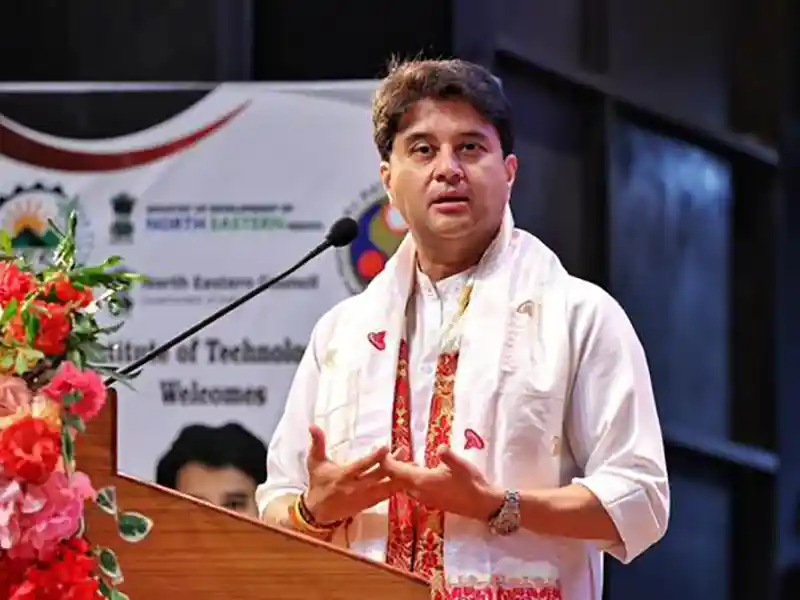
The projects were inaugurated and launched during Scindia’s two-day visit to the state on October 12–13, 2026, in the presence of Mizoram Chief Minister Lalduhoma and other dignitaries. The initiatives aim to improve connectivity, strengthen public infrastructure and expand economic opportunities across the state.
Among the projects inaugurated was the 3.33-km Daido–Vangkawt Road in Champhai, developed at a cost of Rs 17.24 crore under the North East Special Infrastructure Development Scheme (NESIDS-Roads). The road is expected to improve connectivity in the Mizo ginger-growing region and facilitate the transportation of agricultural produce.
Another key project is the 74-circuit-km, 132 kV Bairabi–West Phaileng transmission line via Mamit, developed at a cost of Rs 54.95 crore to strengthen the state’s electricity transmission network. The other completed projects include the Rs 20.50 crore augmentation of the North Vanlaiphai Water Supply Scheme, a Rs 2.64 crore AYUSH Development Centre and the Rs 6.90 crore Aizawl Institute of Arts and Music for the North Eastern Region at Tuivamit Tlang.
The five projects for which foundation stones were laid include the 21-km Pukzing–Silsuri Road in Mamit district, costing Rs 100.24 crore, and the 21-km Tualpui–Champhai Road, estimated at Rs 57.01 crore. Both projects are intended to improve regional connectivity and access to markets and essential services.
A 32.70-km Oil Palm Link Road, costing Rs 26.49 crore, will connect areas across Kolasib, Mamit, Lunglei and Lawngtlai districts. The project is expected to benefit nearly 60,000 people across 19 villages by improving agricultural transportation and access to essential services.
The remaining projects comprise a 40-bed hostel for the Auxiliary Nurse Midwife (ANM) School at Zemabawk in Aizawl, costing Rs 10 crore, and sports infrastructure development worth Rs 34.80 crore to expand facilities and opportunities for young athletes.
Addressing the gathering, Scindia said the initiatives reflected the Centre’s focus on converting improved connectivity into economic opportunities while strengthening public services. He described the approach as an investment in both “Routes and Roots”, with roads and other infrastructure connecting people and markets, while healthcare, education and cultural facilities support local communities.
Scindia also highlighted the role of agriculture in Mizoram’s economy, particularly ginger cultivation. He said the Rs 189.79 crore Mizoram Ginger Mission aims to bring nearly 20,000 farming households into an integrated value chain covering cultivation, processing, branding, connectivity and access to domestic and international markets.
The minister said the objective was to increase the value retained by farmers and local communities rather than focus solely on production.
Highlighting the wider development programme, Scindia said 375 projects worth Rs 4,617.70 crore had been taken up in Mizoram, of which 295 projects involving Rs 2,692.31 crore had been completed. He also noted that the Ministry of Development of the North Eastern Region had been allocated Rs 6,812.30 crore for the North Eastern Region in the current financial year.
Scindia emphasised that infrastructure development should proceed alongside environmental conservation and the preservation of Mizoram’s cultural identity. Invoking the state’s traditional spirit of Hnatlang, a community practice of collective voluntary work, he said development required cooperation between the Centre, the state government and local communities.