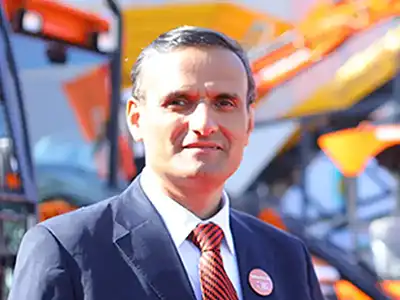

Ben Harrison, Tata Technologies

Ben Harrison,
Global CoE Director – IHM
Non-road (or off-highway) equipment is used in numerous industry verticals such as oil and gas, infrastructure, construction, mining, and agriculture. Two of the largest industries in India – agriculture and construction – contribute a sizeable chunk of the country’s GDP. Unfortunately, they also add to its environmental concerns, due to the air pollutants emitted by diesel engines. The rapid mechanization of agriculture (largely in the form of tractors and equipment such as combines and harvesters), will contribute further to worsening the air quality in the country.
The market for construction equipment and agricultural tractors in India is growing at a rapid pace. A report in December 2016 by Tim Dallmann and Zhenying Shao of the International Council on Clean Transportation on ‘Evaluation of Emission-Control Scenarios for Agricultural Tractors and Construction Equipment in India’ concludes that unless regulatory action is taken to control emissions from agricultural and construction equipment, they could surpass on-road vehicles in the emission of particulate matter (PM) and nitrogen oxide (NOx) in the next decade.
In India, emission standards have historically been set more aggressively for agricultural machinery than construction equipment. India first introduced standards for agricultural equipment with Bharat (TREM) Stage-I in 1999, and for construction machinery with Bharat (CEV) Stage-II in 2007. Bharat (CEV) Stage-II was based on EU Stage-I standards. Bharat (CEV) Stage-III was introduced in 2011, based on the US EPA Tier 2/3 standards, and aligned with Bharat (TREM) Stage-III A for agricultural machinery.
These existing standards will prove inadequate in coming years if air-quality levels are to be improved. The adoption of Bharat (CEV/TREM) Stage-IV is essential because the limits for PM, NOx, and hydrocarbons (HC) will become more stringent with it. The draft notification released by the Indian Ministry of Road Transport and Highways, dated 29th August 2017, indicates that higher emission standards will be implemented in two stages: Bharat Stage (CEV/TREM)-IV standards in October 2020, based on EU Stage-IV standards, and Bharat Stage (CEV/TREM)-V standards in October 2023, based on EU Stage-V standards.
For agricultural applications in India, the introduction of Bharat Stage-IV emissions standards may not lead to improvement in air quality as initially expected. It has been identified that a significant percentage of agricultural machines in India use engines with ratings from 19kW to 37kW, and the EU Stage-IV regulations – on which the Bharat Stage-IV off-road standards are based – doesn’t prescribe any change in emissions standards for this range of engine power ratings. Therefore, a step change in the improvement in air quality from the use of agricultural machines is likely to come only at Bharat Stage-V, which follows EU Stage-V emission standards for engines in the range of 19kW to 37kW.
Going forward, agricultural and construction machinery OEMs will continue to develop high-performance machinery. This will necessitate the optimization of weight distribution and machine system performance to achieve program targets for fuel efficiency, cost, reliability, and durability with the help of CAE tools, alternate materials, and implementation of technologies such as electronic control.
For Bharat Stage-IV, the possible solutions for emission-control technologies are known to engine manufacturers, and have already been demonstrated in the U.S. and Europe to meet the EU Stage-IV and EPA Tier-4 final regulations. However, the implementation of these regulations was found to have an impact on system integration, operator visibility, and the styling of the application due to the additional emission-control components.
The challenge for Bharat Stage-IV is that the end customers may not be able to appreciate the value of the changes being implemented to meet the new emissions regulations. Engine manufacturers will need to work alongside the OEM’s engineering teams to optimize emission-control technologies to meet the unique requirements for India customer applications at affordable costs. Any impact on cost or performance, caused by the emission-control components, will need to be minimized by identifying significant machine changes as early as possible in the development program and by implementing innovative solutions to mitigate the challenges.
In summary, given the increasingly serious environmental concerns that India faces, it is necessary that manufacturers and OEMs understand the importance and support the introduction of future off-road engine emissions standards which play their part in protecting the quality of the air that gives us life.
Published on:
29 November 2017
Published in: NBM&CW December 2017
Share:
We Value Your Comment