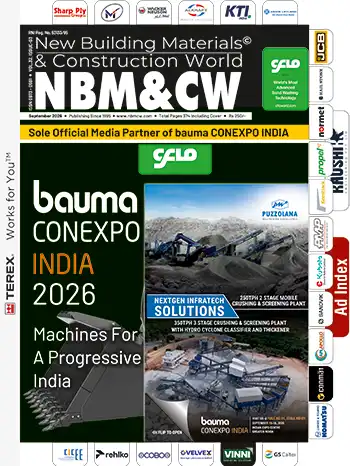

With bauma CONEXPO INDIA 2026 now just weeks away, how has the industry’s response evolved since registrations opened? What level of participation do you expect, and what will distinguish this edition?
The response has been strong because the market has a clear need for a serious industry platform at this point. India is already the third-largest construction equipment market in the world and is targeting the second position by 2030. This creates confidence.But the more important shift is in the quality of participation. Exhibitors are not coming only to display machines. They are coming to address a buyer who has become more technical, more cost-conscious, and more outcome-driven.
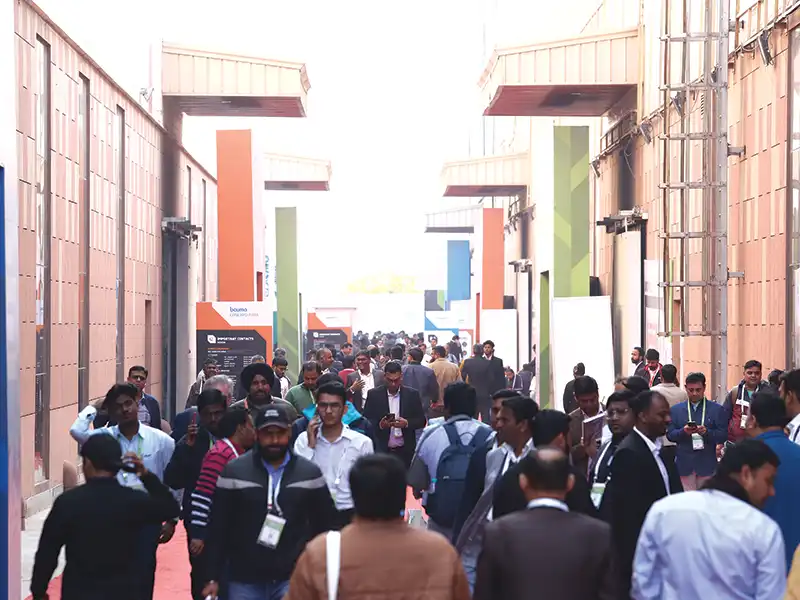
The scale of the 2026 edition reflects this confidence. Over 1,100 exhibitors and 75,000+ visitors from over 100 countries are expected to participate across 1.45 million sq. ft. of exhibition space. International pavilions from Germany, Italy, China, Taiwan and more will bring global technologies and market perspectives into direct conversation with Indian demand.
The exhibition is also strengthened by the support of key industry partners, including the Indian Construction Equipment Manufacturers’ Association (ICEMA), the Builders’ Association of India (BAI), and other leading industry bodies. This combination of scale, global participation and industry alignment gives the 2026 edition a sharper purpose. It is not merely a marketplace for machines; it is a platform for better decisions, stronger partnerships, and more outcome-led business conversations.
The market has seen strong infrastructure investment but also demand fluctuations: how is this influencing exhibitors’ strategies?
The market is not weak; rather it is more disciplined. Domestic sales saw some pressure in FY26 because of slower execution and delayed project awards, but exports grew sharply. This tells us that the Indian industry has two realities operating at the same time: domestic buyers are careful, while global demand for Indian-made equipment is rising.Exhibitors are preparing for conversations around operating cost, financing, asset utilisation, fuel efficiency, and service depth. They know buyers are under margin pressure. They also know that CEV Stage V norms are pushing up baseline equipment costs, which means every purchase must justify itself more clearly.
So, the exhibitor strategy is changing. It is no longer enough to say a machine is powerful. The question is: does it reduce cost per hour, improve uptime, meet emission requirements, and protect the buyer’s balance sheet?
Which equipment segments and innovations will be the key highlights at bauma CONEXPO INDIA 2026?
The strongest interest will come from segments that reflect where India’s infrastructure demand is moving. Highways will remain important, but the market is diversifying. Urban infrastructure will drive demand for compact equipment such as mini excavators, skid-steer loaders, and compact backhoes. These machines are essential for utility trenching, basement excavation, redevelopment projects, and work in congested cities.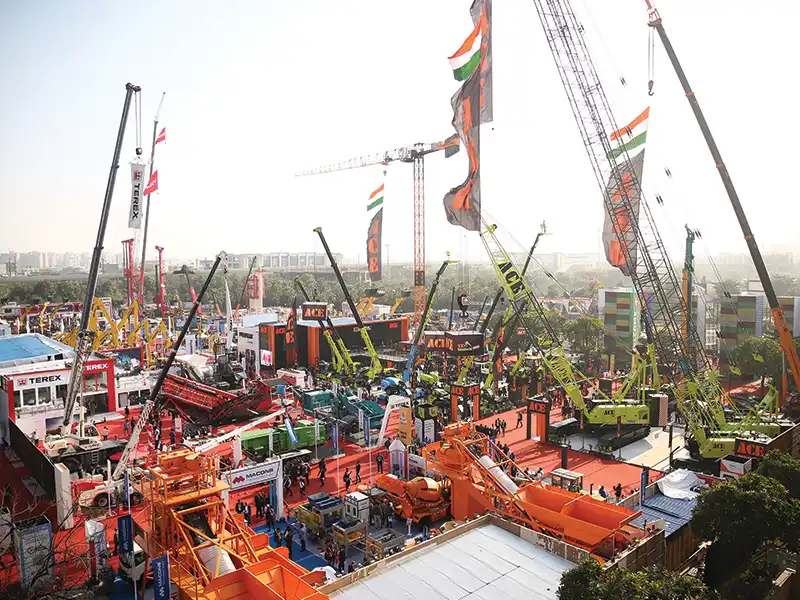
Mining will be another major focus. India’s mining sector is moving beyond basic mechanisation. The next stage will involve autonomous drilling, AI-based fault detection, collision avoidance, digital twins, real-time monitoring and integrated planning.
The direction is clear; the industry is moving from machines that simply move material to machines that generate measurable operating intelligence.
How will the exhibition showcase India’s manufacturing capabilities, localisation and export potential?
India’s construction equipment industry is becoming more globally relevant. The Ministry of Heavy Industries has stated that exports rose 31.5% year-on-year, making it clear that Indian-made equipment is gaining wider acceptance in international markets.Exports to Africa, Southeast Asia, the Middle East, Latin America and parts of Europe are strengthening India’s position in the global construction equipment supply chain. At the same time, Indian OEMs are working to reduce dependence on imported hydraulics, mechatronics, electronics and advanced components.
The international profile of bauma CONEXPO INDIA 2026 is important in this context. With participation expected from 100+ countries and country pavilions from Germany, Italy, China, Taiwan and more, the exhibition will bring global equipment manufacturers, technology suppliers, component providers and solution companies closer to India’s manufacturing and infrastructure priorities.
This matters because India’s construction equipment sector is no longer looking only at imports. It is looking at technology partnerships, component localisation, export readiness, manufacturing depth and long-term competitiveness. Localisation will be one of the defining industry of the next decade.
Infrastructure projects now demand faster execution, lower lifecycle costs and greater sustainability. What are the biggest shifts in industry priorities?
The biggest shift is financial discipline. Contractors are no longer buying equipment only because projects are available. They are calculating utilisation, payback, fuel consumption, maintenance cost, financing burden and resale value. Institutional infrastructure funding is also changing the market. When capital becomes more structured, equipment decisions become more professional.Sustainability is also becoming practical. Buyers want machines that consume less fuel, comply with emission norms, reduce wastage and operate efficiently over a longer lifecycle.
The third shift is flexibility. Smaller contractors do not always want to own expensive machines. They want access. This is why rental, pay-per-use models, asset financing and used-equipment marketplaces are becoming more relevant.
The industry’s next growth phase will depend not only on selling more machines, but also on creating smarter ownership and usage models.
How is bauma CONEXPO INDIA 2026 evolving to showcase advanced technologies, digitalisation and dedicated technology platforms?
Technology can no longer sit on the side of the construction equipment industry. It has moved to the centre. Visitors want to explore fleet management systems, telematics, IoT sensors, predictive maintenance, real-time fuel monitoring, automated payload data, remote diagnostics and machine-learning tools that improve utilisation.Mining visitors will look for digital twins, AI-based safety systems, autonomous operations and integrated control platforms. Contractors will look for technologies that help them manage mixed fleets, reduce idle time, track productivity, and prevent breakdowns.
bauma CONEXPO INDIA 2026 reflects this shift by giving digital and smart equipment solutions the same seriousness as physical machinery. The equipment industry is now a data industry too. The companies that understand this will lead the next phase.
As the industry embraces advanced equipment and digital technologies, how is the exhibition contributing to workforce development?
India cannot operate advanced machines with outdated training models. As equipment becomes more connected, operators need digital awareness. Technicians need diagnostic capability. Engineers need to understand data. Site managers need to interpret machine performance, not just deploy machines. This is especially important in mining, tunnelling, compact urban construction and high-spec industrial projects. A poorly trained operator can reduce the value of even the best machine.bauma CONEXPO INDIA will introduce operators, engineers, technicians and young professionals to new equipment, new operating systems and new expectations. A dedicated VR Zone will showcase immersive training simulators for heavy machinery.
While the industry needs more trained people, it also needs people who can think across machine, data, safety and productivity. This is the workforce challenge ahead.
What initiatives will help create meaningful interactions between exhibitors, serious buyers and decision-makers?
The industry wants to engage in relevant conversations. A contractor working on urban utilities does not evaluate equipment in the same way as a highway operator. A rental company looks at utilisation, financing and fleet flexibility differently from an EPC player. A road contractor, an aggregates operator, a government contractor and an OEM looking for component partners all come with different business questions.As the national platform for India’s construction equipment, infrastructure and mining ecosystem, bauma CONEXPO INDIA is structured to bring these conversations into sharper alignment. Its location gives it proximity to one of the country’s most active infrastructure corridors, but the industry it serves is pan-Indian.
We are seeing this in the quality of visitor interest. Leading industry associations from Tamil Nadu, Karnataka and Kerala — among India’s most active construction, contracting and equipment ownership markets — are expected to participate in huge numbers. There is growing engagement from Jammu & Kashmir, Himachal Pradesh, Madhya Pradesh, Chhattisgarh, Odisha and Rajasthan, among others.
The 2026 edition will also include focused industry pavilions that bring specialist categories into sharper view. These include the Aerial Platform Association of India (APAOI) Pavilion for aerial platform systems and solutions, the Fluid Power Society of India (FPSI) Pavilion for fluid power technologies and systems, and the DEMTECH Pavilion, organised in association with the Indian Demolition Association (IDA), for demolition technology, recycling and remediation solutions.
For exhibitors, this is the real value. The tradeshow will bring them closer to buyers with project exposure, fleet requirements, equipment ownership, rental interests and decision-making authority across India. The 2026 edition will therefore be defined not only by scale, but also by the quality and national spread of its industry participation.
How can stronger government and public-sector participation help accelerate technology adoption and project execution?
Government participation matters because policy and procurement shape equipment demand. Emission norms, safety standards, mining regulations, urban infrastructure policies, localisation incentives and public project specifications all influence the kind of equipment the industry builds and buys.When government departments, infrastructure agencies and public sector organisations engage directly with industry, the market becomes more aligned. Manufacturers understand future requirements. Buyers understand available technologies. Policymakers see what is practical, scalable and ready for adoption.
India’s infrastructure targets are too large for fragmented thinking. Public agencies and private industry need to move closer, especially in areas such as emission compliance, safety, recycling, mining technology, tunnelling, compact urban equipment, and component localisation.
This is also where industry associations play an important role. The involvement of partners such as ICEMA, BAI and other industry bodies help create a more structured dialogue between manufacturers, contractors, policymakers, public agencies and technology providers. For a sector entering a more demanding phase, this alignment is critical.
The Indian construction equipment industry is entering a more serious phase. Growth will not come only from selling more machines. It will come from building machines, technologies, services and partnerships that make infrastructure execution faster, cleaner, safer and more competitive.
How can bauma CONEXPO INDIA also address wider challenges such as financing, sustainability, and execution bottlenecks?
The industry’s challenges are connected: Financing affects equipment ownership. Equipment ownership affects mechanisation. Mechanisation affects project timelines. Project delays affect utilisation. Low utilisation affects profitability. Sustainability norms affect machine cost. Imported components affect competitiveness. No single company can solve this chain alone.bauma CONEXPO INDIA can become the place where these issues are discussed with commercial seriousness. Rental companies, financiers, OEMs, contractors, component suppliers, mining companies and public agencies must all be part of the conversation.
For example, if equipment costs rise because of emission norms, the answer may not be only cheaper machines. It may be better financing, higher utilisation, rental access, used-equipment markets, fuel-efficient technology and stronger lifecycle planning. This is the kind of discussion the industry now needs.
Looking beyond 2026, what will drive the next phase of growth for India’s construction equipment industry?
The next phase will be driven by six forces:First, domestic infrastructure will continue to generate demand, but it will be more diversified across highways, urban infrastructure, mining, tunnelling, logistics, ports, energy, data centres, semiconductor and specialised projects.
Second, exports will become a bigger growth lever. India’s export momentum shows that the world is beginning to take Indian equipment more seriously.
Third, rental and pay-per-use models will expand because many contractors want access to machines without heavy balance-sheet exposure.
Fourth, localisation will become critical. India cannot become a global hub while depending heavily on imported high-value components.
Fifth, mining technology will move from fragmented digital tools to integrated Mining 5.0 systems, where planning, production, maintenance, logistics, safety and sustainability work as one decision ecosystem.
Sixth, clean and efficient equipment will gain ground as emission norms and operating cost pressures reshape buyer choices.
bauma CONEXPO INDIA 2026 will reflect these forces. Its role is to help the industry see where demand is going, where technology is moving, and where business models are changing.