
Review on Corrosion Inhibitors in Concrete

M.N.Bajad, Research Scholar, Dr. C.D.Modhera, Professor and
Dr.A.K.Desai, Professor, Department of Applied Mechanics, S.V.N.I.T, Surat, (Gujarat)
Corrosion Inhibitors
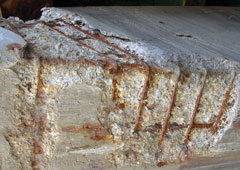
Corrosion of reinforcing steel represents the most widespread form of deterioration of concrete structures resulting in significant costs for repair and replacement worldwide. Despite the huge demand, a simple, cheap and reliable technique that either protects the steel in concrete from corrosion or at least lowers its corrosion rate is still lacking. The concrete repair industry has developed novel techniques that are claimed to prevent the steel from corrosion and/or to restore the protective character of the cover concrete by introducing corrosion inhibitors into the carbonated or chloride contaminated concrete. Inhibitors, chemical substances that prevent or retard corrosion, are applied as concrete admixtures or as surface applied liquids both for preventive or for restorative applications. A short review on literature results regarding the performance of the most frequently used inhibitors for steel in concrete in laboratory and in field tests is given, in particular two inorganic inhibitors, calcium nitrite (DCI) and MFP, and several organic inhibitors, the migrating inhibitors (MCI or SIKA) and an organic corrosion-inhibiting admixture (OCI) are addressed. The problem of transport of inhibitors into concrete is discussed. A critical review of corrosion inhibitors to be used on reinforced concrete structures regarding concentration dependence, durability and measurement and control of the inhibitor action is presented in this paper.

Want to connect with the manufacturer or get more details?

Get in Touch
📅 Published on: 17 April 2013
📖 Published in: NBM&CW April 2013
🔗 Share:
We Value Your Comment

How useful is this information?
In reply to Some User

NBM Media

30+ years of reporting on infrastructure, construction, architecture, & real estate across print, digital, and social media.