In this article, Dr. Naba Kumar Haldar, Group Head – QA & EHS, Bharti Real Estate, examines the role of Artificial Intelligence (AI) in concrete mix design and its impact on the construction industry. The discussion highlights the limitations of conventional mix design methods and explores how AI can optimize mix proportions, predict concrete properties, enhance quality control, and improve strength and durability. Leveraging machine learning and deep learning techniques, AI enables efficient analysis of large datasets and supports more reliable mix formulations. The article provides a comprehensive overview of the current state of AI in this domain, detailing its advantages, challenges, and potential to drive further research and innovation in concrete technology.

Conventional Concrete Mix Design Methods

Figure 1: Flow chart for ACI mix design method
One common traditional technique is prescriptive mix design, which provides a set of predetermined proportions based on standard practice. These ratios are typically decided by the needed concrete strength as well as the specific materials available. Another common technique is the trial-and-error method, which involves altering mix proportions across multiple trial batches until the needed attributes, such as workability and strength, are achieved. This technique is heavily reliant on the concrete producer's expertise and experience. The flow chart for the ACI mix design approach is shown in Figure 1.
Limitation of Conventional Concrete Mix Design Methods
Several limitations connected with traditional techniques of developing concrete mixes can have an impact on the efficacy and efficiency of the mix design process. These limitations stem from the use of subjective judgment and empirical methods. One of the most significant disadvantages is the lack of optimisation. Conventional methods usually use empirical or fixed proportions that fail to account for the project's specific demands or objectives. This may result in a less-than-ideal combination that may not fully meet the planned performance standards or make efficient use of the available resources. Traditional approaches rely heavily on subjective evaluation and prior experience, which can vary between individuals or geographic locations.Another disadvantage is that material variability is not sufficiently assessed. Traditional approaches frequently fail to account for the intrinsic variety of raw materials, such as cement and aggregate. This may result in mixtures that are not optimised for the particular qualities of the materials being used, resulting in variable concrete performance.

Figure 2: The block diagram of the practical application of machine learning in the concrete mix design
AI Application in Concrete Mix Design
Ideal Concrete Mix Proportioning: In civil engineering, artificial intelligence (AI) technologies have been utilised to determine the optimal way to apportion concrete mixtures. To achieve the desired concrete properties, the appropriate proportioning of constituents such as cement, aggregates, water, and additives must be calculated. AI systems can analyse massive databases that include information on performance standards, ideal attributes, and concrete materials. These algorithms can detect patterns and relationships in data in order to provide predictive models for concrete mix proportioning.Engineers can use artificial intelligence to input the desired tangible performance parameters, such as strength, durability, workability, and cost limits. Following that, the AI model may analyse the data and provide optimal concrete mix designs that meet these specifications. Artificial intelligence (AI) methods like as fuzzy logic, neural networks, and evolutionary algorithms can be used to improve concrete mix proportions while keeping a range of constraints and goals in mind. Figure 2 depicts a block schematic of the concrete mix design process as a practical application of machine learning.
The algorithms consider a variety of criteria while determining the best proportional combination, including material qualities, the surrounding environment, building specifications, and cost considerations. Engineers can use AI to obtain the optimal proportioning of concrete mixes, increasing productivity, sustainability, and cost-effectiveness. AI models can handle the ambiguity and complexity of building concrete mixtures, resulting in concrete that performs better and requires less trial-and-error testing. Finally, artificial intelligence (AI) allows for the creation of optimised concrete mixes that consider a range of elements and meet specific project requirements.
Forecasting the Properties of Concrete: AI approaches have proven useful in predicting concrete qualities, allowing engineers to precisely forecast concrete's numerous features and performance measures. AI can generate prediction models by analysing vast quantities of historical concrete data, such as material compositions, curing conditions, and testing results, using machine learning algorithms. These AI models can forecast concrete qualities like compressive strength, workability, durability, setting time, shrinkage, and modulus of elasticity. Figure 3 depicts the input-output relationship for forecasting concrete compressive strength as well as the Artificial Neural Network (ANN) model's structure. AI models can create accurate forecasts by considering elements such as mix proportions, cement kinds, aggregate qualities, water-cement ratios, and curing conditions.
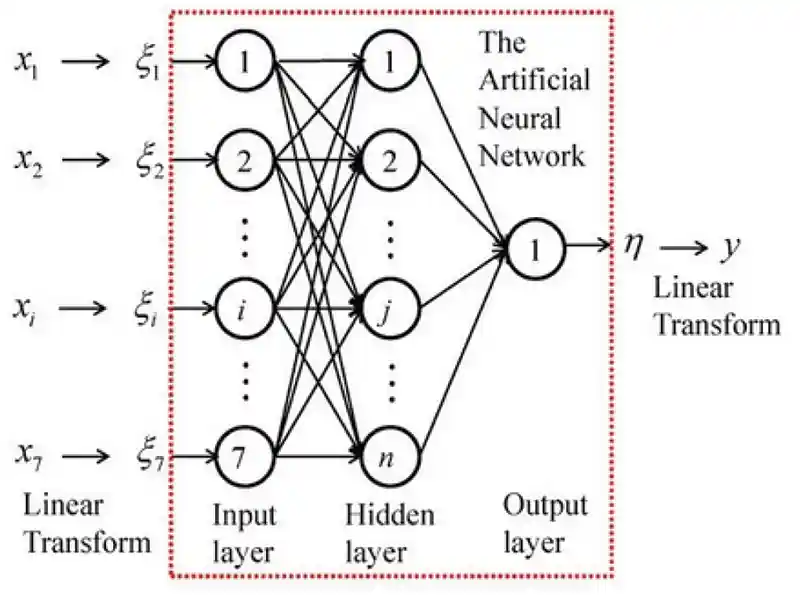
Figure 3: The input-output relation for predicting the compressive strength of concrete and the structure of the ANN model
Prediction of Concrete Strength and Optimisation: The use of artificial intelligence in concrete strength prediction and optimisation has emerged as a vital tool for construction engineers and academics. AI allows for accurate estimate and optimisation of concrete strength through the use of machine learning algorithms, resulting in improved performance and cost-effective design.
Assessing and Improving Durability: The application of artificial intelligence in concrete durability assessment and augmentation has grown in importance in the field of civil engineering. AI approaches provide useful insights and tools for assessing the long-term durability of concrete structures and developing ways to improve their performance.
Benefits and Impact on Concrete Industry
Advantages and Benefits of AI in Concrete Industry: The incorporation of AI into concrete mix design provides several advantages and benefits. To begin, artificial intelligence improves accuracy by utilising massive volumes of data to forecast and optimise concrete mix designs. This allows for more control over desirable attributes including strength, workability, and durability. Second, using AI in concrete mix design saves time and money. AI speeds up the design process and lowers material waste by delivering optimum mix designs upfront. AI also enables the simultaneous optimisation of many objectives. Engineers may optimise for things like strength, affordability, and environmental impact, resulting in well-balanced and sustainable mix designs. AI can also handle complex data.The Impact of AI on the Concrete Industry: Artificial intelligence (AI) has had a revolutionary effect on the concrete industry, revolutionising many facets of concrete production, design, quality control, and maintenance. By automating procedures like production scheduling, quality control inspections, and mix design optimisation, AI algorithms have greatly increased productivity. As a result, projects are being completed more quickly, expenses are down, and productivity is up.
Challenges and Limitations
Data Availability and Quality: A number of obstacles and restrictions must be addressed in order to guarantee accurate and trustworthy results while designing concrete mixes, including data availability and quality. The robustness and representativeness of mix designs may be limited by limited data availability, particularly for specialised applications or particular geographical areas.AI Model Interpretability and Explainability: To guarantee openness and trust in their use, issues with the interpretability and explainability of AI models in concrete mix design must be resolved. It is challenging to analyse and comprehend the decision-making process because of the complexity of model structures, especially in deep learning algorithms. Standardising evaluation measures and setting guidelines for openness and interpretability will help to improve understanding and acceptance of AI models in the concrete mix design.
Integrating AI with Existing Design Practices: It is important to carefully analyse the problems and constraints associated with integrating AI with current design techniques in the design of concrete mixes. Change resistance is a major concern since organisations may have deeply rooted established processes. Effective communication and highlighting the advantages of AI, such as increased accuracy, efficiency, and cost savings, are essential to overcoming this opposition.
Conclusions
Summary of Key Findings: Several major discoveries emerged from debates about AI in concrete mix design and quality monitoring. AI provides considerable benefits to the field, including increased accuracy, efficiency, and cost savings. It provides optimum mix designs, concrete property prediction, and improved durability assessment. Various AI models, including supervised and unsupervised learning algorithms, reinforcement learning, and deep learning techniques, have been effectively utilised in concrete applications.But there are obstacles in the way of incorporating AI with current methods. Some of the main obstacles are process compatibility, data availability and quality, interpretability, and resistance to change. Effective data transformation, validation processes, explainable AI strategies, training, and communication are all necessary to overcome these obstacles. Through the analysis of sensor data, defect detection, and process improvement, artificial intelligence (AI) plays a critical role in quality control and assurance. In addition, it helps with durability evaluation and improvement as well as property prediction for concrete. AI enhances productivity, accuracy, sustainability, and resource utilisation in concrete mix design and quality monitoring.
Recommendation For Future Research
- Explainable AI: Improve the interpretability of AI models in the creation of concrete mixes to facilitate open decision-making.
- Data Standardisation and Exchange: To facilitate cooperation and data exchange, provide uniform formats for concrete mix design data.
- Real-time Feedback and Monitoring: Combine AI models with real-time monitoring systems to continuously optimise mix designs while building.
- Uncertainty Analysis: Use techniques from uncertainty analysis to evaluate the accuracy of AI predictions.
- Integration of Life Cycle Assessment: To assess the environmental impact of concrete mix designs, combine artificial intelligence (AI) with life cycle assessment approaches.
- Field Validation and Case Studies: To determine if AI models can be applied practically in actual construction projects, carry out comprehensive validation studies.
- Collaboration and Knowledge sharing: To promote interdisciplinary research and knowledge sharing, promote cooperation between academic institutions, business, and research organisations.