Vijay Kumbhani, Executive Director, Pavers and Blocks Manufacturers Association
India’s accelerated infrastructure expansion across highways, logistics parks, industrial corridors, ports, metro systems, and smart urban developments, has created a structural opportunity for engineered pavement solutions that combine durability, speed of execution, and lifecycle efficiency. In this evolving landscape, the concrete block paving (CBP) industry is undergoing a significant transformation. What was once perceived largely as an aesthetic or low-traffic surface solution has matured into a structurally engineered pavement system capable of supporting heavy axle loads, container-handling equipment, industrial traffic, and high-frequency urban mobility demands.The fundamental engineering strength of concrete block pavements lies in their interlocking mechanism, which enables effective load transfer through a composite action between blocks, jointing sand, and base layers. Unlike monolithic rigid pavements that depend solely on slab strength, block pavements distribute loads laterally, offering structural stability with flexibility. This characteristic makes them particularly suitable for infrastructure environments where operational continuity, phased maintenance, and utility reinstatement without extensive demolition are critical. In high-traffic industrial and logistics applications, this modular resilience directly contributes to reduced downtime and lower long-term maintenance costs.
Manufacturing Excellence, Standardisation, and Mechanised Execution

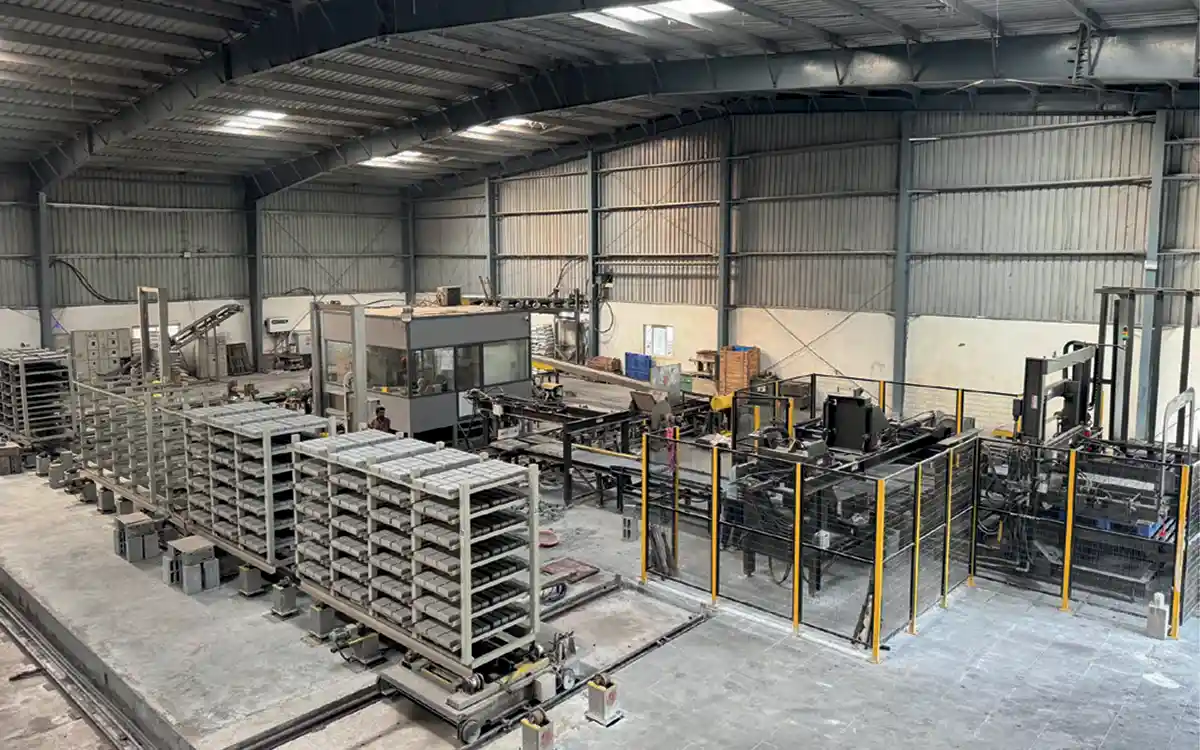
Advanced automated batching systems, high-efficiency vibro-compaction technology, optimised curing cycles, and stringent laboratory-based quality control protocols are therefore essential to ensuring consistent and reliable output. Alignment with recognised engineering standards strengthens market confidence and ensures that concrete block paving is evaluated as a structural pavement system rather than merely a surface finish option. As infrastructure assets are now designed for longer service lives with lower intervention frequency, disciplined adherence to performance benchmarks becomes central to industry credibility.
Parallel to manufacturing advancement, mechanisation represents a decisive shift in the evolution of the block paving sector. Installation practices, traditionally labour-intensive, are increasingly supported by advanced mechanical laying systems capable of delivering significantly higher daily output with uniform alignment and joint consistency. In large-scale infrastructure works where thousands of square metres may be laid within compressed timelines, mechanised block installation enhances productivity, reduces dependency on skilled labour shortages, and improves installation precision.
In industrial corridors, container yards, and high-traffic transport facilities, productivity and execution speed directly influence commercial viability. Mechanised systems minimise human error, optimise material utilisation, and ensure consistent compaction quality. The integration of manufacturing precision with mechanised execution marks a critical transition toward industrial-scale capability and performance-driven growth.
The concrete block paving industry, once perceived as a low-traffic surface solution, has matured into a structurally engineered pavement system capable of supporting heavy axle loads, container-handling equipment, industrial traffic, and high-frequency urban mobility demands.

Sustainability, Lifecycle Performance, and Expanding Infrastructure Applications
Concrete block paving systems inherently align with emerging sustainability and ESG frameworks that increasingly guide infrastructure investments. Their modular configuration allows reuse and recyclability, supporting circular economy principles and reducing end-of-life material waste. In addition, permeable block paving systems contribute to stormwater management, groundwater recharge, and surface runoff control—an increasingly important consideration in climate-sensitive urban planning.The capacity to incorporate recycled aggregates and selected industrial by-products into manufacturing enhances resource efficiency and reduces embodied environmental impact. When evaluated over extended service cycles, block pavements often demonstrate favourable lifecycle economics compared to pavements requiring frequent resurfacing or rehabilitation. Reduced maintenance disruption, ease of reinstatement, and adaptability to phased development further strengthen their long-term value proposition.
This sustainability advantage is reinforced by the expanding application spectrum of concrete block paving across infrastructure development. Beyond conventional urban roads and pedestrian pathways, CBP systems are now extensively deployed in container terminals, industrial flooring, logistics parks, metro corridors, waterfront developments, airport service areas, and heavy-duty pavements requiring high structural integrity. Specialised heavy-duty pavers, engineered surface textures, and tailored design configurations allow solutions to be customised for diverse load classes and operational environments. This adaptability positions the industry as a strategic contributor to resilient, future-ready infrastructure.
Industry Challenges and the Imperative for Technical Alignment
Despite technological progress and growing market acceptance, the concrete block paving industry continues to face structural challenges that must be addressed to fully realise its potential. Variability in product quality among smaller and unorganised manufacturing units remains a significant concern, particularly where adherence to dimensional accuracy, strength parameters, and durability benchmarks is inconsistent. In high-load applications, such inconsistencies can compromise interlocking efficiency, and long-term pavement behaviour.Equally critical is the limited awareness of scientifically engineered block pavement systems among certain stakeholders. Inadequate understanding of structural design principles, sub-base preparation requirements, load calculations, and installation best practices often results in underperforming pavements, where execution deficiencies are mistakenly attributed to the product itself. Skill gaps in installation practices and limited adoption of mechanised systems further compound these issues.
Procurement practices driven predominantly by lowest initial cost, rather than lifecycle performance evaluation, hinder quality progression. Infrastructure assets designed for 15–30 year performance cycles require performance-based specifications and lifecycle costing approaches. A transition toward technical evaluation frameworks that prioritise durability, maintenance intervals, and structural reliability is essential for sustainable industry growth.
Addressing these systemic challenges demands structured technical engagement, stronger enforcement of standards, formalised training and certification programmes, research-backed advocacy, and collaborative alignment across manufacturers, consultants, contractors, urban planners, and policymakers. The movement from fragmented expansion to organised, performance-led growth will depend on collective accountability and disciplined standardisation.
Hyderabad to host 13th Edition of the International Conference on Concrete Block Pavement (ICCBP) from 9-10 April 2026
The ICCBP represents a defining milestone for the Indian block paving industry. Hosting a globally recognised and a dedicated technical forum platform of this scale at this pivotal stage of the industry’s evolution, assumes strategic importance; it underscores India’s growing relevance in the international pavement engineering community and reflects the maturity of its manufacturing ecosystem.The conference provides a structured platform for dialogue on evolving design standards, mechanisation trends, sustainability integration, material innovation, and research-driven performance evaluation. It enables benchmarking of Indian manufacturing practices against global standards and facilitates exchange of case studies across diverse climatic, loading, and operational conditions.
More importantly, the conference combines global expertise with Indian execution realities. It allows stakeholders to examine advancements in permeable paving systems, heavy-duty applications, automated laying technologies, and quality assurance frameworks within the context of India’s rapidly expanding infrastructure landscape.
Over the years, ICCBP has established itself as a key international forum where scientific progress and practical implementation come together to advance sustainable pavement solutions worldwide. ICCBP 2026 edition will be the first in India, supported by PBMA (Paver & Block Manufacturers Association) that has 45 members across the country.
The conference agenda reflects the rapid technological and regulatory evolution of the sector, covering topics such as high-performance paving systems, environmentally responsible materials, climate-resilient design concepts, international guidelines, long-term performance, sustainability, and innovative pavement applications.
By bringing together the entire value chain –– manufacturers, researchers, consultants, contractors, equipment providers, and policymakers to exchange knowledge on the latest developments in concrete and segmental paving technologies, strengthening the industry’s ability to accelerate innovation, reinforce quality discipline, and promote structured standardisation. Speakers from across the globe will contribute to the international character and dynamic spirit of the event, supported by a comprehensive range of research papers and technical presentations.
As infrastructure expectations rise in scale, speed, climate resilience, and lifecycle efficiency, such globally recognised forums ensure that the Indian concrete block paving sector remains technically robust, future-ready, and globally competitive.