
Dada S. Patil, Associate Professor at AIKTC, SoET, Panvel, Navi Mumbai, draws attention to a commonly overlooked but critical issue in concrete construction: the unchecked assumption that all water is suitable for mixing and curing - a practice that can lead to serious structural failures as presuming the quality of mixing and curing water in RCC construction, without scientific validation, can quietly sabotage structural integrity.
Introduction
Over the years, many building failure cases have been witnessed across the world, which resulted in the loss of lives and property. Investigations carried out on the causes of failures indicated improper design, inadequate supervision and inferior materials as the factors responsible for the failures. However, analysis of mixing and curing water is usually not carried out; water quality is always taken for granted. Water is a vital constituent of concrete. A properly designed concrete mix, typically having 15 to 25% water by volume, exhibits good workability for fresh concrete and required durability and strength for the hardened concrete [1]. It serves as a reactant to the cement hydration reaction. It must be ensured that the water used to mix and cure the concrete does not possess characteristics that can hamper the concrete performance.Concrete industry consumes a huge amount of freshwater. Approximately, 1 billion cubic meters of water is utilized annually to produce the concrete [2]. Water is also consumed for cleaning the aggregates before concrete casting. A significant amount of water is used to clean the equipment used for mixing, transporting, and placing the concrete. Finally, water is used for curing the hardened concrete. Based on standards, water with a very small percentage of impurities, such as that useful for drinking, is acceptable for mixing. However, in the developing countries where availability of potable water is difficult, the contractors, with limited resources to carry out water treatment, try to use any available water source for the concrete production. This practice may be harmful to the concrete performance because mixing water can affect hydration mechanism, porosity, mineralogical and strength properties in concrete [2]. Clear distinction has to be made between the influence of mixing water and the attack on hardened concrete by aggressive waters owing to the fact that some of the latter type may be harmless or even advantageous when used in mixing [3].
Mixing Water
Water can exist in a solid form as ice, a liquid form as water, or a gaseous form as vapour. Mixing water is the free water found in freshly mixed concrete. It has three major roles: it undergoes reaction with the cement particles, forming hydration products; it acts as a lubricant, improving the workability of plastic state concrete; and it reserves the required space in the paste for accommodating the hydration products. The quantity of water used for better workability is always greater than that required for the complete hydration of the cement. Unlike other raw materials, the raw water supply varies considerably in quality, both from one geographical location to another and from season to season. Water originating from an upland surface source has a low content of dissolved solids and it is soft, with a greater concentration of organic contamination, most of which is colloidal. On the contrary, underground water contains lots of dissolved solids and a high hardness level but a low organic matter. Seasonal fluctuations in water quality are witnessed in surface waters [1].During the autumn and winter season, dead leaves and decaying plants tend to release huge amounts of organic content into streams, lakes, and reservoirs. Therefore, the degree of organic contamination in surface waters attains a peak in spring and falls to a minimum in summer. Too many impurities in mixing water affect setting time and concrete strength; they also cause efflorescence, staining, reinforcement corrosion, volume instability and decreased durability. Usually it is said that if water is potable, it is also suitable for concrete making. In other words, if water does not have any particular taste, odor, or color and does not fizz or foam when shaken, then it is assumed to be fit for concrete work. The requirement of portability of water is not absolute; drinking water may not be suitable as mixing water when it has a greater concentration of sodium and potassium and there is a probability of alkali-aggregate reaction [3]. In most cases, it is not possible to use drinking water for mixing concrete because of the high demand for freshwater for human consumption, combined with a scarce supply of freshwater in some communities [2]. Hence, other available water sources are utilized to produce concrete. Some water unsuitable for drinking is still useful for producing the concrete.
Impurities in mixing water may influence the resulting hydration reaction, which may result in deterioration of concrete [2]. Regulations for the suitability of waters for mixing concrete are in place; however, water not fit for drinking and also containing impurities like sea and wastewaters are used for producing concrete [2]. Impurities in wastewater sources can hamper the concrete properties. The assessment of water suitability for concrete is based on the regulations prevailing in some parts of the world, which provide limitations on the number of impurities allowed for water to be used in concrete. Some of the parameters used to determine the suitability of mixing water are total suspended solids (TSS), biological oxygen demand (BOD), chlorine and sulphate residue, total dissolved solids (TDS), total organic, and chemical oxygen demand (COD) [2].
Impurities in water
Water should not be used if it contains huge amounts of suspended solids, dissolved solids or organic materials. The main categories of impurities in raw water consist of suspended solids, dissolved solids and dissolved organic material. Suspended solids in water comprise of silt, clay, pipe work debris, organic matter and colloids. Up to about 2000 ppm of suspended clay or silt can be tolerated [1]. Greater amount may increase water demand, drying shrinkage or lead to efflorescence. Muddy water must be allowed to clear in settling basins before use. Colloidal particles, either organic or inorganic, are not truly in solution or suspension and give rise to haze or turbidity in the water [1].Carbonates and bicarbonates influence the setting time of cement. Sodium carbonate leads to quick setting [4]. If bicarbonate > 1000 ppm, tests for setting time and strength should be done. Brackish water contains Cl- and SO4-. Chloride should be 10,000 ppm and sulphate 3000 ppm. Turbidity mus be 2000 ppm. This is because f silt and other suspended material which interfere not only with setting, but also with hardening and bond properties [4]. Algae entrap a huge quantity of water hich results in strength reduction [4]. The source of water should be reliable.
A dark color or a smell of water does not necessarily mean that the harmful content is present [3]. Natural water, slightly acidic, is harmless. However, water having humic or other organic acids may hamper the concrete hardening. Such water and highly alkaline water must be tested [3].
Sea Water
Sometimes, sea water has to be used for mixing the concrete. It has a total salinity of about 3.5% (78% of dissolved solids being NaCl and 15% MgCl2 and MgSO4). Such water results in slightly higher early age strength but a lower long-term strength [3]. Sea water (or any water with huge amounts of chlorides) causes dampness and efflorescence. Sea water increases the risk of reinforcement corrosion, especially in tropical regions. Corrosion is encountered in structures exposed to humid air when the cover to steel is insufficient or the concrete is not dense, so that the corrosive effect of residual salts in the presence of moisture occurs. On the contrary, when RCC structure is permanently under water, either marine or fresh, use of sea water for mixing poses no detrimental effects on concrete [3]. Surface moisture of the aggregates is also to be given due importance.Water for Curing and Washing
The criteria for curing water are less rigid because it is in contact with the concrete for relatively small time. Such water may contain more inorganic and organic materials, sulfuric anhydride, acids, chlorides and so on, than acceptable mixing water, especially when slight discoloration of the concrete surface is acceptable [1]. Iron or organic matter may lead to staining, especially if water flows gradually over the surface and evaporates quickly. Concrete may be attacked by water having free CO2. Flowing pure water, formed by melting ice or by condensation, and having little CO2, dissolves CaOH2 and leads to surface erosion.It’s better to send water samples to a laboratory for testing and recommendations. Water for washing aggregates must not contain materials in quantities large enough to create harmful films or coatings on the aggregate surface. The same requirement holds when the water is utilized for cleaning concrete mixers and other concreting equipment [1].
IS 456:2000 Recommendations
Clause 5.4
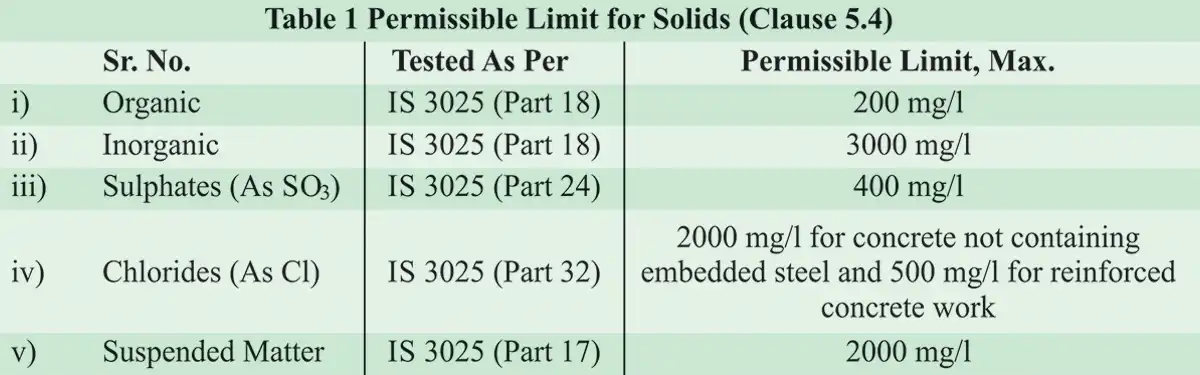
Water used for mixing and curing shall be clean and free from injurious amounts of oils, acids, alkalis, salts, sugar, organic materials or other substances that may be deleterious to concrete or steel [5]. Potable water is generally considered satisfactory for mixing concrete. As a guide, the following concentrations represent the maximum permissible values:- To neutralize 100 ml sample of water, using phenolphthalein as an indicator, it should not require more than 5 ml of 0.02 normal NaOH. The details of test are given in 8.1 of IS 3025 (Part 22).
- To neutralize 100 ml sample of water, using mixed indicator, it should not require more than 25 ml of 0.02 normal H2SO4. The details of test shall be as given in 8 of IS 3025 (Part 23).
- Permissible limits shall be as given in Table 1.
5.4.1.1: The sample of water taken for testing shall represent the water proposed to be used for concreting, due account being paid to seasonal variation. The sample shall not receive any treatment before testing other than that envisaged in the regular supply of water proposed for use in concrete. The sample shall be stored in a clean container previously rinsed out with similar water.
5.4.1.2: Average 28 days compressive strength of at least three 150 mm concrete cubes prepared with water proposed to be used shall not be less than 90% of the average of strength of three similar concrete cubes prepared with distilled water. The cubes shall be prepared, cured and tested in accordance with the requirements of IS 516.
5.4.1.3: The initial setting time of test block made with appropriate cement and water proposed to be used shall not be less than 30 minutes and shall not differ by ± 30 minutes from the initial setting time of control test block prepared with the same cement and distilled water. The test blocks shall be prepared and tested in accordance with the requirements of IS 4031 (Part 5).
5.4.2: The pH value of water shall be not less than 6.
5.4.3: Sea Water
Mixing or curing of concrete with sea water is not recommended because of presence of harmful salts in sea water. Under unavoidable circumstances, sea water may be used for mixing or curing in plain concrete with no embedded steel after having given due consideration to possible disadvantages and precautions including use of appropriate cement system.5.4.4: Water found satisfactory for mixing is also suitable for curing concrete. However, water used for curing should not produce any objectionable stain or unsightly deposit on the concrete surface. The presence of tannic acid or iron compounds is objectionable.
Cases of severe damage to buildings in Chennai and NCR due to poor water quality
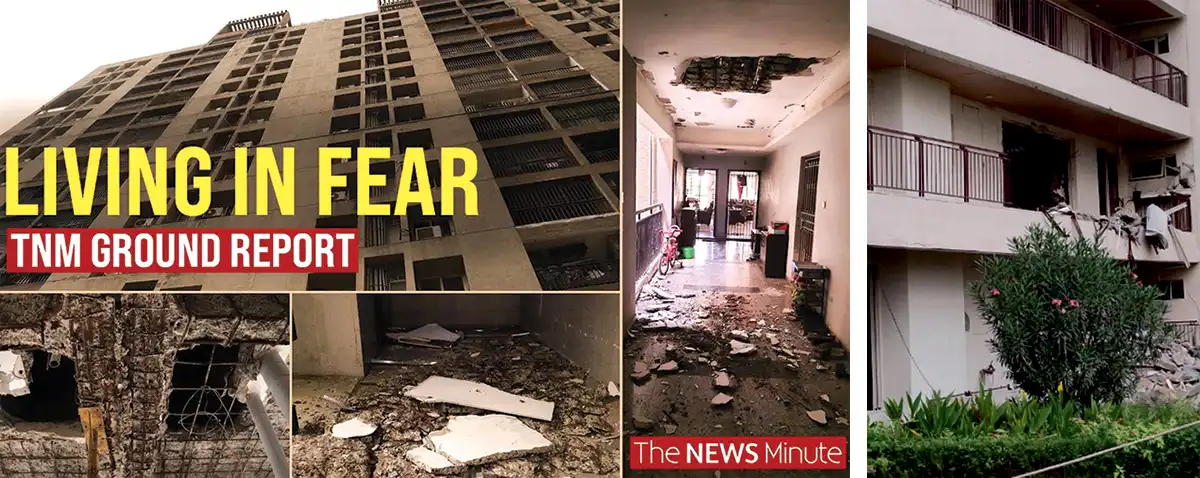
The online news by ‘The News Minute’ dated 3rd February 2024 [6] mentions an IIT Madras report recommending the demolition and reconstruction of Chennai’s apartments inside a complex. The news’ punchline reads: The apartment complex had in July 2023 been in the news due to severe structural damage, endangering the lives of 500 families living in 17 storeys.The technical content of the news is reproduced below:The Indian Institute of Technology, Madras (IIT-M) has called for the immediate evacuation of the residents of Apartments in Chennai's Choolaimedu area. IIT-M has further said that all the 3 blocks of the apartment complex must be demolished in a controlled manner. IIT-M was tasked with investigating the cause for the deterioration by the Chennai Metropolitan Development Authority (CMDA). IIT-M has also recommended reconstruction of the apartment complex to meet the desired standards of strength and durability (or desired service life), suggesting that Block A and Block B, which are both in a more advanced stage of decay, are to be first demolished and reconstructed; the report adds that this can be carried out within a year. Further, the report recommends that Blocks B and C after reconstruction can be used to house all the present residents so that Block C can be constructed as stage 2 of the repair work. Lastly, the report also recommends that new construction material should be tested to meet the required standards.
In the report, IIT-M has highlighted that the main cause for the deterioration in the apartment complex was chloride-induced corrosion. It explains that the use of chlorine-contaminated water during the mixing and curing of the concrete is the major reason for the building's present condition. It further adds that the use of poor concrete quality and inadequate cover depth have worsened the problem caused by the chlorine-contaminated water. IIT-M has also said that excessively thick plaster had been used to inappropriately compensate for the insufficient concrete cover.
The report confirms the CMDA’s earlier suspicion that the deterioration had occurred primarily due to chlorine-contaminated water. In July 2023, it came to light that the three blocks - A, B and C of the 17 floors of Apartments were severely structurally compromised. Multiple cracks and ceiling collapses had occurred between 2021 and 2023. When TNM visited the ground, it was discovered that even the lifts had become unsafe due to the extensive damage.
The online news by the ‘The Hindu’ (3rd July 2023) [7] has the title “Chloride levels posing risk to housing in NCR, experts call for relook of building norms”. The brief news reads as follows:
Reports by IIT Delhi, Gurugram authorities on housing projects flag the presence of chloride in concrete coming from the groundwater used for construction; experts propose amendments to building codes.
While the quality of raw materials such as cement, steel bars, sand and bricks etc., is vital for residential construction, that of water is often overlooked. A report published in early June 2023 by IIT Delhi has raised concerns over the standard of water used in the NCR. There may be many such cases of deterioration of the buildings due to causal attitude of contractors and builders of taking for granted the water quality.
In a nutshell
The demand for concrete is expected to increase owing to an exponential population growth, urbanization, and modern lifestyles. Hence, an increased demand for the mixing water is obvious. However, few countries in the arid areas have a scarcity of freshwater, which leads to a challenge to green concrete production. Contractors should select the best type of water while enhancing environmental sustainability. Further, researchers should explore alternate sources of mixing water to overcome the current problems faced with the existing water available for mixing concrete.To reduce the harm to human health and life, especially the labourers on site, there is a dire necessity of following the set guidelines and standards on the suitability of water to be utilized for mixing the concrete. These regulations ensure that there is no detrimental effect on the concrete properties due to mixing water.
On a lighter note, water in the concrete can be made analogous to the salt in the food. Salt is the cheapest ingredient of all; but, if poor quality salt is used, it will ruin the test of the food containing rich ingredients. On a similar line, mixing and curing water is the cheapest constituent in the concerting work; however, overlooking its quality will make all the concrete making efforts go in vain.

References
- Zongjin Li, Advanced Concrete Technology, John Wiley & Sons, Inc., Hoboken, New Jersey, USA, 2011, pp. 85-88.
- Paul Awareya, Adeyemi Adesina, Oladimeji B. Olalusi, and Amelec Viloria, Reinforced Concrete Deterioration Caused by Contaminated Construction Water: An Overview, Engineering Failure Analysis, Vol. 116, Oct. 2020, 104715, Elsevier.
- A. M. Neville & J. J. Brooks, Concrete Technology, Second Edition, Prentice Hall (Pearson Education Ltd.), England, 1987, pp.73-75.
- Shiv Kumar, Director, IRICEN, Pune and Ghansham Bansal, Professor, Bridges, M. R. & Co., Concrete Technology, Indian railways Institute of Civil Engineering, Pune, January 2014, pp. 43-44.
- Indian Standard, IS 456: 2000 (Reaffirmed 2005), Plain and Reinforced Concrete- Code of Practice (Fourth Revision), Bureau of Indian Standards, New Delhi, India.
- The News Minute, 3rd Feb. 2024, written by Bharathy Singaravel; edited by Korah Abraham, Channai.
- The Hindu, 3rd July 2023, Reported by Soibam Rocky Singh, New Delhi.
Dr. Dada Subahsh Patil has 2.5 years of industrial experience and 22 years of teaching experience at degree Civil Engineering level. His fields of interest are Advanced Concrete Technology, Structural Analysis & Design, Repairs & Rehabilitation, Geotechnical Engineering, etc.