As the cement sector searches for viable decarbonisation pathways, waste-derived fuels are rapidly moving from experimental concepts to industrial reality. Drawing on practical experience with RDF co-processing, Dr. Mallikarjun S. D, Dr. Manjunatha Lokanahally Ramachandra, Arvind Kumar Sharma, and Rajan Killukurussi of JSW Cement examine how cement plants are replacing fossil fuels with processed municipal waste—suggesting that India’s growing waste challenge and the industry’s decarbonisation goals may, in fact, share a common solution. By converting environmental liabilities into industrial resources, RDF co-processing is beginning to support a more sustainable and circular manufacturing ecosystem.
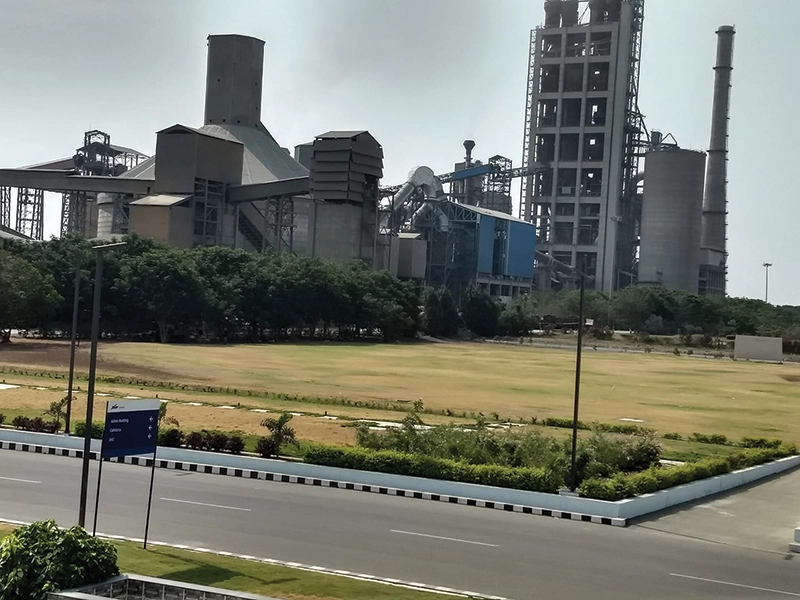
Introduction
The cement industry accounts for nearly 7–8% of global anthropogenic CO2 emissions, primarily due to the calcination process and fossil fuel combustion. Decarbonization strategies in the sector broadly focus on three levers:- reducing the clinker factor
- enhancing energy efficiency
- substituting fossil fuels with alternative fuels and renewable energy sources.
Methodology and Intervention
RDF Sourcing and Preparation
- Feedstock Origin: RDF sourced from municipal solid waste fractions after segregation of recyclables and compostable.
- Pre-processing: Shredding, drying, and homogenization to ensure calorific value consistency.
- Calorific Value Range: 2,500–3,000 kcal/kg.
Kiln Integration
- Plants: Nandyal Integrated Plant & Shiva Grinding Unit.
- Feeding System: Dedicated RDF handling line, preheater feeding, and combustion optimization.
- Quality Assurance: Continuous monitoring of flame stability and clinker quality.
Monitoring Systems
- Installed Continuous Emissions Monitoring Systems (CEMS) to track SOx, NOx, CO, and particulate matter.
- Regular third-party audits ensured compliance with Central Pollution Control Board (CPCB) norms.
Results and Discussion
RDF Utilization
A total of 1,57,000 tonnes of RDF were co-processed in FY 2024–25, with Nandyal contributing the largest share as shown in Table 1 below.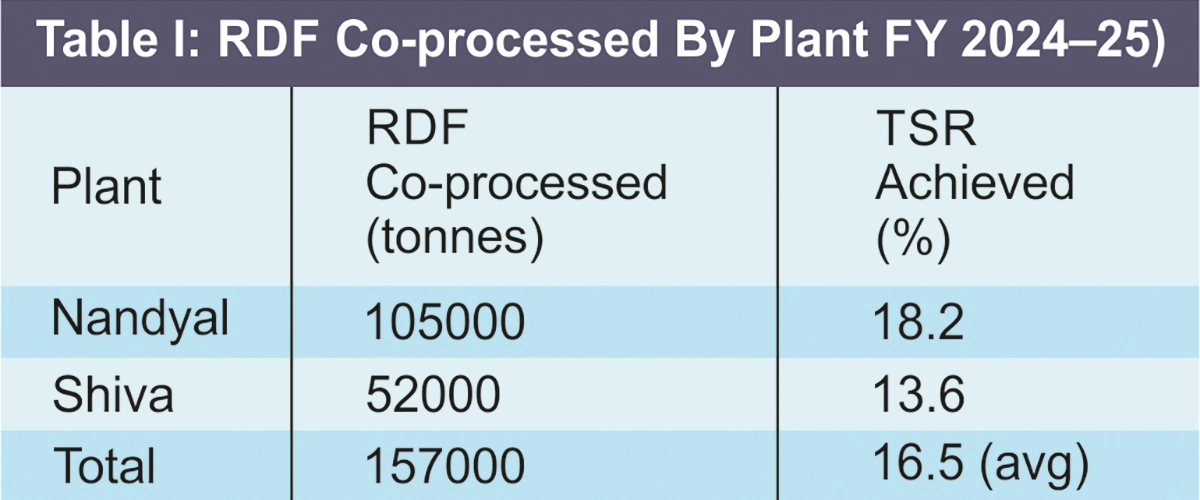
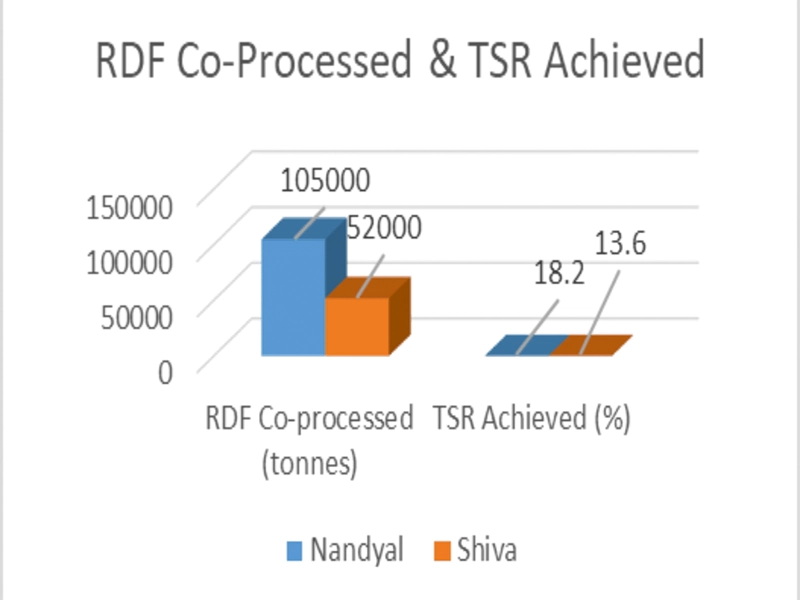
Thermal Substitution Rate (TSR)
Carbon Emission Reduction
The RDF co-processing intervention avoided nearly 1,20,000 tonnes of CO2 emissions. The impact equivalence is illustrated below.- Equivalent to 26,000 passenger cars removed from roads annually, or
- Equivalent to planting 2 million mature trees.
Circular Economy Benefits
- Reduced coal/pet coke consumption by ~95,000 tonnes.
- Diverted 1,57,000 tonnes of non-recyclable waste from landfills.
- Strengthened partnerships with municipal bodies for sustainable waste management.
Benchmarking with Global Best Practices
- Global leaders in cement achieve TSR >40%.
- JSW Cement’s 16.5% represents a step-change for India, nearly doubling the national industry average.
Challenges and Learnings
- Logistics: High variability in RDF supply chain from municipalities.
- Technical: Maintaining calorific value uniformity required advanced feed blending.
- Regulatory: Need for supportive policies to improve RDF quality standards in India.
Conclusion
JSW Cement’s co-processing initiative at Nandyal and Shiva plants exemplifies how alternative fuel adoption can deliver measurable climate benefits while contributing to circular economy objectives. Achieving a TSR of 16.5% and avoiding 1, 20,000 tons of CO2 emissions in FY 2024–25, the initiative sets a replicable model for India’s cement industry.Future focus will include:
- Expanding RDF and biomass-based fuel use to other plants.
- Leveraging digital twin models for fuel mix optimization.
- Pursuing TSR levels aligned with global best practices (>30%).
Acknowledgment
The above work is supported by the JSW Cement Limited and Shiva Cement Limited, India and we thank our management for their support in accomplishing this research article.References
- A. Cichocki and R. Unbehaven, Neural Networks for Optimization and Signal Processing, 1st ed. Chichester, U.K.: Wiley, 1993, ch. 2, pp. 45-47.
- International Energy Agency (IEA). Technology Roadmap: Low-Carbon Transition in the Cement Industry. Paris: IEA, 2018.
- WBCSD & CSI. Guidelines for Co-processing Fuels and Raw Materials in Cement Manufacturing. Geneva, 2014.
- CPCB (2023). Annual Report on Municipal Solid Waste Management in India.
- JSW Cement Sustainability Report FY 2024–25
About the Authors
He has more than 15 years of academic, industrial, and research experience in the areas of environmental management, environmental clearances, sustainability, ecological restoration, pollution control, and regulatory compliance. He has worked with large industrial operations including cement plants, power plants, and open-cast mines, and has executed environmental impact assessments, greenhouse gas inventories, forest clearances, biodiversity audits, hydrogeological studies, carbon sequestration analyses, and environmental monitoring programs. He served as an expatriate faculty member in Ethiopia under the UNDP initiative and has worked with major Indian industries, including NLC India Limited, where he contributed to the Sustainable Development Cell. He was selected as a Technical Officer at the Central Public Health and Environmental Engineering Organization (CPHEEO) through the Union Public Service Commission. He currently serves with JSW Cement Limited, Mumbai, where he supports sustainability initiatives, compliance, and environmental strategy. His research interests include adsorption processes for heavy-metal removal, soil–sediment interaction, industrial wastewater treatment, environmental policy, and sustainable industrial development.
Dr. Mallikarjun has published research papers in reputed international journals and contributed technical work in the field of environmental engineering. He has been associated with various technical committees, academic institutions, and professional bodies in the environmental and civil engineering domain.
Note: The Manuscript has been published in the conference proceedings of EUROPA 2026 Int’l Conference -International Forum of Engineers and Practitioners.