
From Durability to Design Freedom: The Rise of Glass Fiber Reinforced Concrete (GRC)
With its superior strength-to-weight ratio, design versatility, durability, corrosion resistance, and reduced maintenance requirements, Glass Fiber Reinforced Concrete is increasingly emerging as the material of choice for sustainable and technologically advanced construction.
Profit margins in the construction industry are historically thin.
Avoiding unnecessary risk is always key and construction businesses have always been somewhat reluctant to explore new methods and materials.
However, a few years ago, we saw an event which forced many to change their outlook. During the coronavirus pandemic of 2020 - 21, a host of paused projects, along with social distancing, furloughs and redundancies, squeezed the industry and caused thousands of experienced construction workers to leave or retire.
In the wake of the pandemic, many businesses were forced to re-evaluate their traditional practices and the adoption of (for example) digital technology and offsite construction methods increased.
Construction may still be a somewhat conservative industry, but it is now more open than ever to new technologies, methods, and materials.
Designed for the Future
One material gaining traction in construction is GRC – an alternative to steel-reinforced concrete. This is by no means a recent innovation, but it’s fair to say that it is far from a mainstream construction material. This might seem strange, given that GRC is known to be significantly more durable than traditional concrete.Its higher initial cost and the need for upfront planning for its use have been cited as drawbacks, but it is now playing an increasingly important role in the construction of some of the world’s most significant building projects.
And GRC’s many applications are now gaining attention from construction businesses that see long-term benefits such as extended lifespan, lower maintenance costs, and a range of sustainability pluses.
He adds, “GRC is significantly lighter than precast concrete, which can lead to lower transportation and installation costs. While standard concrete is strong in compression, it is weak in tension, which is why it often tends to break down.”Says Jun Yamashiro, Sales Manager at the Glass Fiber Division of Nippon Electric Glass (NEG), “GRC is particularly effective as an exterior material for buildings with high design requirements. Complex-shaped concrete structures tend to become significantly larger when constructed with steel-reinforced concrete ––– making them difficult to realize. In contrast, GRC allows for a reduction in concrete thickness, making it an ideal solution for such projects.”

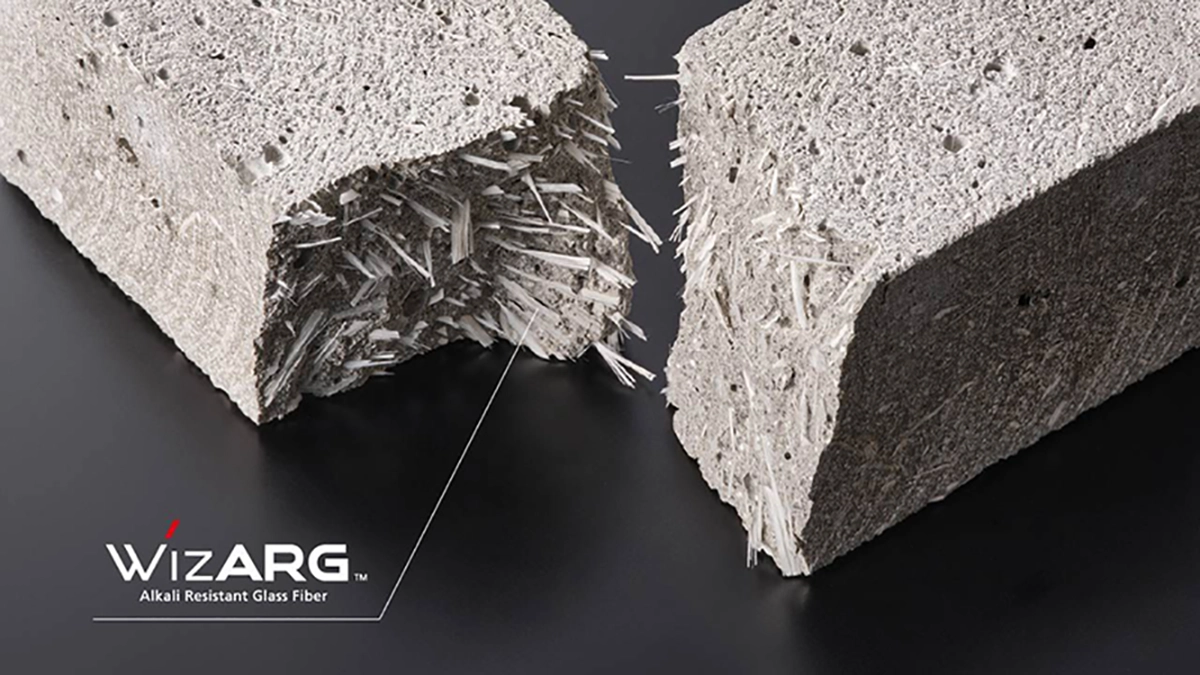
GRC, as a composite material made by embedding an alkali-resistant glass fiber network into cement, offers the tensile strength that standard concrete lacks. The result is a material that is stronger, more durable and more flexible than traditional concrete. GRC’s fibers prevent the formation of large cracks and hold the material together, making it suitable for thin-walled, complex architectural designs – especially facades, cladding and decorative elements.
He informs that in the built environment, any reduction in maintenance means a reduction in costs, which can make all the difference to the success or failure of a project. With standard reinforced concrete, one of the main causes of deterioration is the corrosion of the embedded steel reinforcement.
“GRC offers an advantage here as its reinforcing material consists of alkali-resistant glass fibers, which are not susceptible to corrosion. This contributes to its long-term durability. Another benefit of GRC is safety. Since the glass fibers used as reinforcement are non-combustible, GRC also offers reliable fire resistance.”
Advantages of Glass Fiber Reinforced Concrete
- Lightweight material with high strength-to-weight ratio
- Superior tensile strength, crack resistance, and structural stability
- Excellent durability, corrosion resistance, and long service life
- Fire resistance and reduced maintenance requirements
- Lower lifecycle, handling, transportation, and installation costs
- Reduced structural load, thinner sections, and lower steel reinforcement requirement
- Greater architectural design flexibility for complex shapes, facades, cladding, roofing, and decorative applications
- Suitable for modular construction, tunnel lining, and coastal or marine environments
- Compatible with 3D printing and advanced construction technologies
- Reduced cement consumption and improved sustainability
- Better long-term return on investment and enhanced aesthetic appeal
Reinforcing Return on Investment
It’s fair to say that GRC is likely to have a higher initial cost than traditional steel-reinforced concrete, due to the higher cost of the glass fibers and necessary plasticizers, combined with a slightly more complex and energy-intensive manufacturing process.However, the overall cost may be comparable or even lower in the long run, due to reduced labor and handling costs since GRC is lighter than steel-reinforced concrete, faster installation times, and lower lifetime maintenance costs.
NEG has over 70 years’ experience in producing specialist glass products. Jun’s division produces a specially formulated alkali-resistant glass fiber called WizARG™ which offers a broad line-up in terms of hardness, flexibility, and thickness. It is available in a number of sizing agents, filament diameters, and cut lengths. This allows the division to propose the most suitable type of glass fiber based on the specific needs of each customer, from GRC panels to crack control in concrete.
And whatever the application, the thickness and weight of concrete structures can be reduced through the use of WizARG™, allowing for wider spans in applications like large ceilings and reducing the amount of reinforcement needed. This enhances the design flexibility of structural engineering and contributes to the realization of more aesthetically pleasing designs.
What’s more, WizARG™ requires significantly less cement than steel-reinforced concrete. This is just one of a number of potential environmental benefits, which benefit developers looking to get major projects up and running.
Glass Fiber Reinforced Concrete is playing an increasingly important role in the construction of some of the world’s most significant building projects.
A Very Superior Product
Experiments with GRC were taking place in the 1950s, but the material became widely available only in the 1970s, following the development of alkali-resistant glass fibers, which gave it superior corrosion resistance. These glass fibers had a high zirconia content – one of the crucial distinctions between GRC products.Jun informs that the ability of the glass fiber to resist corrosion from the alkaline nature of cement is determined mainly by the zirconia [ZrO₂] content in the glass. “Basically, the higher the zirconia content, the greater the alkali resistance.”
WizARG™ contains a high ZrO₂ content among commercially available alkali-resistant glass fibers, giving it outstanding alkali resistance. Another differentiator is the manufacturing process, which takes place under strict quality control standards in Japan.
The method of manufacturing WizARG™ glass fiber includes processing in an all-electric direct melt furnace, which converts almost all its electrical energy into heat in an extremely uniform way, producing a more stable fiber.
The Future of GRC is Now
Up to this point, the benefits of GRC have been seen largely in building facades, cladding panels, and other aesthetic architectural components, where its light weight and design versatility come to the fore.But things are changing: more and more designers are seeing GRC’s benefits within roofing and walls. GRC is also being used as tunnel lining and formwork, and it is potentially a game changer within the world of modular construction.
WizARG™ also has excellent potential within coastal and marine facilities, as concrete is prone to carbonation due to the influence of salt and humidity, which in turn accelerates the corrosion of rebars. WizARG™ remains unaffected in performance even if the concrete carbonates.
With smart technologies such as 3D printing, driving more complex architectural designs, and a market focused on resource efficiency and reducing environmental impact, the future for high-quality GRC looks promising.
Click here to learn more about WizARG™
https://www.neg.co.jp/en/products/arg-fiber/index.html?utm_source=nbm%26cw&utm_medium=social&utm_campaign=202606_nbm%26cw
Published on:
01 June 2026
Share:
We Value Your Comment