The inclusion of aggregate geological origin in elastic modulus estimation under draft IS 456:2025 marks a significant shift in RCC design approach. Dr. Dada S. Patil, examines how this move from strength-based to a more material-sensitive approach could influence structural behaviour, serviceability predictions, and overall design accuracy, and highlights the technical, practical, coordination, and contractual challenges in aligning design assumptions with on-site conditions.
Introduction
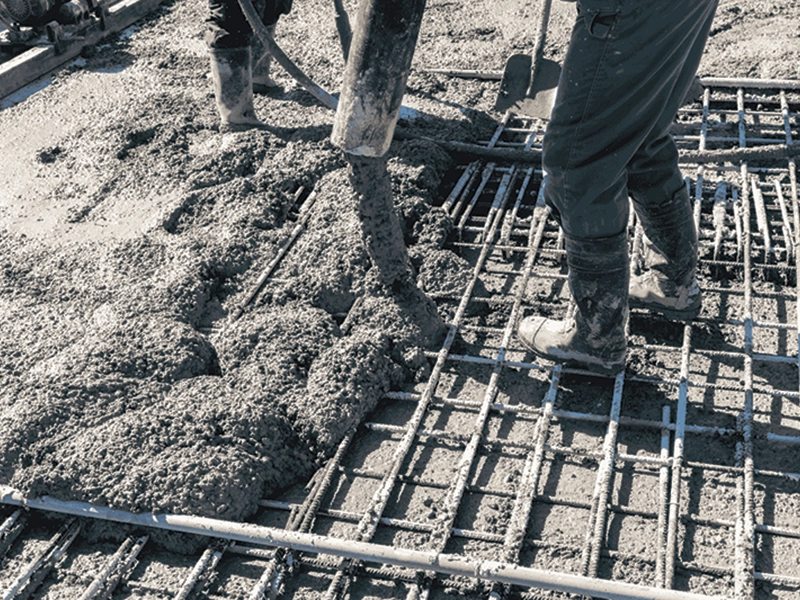
This transition represents a major paradigm shift in RCC design in India. The new approach improves accuracy but simultaneously introduces practical challenges for coordination among structural designers, RMC plants, contractors and aggregate suppliers. Owing to India's vast geological diversity and inter-state material supply chains, implementation will require systematic changes in design specifications, quality control and material traceability.
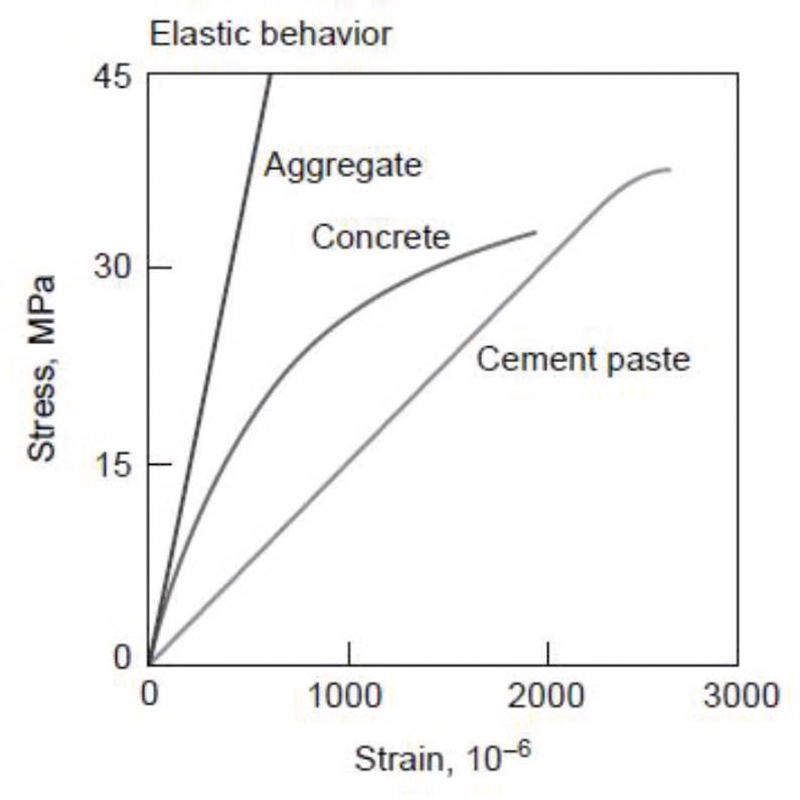
Figure 1: Typical Stress-Strain Behaviours of Cement Paste, Aggregate and Concrete [4]
Concrete elastic modulus affects deflection of structural elements, crack width control, structural vibrations, column shortening in tall buildings, second order P-Δ effects in slender structures, lateral drift in high-rise buildings, shrinkage and creep calculations, composite behaviour with reinforcements, etc.
Effect of Aggregate Mineralogy on Modulus Value
Concrete behaves as a composite material; cement paste deformation is partially restrained by aggregates. As aggregates constitute majority of the volume, their stiffness significantly influences the composite modulus [4].Stiffer aggregates like quartzite and basalt provide greater resistance to deformation, leading to higher concrete modulus and softer sedimentary rocks like sandstone may produce concrete with lower elastic stiffness [6].

Modulus Value - IS 456: 2000 Code v/s IS 456:2025 Draft CodeM
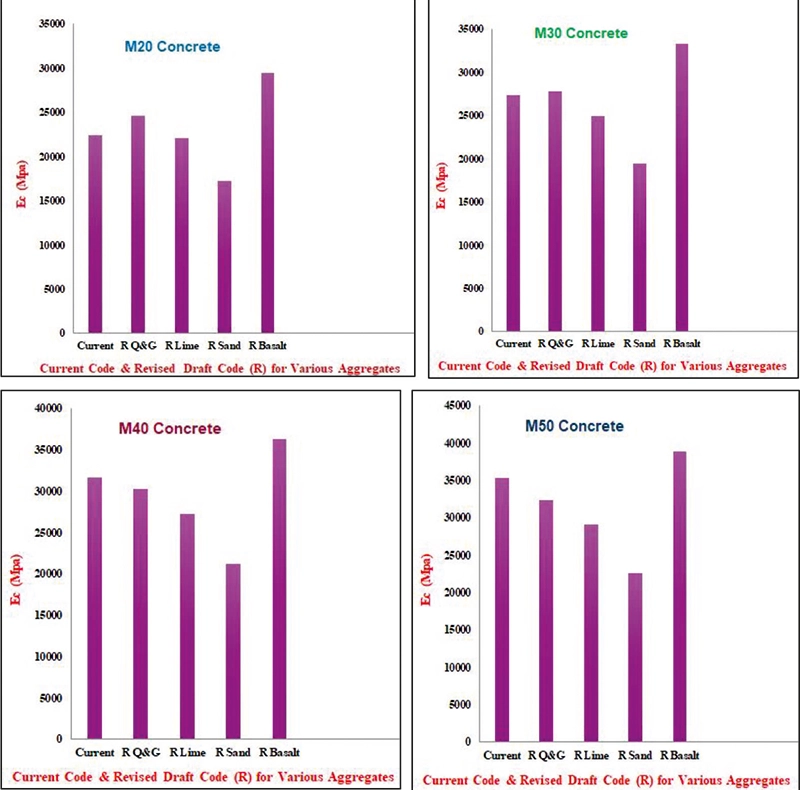
Figure 2: Concrete Elastic Modulus Values as per Current Code & Revised Draft Code
Ec = 5000 (fck)0.5 Mpa.
This expression assumes that the stiffness of concrete is governed primarily by the concrete compressive strength.
Extensive experimental research revealed that the mineralogical composition and stiffness of aggregates considerably influence the modulus value. Hence, draft revision of IS 456:2025 [2] introduces provisions that modify the modulus depending on the geological origin of aggregates. While this approach improves analytical accuracy, it introduces several new challenges for structural design practice in India. As per clause 7.1.4.1 of IS 456: 2025 draft code:
Ec = 10000 (fck)0.3 Mpa.
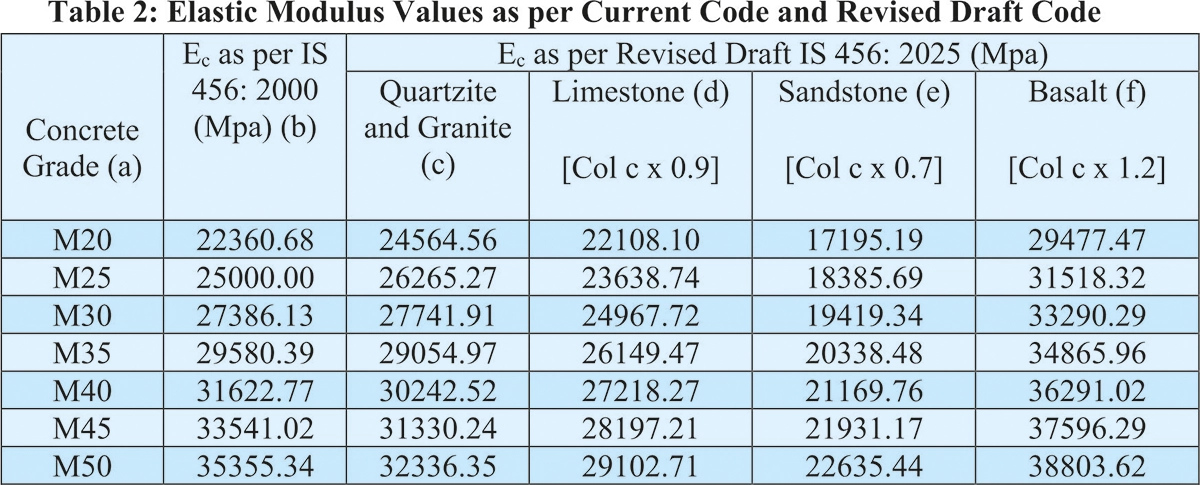
Clause 7.1.4.1.1 mentions that the above equation is valid for the concrete having quartzite and granite aggregates only. For limestone and sandstone aggregates, value shall be reduced by 10% and 30% respectively. For basalt aggregates, value shall be increased by 20%.
Calculations were carried out for M20 to M50 concrete grades and modulus values are shown in table 2. For the same characteristic compressive strength, modulus value varies significantly depending on the geological origin of aggregates, as per the revised draft code.
Numerical Illustration: Influence of Aggregate Type on Slab Deflection
To illustrate the potential implications of aggregate-dependent modulus values introduced in IS 456:2025, a numerical example is presented to demonstrate how variations in the modulus may affect predicted deflections in RCC members by considering a simply supported slab of span 5 m and an overall depth 150 mm, subject to a total uniformly distributed load of 5 kN/m; M30 concrete is considered. For simplicity, slab is considered as a 1 m. wide strip, behaving as a simply supported beam.Moment of inertia I = (BD3 / 12) = (1000 x 1503 / 12) = 281250000 mm4
Span L = 5000 mm
Load W = 5 kN/m = 5 N/mm
Central deflection Δ = (5 WL4 / 384 EI)
Referring modulus values from table 2 for M30 concrete, table 3 shows the central deflection values
Difference between basalt and sandstone cases = [(7.45 – 4.34) / 4.34] x 100% = 71.66%.

Figure 3: A Simply Supported Slab of 5 m. Span Subject to UDL
This shows that, for the same concrete grade, central deflection corresponding to sandstone aggregate concrete is 71.66% more than that of the basalt aggregate concrete, as per the revised draft code.
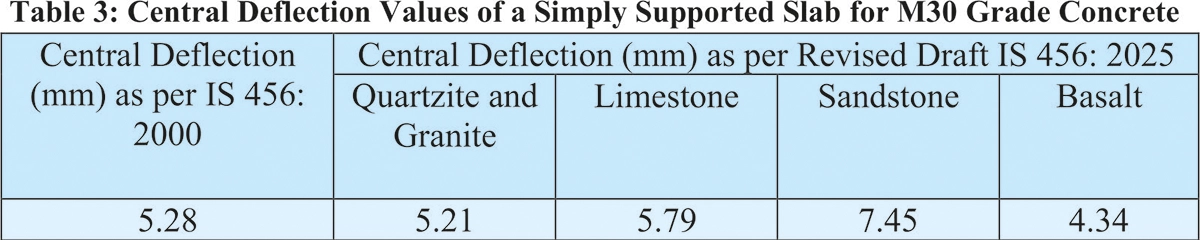
This example demonstrates that the assumed aggregate type can largely affect predicted structural behaviour. If the structural designer assumes basalt aggregates during design, but the contractor uses sandstone aggregates, slab deflection may increase significantly. Although such differences may still fall within permissible limits in many cases, they can affect serviceability considerations such as cracking behaviour, long-term deflection, column shortening in tall buildings, vibration performance, differential settlement, etc.
In high-rise structures and long-span slabs, even a 10–20% variation in stiffness may influence structural performance predictions. This example illustrates that aggregate mineralogy is not merely a material property but a parameter capable of influencing global structural response. Consequently, the practical implementation of aggregate-dependent modulus provisions requires careful consideration within the design–construction interface.
Regional Distribution of Aggregates in India
India’s geology varies widely, leading to different aggregate types dominating different regions [7]. In western India, the Deccan trap basalt formations dominate states such as Maharashtra and Gujarat. Cities using basalt aggregates are Mumbai, Nashik, Nagpur, Pune, etc. Southern India is dominated by granite and gneiss formations. Bengaluru and Hyderabad have granite formations; Chennai has granite and charnockite rocks. Northern regions including Rajasthan and parts of Haryana use quartzite and sandstone aggregates. Central and Eastern India regions like Madhya Pradesh, Chhattisgarh and Jharkhand have mixed geological formations such as granite, limestone and basalt [8-10].Conventional Structural Design Workflow v/s Modified Workflow Under IS 456:2025
The conventional design workflow is: architectural planning, structural design by consultant, tendering and contractor selection, contractor appointing the concrete supplier and supplier sourcing aggregates from quarry. Thus aggregate selection usually occurs after structural design is completed. This creates difficulties when the modulus depends on aggregate geology.Proposed workflow under aggregate-based modulus will be: identifying aggregate source, determining geological type, estimating modulus value, performing structural analysis and ensuring that contractor utilizes the same aggregate source. This new dependency between design stage and construction materials may complicate project coordination.
Situations Where Aggregate Type Assumed by Designer May Differ from Actual Aggregates Used
Although specific regions in India are dominated by particular geological formations, the aggregate type used in a project may not always correspond to the local geology. Several practical factors can lead to discrepancies between the aggregate type assumed during structural design and the aggregates actually used during construction.Aggregates transported across state boundaries: In modern construction practice, aggregates are often transported over long distances depending on availability of quarry permits, transportation cost, demand–supply imbalance, large infrastructure projects, etc. Thus, a structural engineer assuming basalt aggregates in Maharashtra may actually get granite aggregates transported from Karnataka.
Quarry closure or environmental restrictions: Quarries may shut down due to environmental clearances, mining restrictions, local community protests, court orders, etc. When such closures occur, contractors may suddenly change aggregate sources during construction. This creates a mismatch with the modulus assumed in design.
Contractor procurement decisions: Contractor often prioritizes transport distance, supplier availability, long-term supply contracts, lower cost, etc. Even if the structural designer assumes a typical local aggregate, the contractor may procure aggregates from a different quarry offering lower prices. This decision is usually made after structural design is completed.
RMC supplier practices: RMC plants frequently change aggregate sources depending on supplier availability, production demand, logistics, etc. For instance, an RMC plant may use granite aggregates in first week and basalt aggregates in second week, depending on the supply. Hence, aggregate mineralogy in the same project may vary over a period of time.
Mixed aggregates from multiple quarries: Contractors sometimes use aggregates sourced from multiple quarries simultaneously for blending aggregates to meet grading requirements, minimizing transport cost and maintaining continuous supply. As a result, concrete may contain mixed aggregate mineralogy, making it difficult to define a single modulus value.
Urban areas importing the aggregates: Major metropolitan cities frequently import aggregates from the neighbouring cities or states. Thus the aggregate type used in cities may not represent the local geological formation.
Variation within same rock category: Even within the same rock type, modulus values can vary largely. Referring table 1, it can be seen that assuming a generic rock type may still introduce uncertainty.
Change of aggregate source during construction: In huge projects such as bridges, metro structures, high-rise buildings, etc., construction may last 2 to 5 years. During this period, aggregate suppliers may change due to logistics issues, quarry depletion, project cost changes, etc. This can render modulus assumptions made at the design stage to be invalid.
Lack of geological verification: Construction sites seldom verify aggregate mineralogy. Quality control team usually checks water absorption, crushing strength, grading, flakiness index, etc. Geological classification of aggregates is usually not confirmed. Thus the designer may assume basalt while the aggregate could be basaltic andesite or granite gneiss, with different stiffness.
Practical Challenges in Indian Construction Industry
While theoretically accurate, the revised approach poses many implementation challenges.Documentation and traceability: Accurate modulus prediction will require documentation of bulk density, aggregate modulus, geological type and quarry location. This necessitates new requirements for quarry certification, material traceability and laboratory testing.
Design revision risks: If aggregate source changes during construction, actual modulus may differ from design assumptions, thereby influencing structural analysis outcomes and serviceability calculations. Hence, a mechanism for design verification during construction may become essential.
Implications for Indian Construction Industry
The revised provisions represent a shift towards material-sensitive structural design. The advantages are improved serviceability performance, better alignment with international practice and more accurate deflection prediction. However, successful implementation requires improved coordination among structural consultants, contractors, material suppliers and testing laboratories. Underestimation or overestimation of modulus influences behaviour of structural elements. In tall buildings and long-span structures, these inaccuracies can result in unexpected cracking, façade misalignment, floor level mismatches, etc. To be on conservative side, designers may assume lower-bound modulus values corresponding to softer aggregates, leading to uneconomical design. Modern high performance concretes use silica fume, GGBFS, fly ash, recycled aggregates, etc. These materials alter stiffness behaviour, making aggregate-sensitive modelling more appropriate.Strategies for Effective Implementation in India
Aggregate characterization database: India could benefit from a national database of aggregate properties, including petrographic classification, density and elastic modulus. Such a database would assist designers in selecting appropriate modulus values.Mandatory testing protocols: RMC plants may need to conduct static modulus tests, ultrasonic pulse velocity tests and dynamic modulus estimation. These tests should be conducted for each major aggregate source.
Early design-material integration: Project specifications shall comprise of approved aggregate sources, minimum modulus requirements and testing frequency. This ensures that the modulus assumed in design corresponds to the material used in construction.
Digital material traceability: Modern construction projects can use digital systems to track quarry source, aggregate batches and RMC mix records. This ensures consistency between design assumptions and field materials.
Broader Implications for Structural Engineering Practice in India
Adopting the aggregate-sensitive modulus estimation reflects a broader evolution in structural engineering. Key implications include:Shift towards performance-based design: Instead of relying solely on empirical formulae, designers will increasingly incorporate material-specific properties.
Integration of material science and structural design: Future structural engineering practice will require closer collaboration with geologists, material scientists and concrete technologists.
Higher accuracy in serviceability design: For modern structures, accurate stiffness modelling is essential.
Conclusions
The current modulus estimation approach in IS 456:2000, based solely on compressive strength, offers simplicity but overlooks the significant effect of aggregate properties. Consideration of aggregate geological origin in estimating concrete modulus reflects a scientifically justified advancement in Indian structural design practice. As aggregates constitute the majority of concrete volume, their stiffness greatly affects concrete elastic behavior.The forthcoming IS 456:2025 draft revision represents a vital step towards more realistic modelling of concrete behaviour by incorporating aggregate characteristics into modulus estimation. However, the successful implementation of this approach will require improved coordination among designers, contractors and RMC plants, improved material characterization and testing, robust documentation of aggregate sources and adopting the construction management practices.
Given India’s vast geological diversity and complex supply chains, these changes present both challenges and opportunities. If implemented effectively, the revised provisions will significantly improve the accuracy of serviceability predictions and long-term performance of RCC structures across the country. To ensure effective implementation, the industry may need clearer guidelines, regional modulus recommendations, improved contractual specifications and enhanced coordination between design and construction teams. While the revised provisions improve theoretical accuracy, their successful implementation will depend on adapting them to the realities of construction practice in India.
References
- Bureau of Indian Standards- IS 456:2000: Plain and Reinforced Concrete- Code of Practice.
- Draft Revision of IS 456: 2025: Plain and Reinforced Concrete- Code of Practice.
- Mindess, S., Young, J.F., & Darwin, D. (2003), Concrete, Prentice Hall.
- Mehta, P.K., & Monteiro, P.J.M. (2014), Concrete: Microstructure, Properties and Materials, McGraw Hill.
- Neville, A.M. (2011), Properties of Concrete, 5th Edition, Pearson Education.
- ACI Committee 363 (2010), Report on High-Strength Concrete, ACI 363R-10, American Concrete Institute Committee 363, Farmington Hills, MI.
- Geological Survey of India (GSI) (2011), Geology and Mineral Resources of India.
- Indian Bureau of Mines (2023), Indian Minerals Yearbook-Building & Construction Materials, Ministry of Mines, Government of India.
- Radhakrishnan, V., & Vaidyanadhan, R. (1997), Geology of India, Geological Society of India.
- Singh, S. (2018), Physical Geography of India, Prayag Pustak Bhawan.
About the author: