According to MP Financial Advisory Services LLP (MPFASL), India’s steel sector is on a strong growth trajectory toward the government’s ambitious target of achieving 300 million tonnes per annum (MTPA) of crude steel capacity by FY2030–31.
Seen as the backbone of infrastructure and manufacturing, the industry is at a crucial inflection point. Scaling up to 300 MTPA is vital for meeting surging domestic demand, reducing import dependency, and positioning India as a global steel powerhouse.
As of FY2024–25, India has achieved an installed capacity of 205 MTPA, followed by proposed capacity expansion plans of 167 MTPA till 2031 by major steel players. However, the sector faces several challenges, including the need for iron ore beneficiation, an 85% dependency on imported coking coal, limited availability of steel scrap, and high CO₂ emission intensity in the steelmaking process. Additionally, external headwinds such as low-cost imports from China, EU safeguard duties, and impending carbon tariffs pose further risks to the industry's growth trajectory. High logistics costs accompanied by the time-consuming process for obtaining approvals for green field projects and a higher cost of financing when compared to China, the largest steel producer, further pose challenges towards the desired steel capacities.
MPFASL report further notes that India’s steel consumption—currently at 93.4 kg per capita compared to the global average of ~219 kg—is expected to rise sharply, as India accelerates investments in infrastructure, affordable housing, and manufacturing. Bridging this consumption gap will necessitate a substantial increase in steel-making capacity, reinforcing the strategic need to achieve the 300-million-ton crude steel capacity target.
The report notes that while there are challenges, the 300 MTPA steel capacity target by 2030–31 would be achieved through a multi-pronged strategy, dependent on 5 critical levers- accelerated investments in green and value-added steel, infrastructure and raw material linkage improvements, clean technology adoption, policy reform for financing and approvals, and a strong public–private execution model.
Mahendra Patil, Founder and Managing Partner at MP Financial Advisory Services LLP said, “India’s 300 MTPA steel ambition is not just an industrial goal but a strategic move toward self-reliance, global competitiveness, and climate leadership. Overcoming resource, policy, and trade challenges through innovation and sustainability will be key to positioning India as a global hub for green and specialty steel, supporting its $5 trillion economy vision.”
Driven by rapid industrialization and infrastructure-led growth, India’s steel production has surged in recent years, positioning the country as the second-largest steel producer globally, behind China, which accounts for over 50% of the world’s output. Currently the world’s second-largest steel producer, India is driving this transformation amid robust infrastructure demand, policy support, and global supply chain realignments.
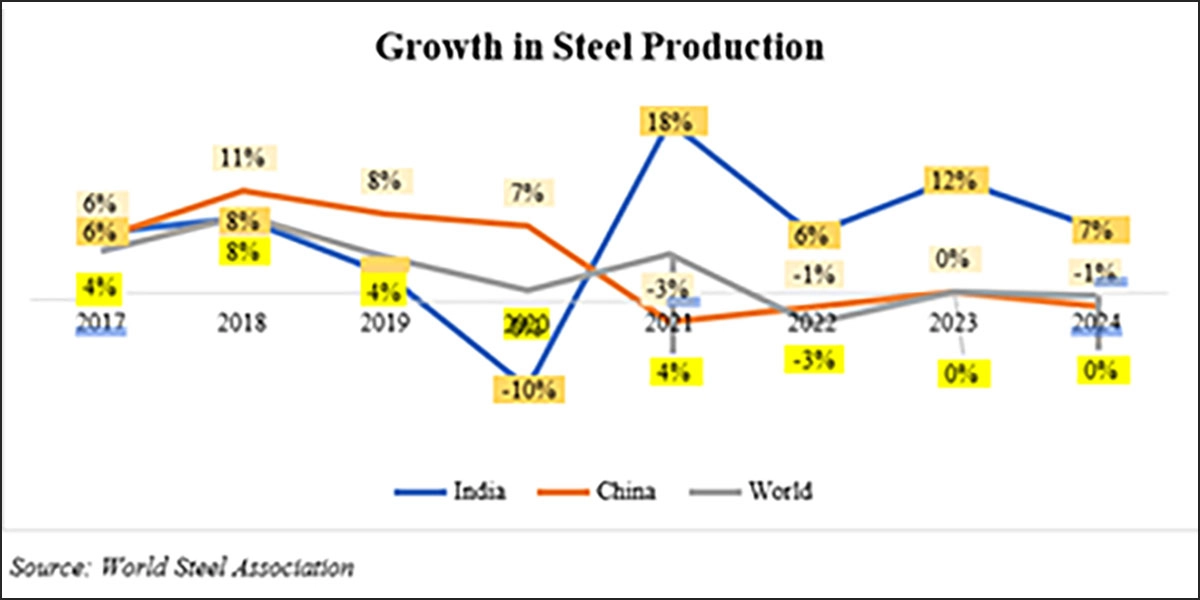
The growth rate of steel production in India has outpaced both China and the global average. Between 2016 and 2024, India recorded a CAGR of ~5%, compared to 2.76% for China and 1.77% globally. Notably, while China’s steel production has been declining since 2020, India witnessed an accelerated CAGR of 8% during this period. This divergence underscores India’s rising prominence in the global steel industry, supported by abundant raw materials, cost-effective labor, and enabling government policies.
“India’s steel transformation is not merely a capacity expansion; it’s a strategic leap toward energy security, climate resilience, and economic sovereignty. The next phase will be defined by innovation, sustainability, and scale”, added Mahendra Patil.
India’s ambition to achieve 300 million tonnes of steel capacity and 255 MTPA crude steel production by 2030–31 is ambitious but not without significant challenges. MPFASL notes that the journey to 300 MTPA can be achieved by five strategic enablers:
- Private sector participation: The private sector accounts for approximately 83% of India’s steel production, with the remaining share contributed by public sector undertakings such as SAIL and RINL. These companies are actively pursuing capacity expansion and green steel production, aligning with the global shift toward low-carbon steel and playing a critical role in achieving the country’s 300 MTPA capacity target by 2030–31. As on March 31, 2025, the companies have announced 167 MTPA capacity expansion projects to be commissioned by 2030-31.
- Domestic growth/consumption: The domestic steel demand is expected to rise significantly, driven by robust growth in infrastructure, construction, railways, and the automotive sector. This aligns with India’s broader vision of becoming a $5 trillion economy by 2029.
- Policy supports: The Government of India is actively enabling the growth of the steel sector by ensuring raw material security and facilitating market access for finished steel products through initiatives like Mission Coking Coal (2021), Steel Scrap Recycling Policy, PLI scheme for speciality steel etc.
- Technology upgradation: India is actively upgrading technological capabilities in its steel sector to transition towards gas-based and hydrogen-based DRI plants, broader EAF usage, integration of CCUS and biochar in calibration with support from the government, align with global sustainability targets, strengthen competitiveness in ESG-conscious markets, and support the country’s broader decarbonization goals.
- Opportunities in Specialty Steel – Moving Up the Value Chain: India continues to depend on imports for high-grade specialty steel used in the automotive, defence and power sectors. To bridge this gap, the Production Linked Incentive (PLI) scheme for Specialty Steel, with an outlay of ₹6,322 crores over 2023–28, aims to: Add 25 MTPA of value-added steel capacity, attract ₹40,000 crore in investments, create over 5 lakh jobs, including 68,000 direct jobs.