Referring to policy measures, Pandey said, “The Government has taken coordinated action through the Steel Scrap Recycling Policy 2019, the Vehicle Scrappage Policy, the rollout of Registered Vehicle Scrapping Facilities, and the integration of scrap management with national circular economy initiatives. Recently notified Extended Producer Responsibility (EPR) mandates for end-of-life vehicles and construction and demolition waste are expected to accelerate formal scrap recycling.”
Looking ahead, Pandey said, “India aims to progressively raise the share of scrap in steelmaking towards the global average of 31%. As the country moves towards 300 million tonnes of steel capacity by 2030 and 500 million tonnes by 2047, steel scrap will play a decisive role in conserving raw materials, reducing coal imports, lowering emissions, and supporting India’s commitment to achieve net zero by 2070.”
Shri. Pandey affirmed India's positioning in scrap – based steelmaking as a booster to its decarbonisation efforts, as it helps to avoid carbon emission and also substitutes iron ore, coking coal. As India is targeting 300 million tonnes of crude steel capacity by 2030-31, the recycled steel scrap consumption will gain a momentum.
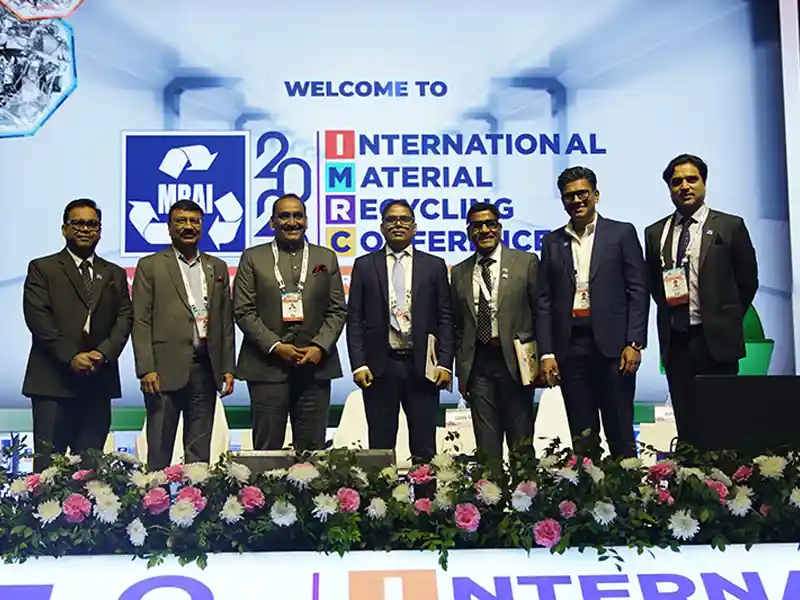
Highlighting operational challenges, Shri. Sanjay Mehta, President, MRAI, stressed the urgent need for policy rationalisation. “The recycling industry needs GST on scrap to be reduced to 5%, as current high rates are hurting growth and pushing the sector into non-compliance. Further, the import duty on aluminium scrap needs to be fully removed. Extended Producer Responsibility across e-waste, tyres and plastics must also be implemented more effectively, as weak enforcement is undermining the recycling value chain,” he said.
Emphasising the social dimension of recycling, Shri. Mehta added that nearly one-third of scrap in India originates from ragpickers, households and small workshops. “Lower GST and routing scrap purchases from the unorganised sector through UPI-based transactions, while discouraging cash at the first level of collection, will help bring these workers into the formal economy with dignity and sustainability,” he said.
Speaking on the evolving industry landscape, Shri. Dhawal Shah, Senior Vice President, MRAI, said that recycling in India has decisively transitioned from a CSR-driven activity to a core business strategy. India today had more than 1400 start-ups operating across waste management and sustainability. At this pace, the recycling industry could surpass mining well before 2050, reflecting the scale, confidence and long-term opportunity emerging across the sector.”
Shri. Zain Nathani, Vice President of MRAI called India's recycling industry to be a game changer and the Government's duty rationalisation impetus would further help. Shri. Amar Singh, Secretary General of MRAI mentioned that the Indian recycling industry has seen a transition and poised to take further leaps with enhanced contributions in the GDP.
Shri. Rajat Agarwal, Managing Director of Gravita India Limited, while addressing the role of finance and global capital stresses that capital was no longer a constraint for responsible recyclers. He said, “Global green funds and ESG-focused investors are actively backing scalable recycling platforms that deliver both financial returns and environmental impact. Recycling today sits at this powerful intersection.” He added that with strong governance, supportive policies such as EPR, and India’s circular economy vision, Indian recyclers are now globally competitive climate-solution providers.
Organised by the Material Recycling Association of India (MRAI), the three-day conference is being held from January 20–22, 2026, at the Novotel Jaipur & Convention Centre, Jaipur, and brings together policymakers, industry leaders, and global stakeholders to discuss recycling’s role in sustainable industrial growth.
The conference opened with discussions on sustainability, climate change, energy storage and circular economy transitions, while also addressing long-standing industry concerns around regulatory clarity and market stability.