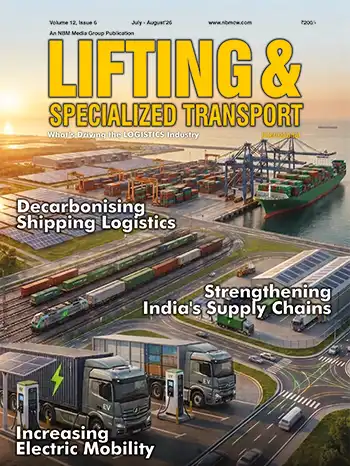
Logistics decarbonisation has moved from a voluntary commitment to a structural requirement. Regulators, investors, and large customers are all asking the same question of freight and supply chain companies: how quickly are emissions being reduced? For an industry built around trucks, ships, and warehouses, this shift places container reuse and digital matching technology at the centre of the conversation. These are practical tools that can lower emissions and costs simultaneously, and they can be adopted without requiring businesses to fundamentally change how they operate.“The future of logistics decarbonisation lies not only in cleaner fuels, but in using existing assets more intelligently. Container reuse and smart matching can reduce empty movements, lower costs, and deliver measurable emissions savings without requiring major changes to existing operations,” says Dhruv Taneja, Founder & Global CEO, MatchLog.

The Weight of Scope 3 in Logistics
Most companies still think of their carbon footprint mainly in terms of their own factories, offices, and vehicles. For logistics companies, this framing misses the larger picture. Category 4 emissions, covering upstream transportation and distribution, typically account for 60% to 80% of total Scope 3 emissions in the sector, reflecting its dependence on extensive freight networks and subcontracted carriers operating trucks, ships, trains, and aircraft (Nexio Projects, 2026). Corporate supply chain emissions are, on average, 26 times higher than a company's own direct operational emissions, according to CDP data (EcoVadis, 2026).These are also the emissions that are hardest to measure, since they occur across networks a company does not directly control. A recent MIT-linked study found that spreadsheets remain the primary tool used by most organisations to track Scope 3 data, which helps explain why so many disclosures today are based on estimates rather than measured figures (EcoVadis, 2026). Any credible decarbonisation strategy in logistics therefore has to treat these upstream transportation emissions as a primary focus, rather than a footnote in a wider sustainability report.
Empty Running Is Also an Emissions Problem
The inefficiency at the heart of freight movement has long been treated as an operational cost issue. It is equally an emissions issue. In Europe, around 20% of trucks run empty at any given time, while partially loaded vehicles are also common (Transport & Environment). Research published in Nature Communications studied China's road freight sector and found that improvements in load factor and reductions in empty running could cut road freight emissions by 9% to 24% in the near term and by more than 23% over the longer term (Nature Communications, 2026).This makes logistics efficiency one of the most viable near-term levers for emissions reduction, and one that does not carry the capital burden associated with many fuel-switching programmes. AI-powered freight-matching platforms are already demonstrating this in practice, with several reporting reductions in empty miles of 30% or more by replacing manual load searches with algorithms that match available capacity to nearby demand in real time (CXTMS, 2026).
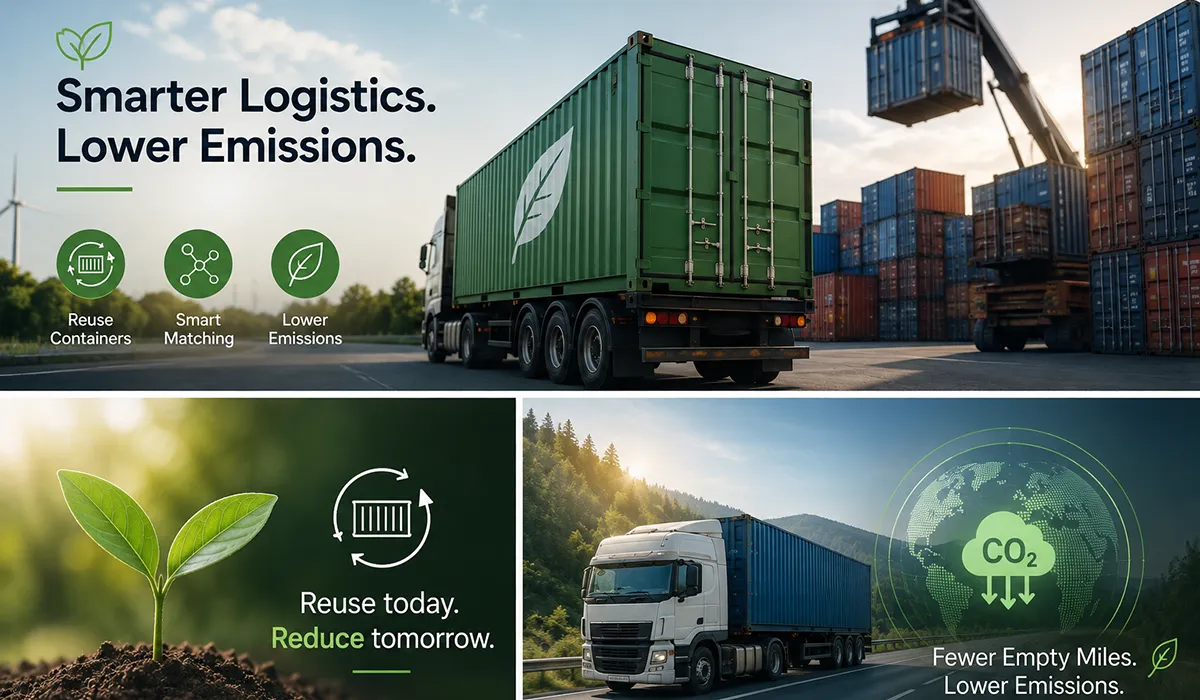
The pattern across markets is consistent. When trucks and containers move loaded instead of empty, the emissions savings scale directly with the distance no longer driven without cargo.
How Container Reuse Fits the Decarbonisation Agenda In between the article.
“Container reuse enables decarbonisation by making smarter use of existing assets, reducing empty movements, fuel consumption, and emissions.”Container reuse, commonly known in the industry as a street turn, applies this same logic to ocean freight and inland trucking. Instead of returning an empty import container to a depot before it is sent out again for an unrelated export booking, the container is matched directly with a nearby export load and reloaded for its outbound journey. This can eliminate two idle truck legs and one depot-handling cycle from every matched movement, each of which carries its own diesel consumption and emissions load.
What makes this approach distinct from many other decarbonisation levers is that it does not depend on new vehicle technology, alternative fuels, or large capital investments. Electric trucks and low-carbon fuels remain important long-term solutions, but their adoption has remained uneven because of infrastructure limitations, high upfront costs, and uncertain freight demand in many markets, including India (SupplyChainBrain, 2026).
Container reuse works within the existing fleet and container pool, extracting emissions savings from assets businesses already own and operate. For an industry under pressure to demonstrate progress on decarbonisation while still managing thin operating margins, this is a lever that draws on smarter use of resources already in hand, without requiring a new balance-sheet commitment.
Technology as the Enabler
Street turns have historically been underused largely because of a visibility gap. Matching an import container with a compatible export booking requires real-time data on container location, condition, size, ownership, and carrier approval. This information has traditionally been spread across separate spreadsheets, phone calls, and disconnected systems.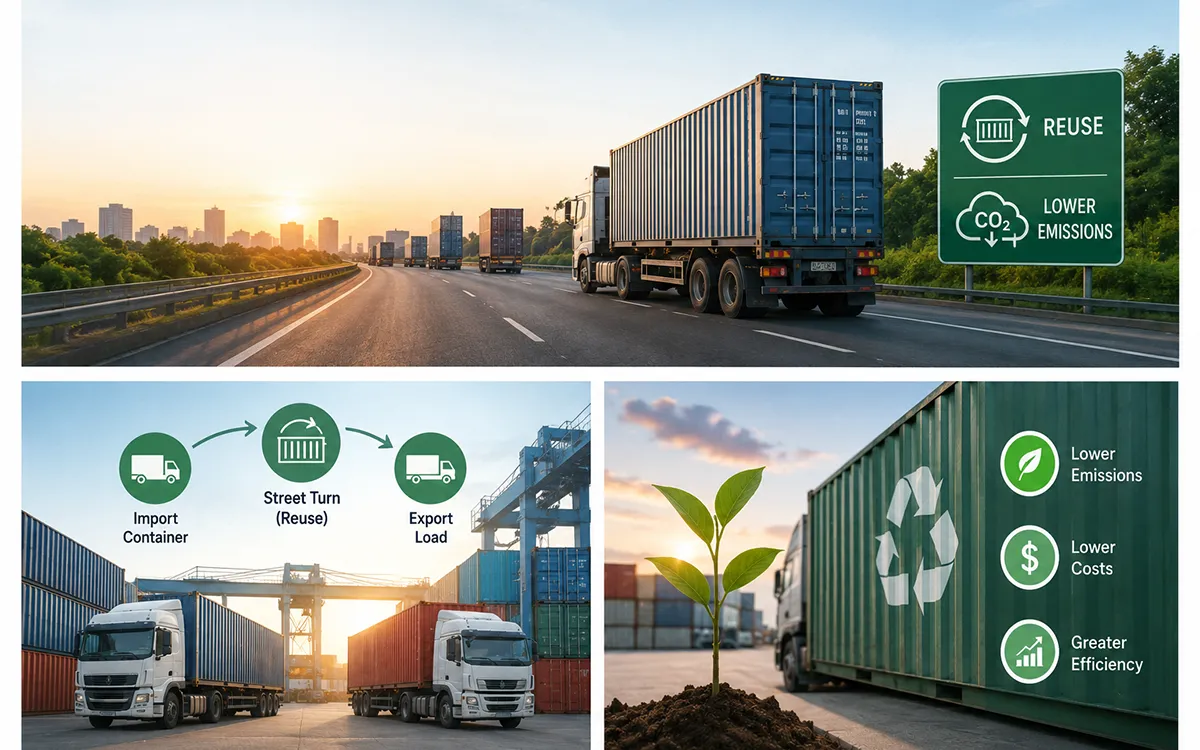
Digital matching platforms address this challenge by bringing together booking data, container specifications, and carrier rules in a single system, allowing a match to be identified and confirmed within the same operational window in which a business already works.
This is an important distinction for any company evaluating decarbonisation options. Adopting a matching platform does not require new trucks, new depots, or new contracts with shipping lines. It simply connects existing bookings with existing capacity more efficiently, which is why it can be adopted without disrupting day-to-day operations.
The same data layer that enables the match also produces something businesses increasingly need: a verifiable record of container movements avoided and the corresponding diesel and emissions savings. This data can feed directly into sustainability reporting as part of the normal operational workflow.
The Regulatory Push Making This Urgent
“As sustainability disclosures become more stringent, measurable reductions in empty container movements are becoming a business imperative—not just an environmental goal.”India's regulatory environment is accelerating this shift. The Securities and Exchange Board of India has moved its Business Responsibility and Sustainability Reporting framework from a largely voluntary exercise to one with phased mandatory assurance. This coverage extends from the top 150 listed companies in FY 2023-24 to the top 1,000 by FY 2026-27 (Maheshwari & Co, 2026).
Value-chain disclosures, covering emissions generated by suppliers and logistics partners in addition to a company's own operations, are central to this expansion. For any listed manufacturer, retailer, or exporter working through third-party logistics providers, this means their carriers' empty running and fuel consumption will increasingly show up in their own sustainability reporting.
Exporters face parallel pressure from outside the country as well. The European Union's Carbon Border Adjustment Mechanism continues to apply to Indian exports even under the recently signed India-EU trade agreement (Treelife, 2026). The carbon intensity associated with the logistics used to move goods to European buyers now carries a direct cost implication alongside the reputational one.
Logistics companies that can demonstrate measurable reductions in empty container movements are no longer offering a nice-to-have service. They are helping their clients meet compliance obligations that are becoming harder to avoid with each reporting cycle.
What Adoption Looks Like in Practice
For a business considering this shift, the practical path is narrower than it might appear. It begins with connecting existing container and booking data to a matching system, typically starting with the busiest import-export corridors where matching opportunities are most frequent.No fleet changes, depot investments, or new carrier agreements are required at this stage. Matches are validated against each carrier's own street-turn approval rules, since shipping lines retain the final say on whether a specific container can be reused in this way.
Once a base of matched movements is established, the same data can be extended into monitoring and reporting. This gives a business both an operational efficiency gain and a documented emissions reduction that it can incorporate into its own disclosures or share with a customer requesting such information.
None of this requires businesses to pause existing operations while the system is put in place. This is a key reason why it can find faster adoption than fleet-electrification or fuel-switching programmes that demand a longer transition period.
Efficiency and Emissions as a Single Metric
“In freight logistics, efficiency and emissions reduction are becoming two sides of the same metric—what saves fuel and time also lowers carbon.”The larger point that businesses navigating this space should take away is that cost efficiency and emissions reduction have effectively become the same metric in freight logistics. A container that avoids an unnecessary depot run saves diesel, driver hours, and turnaround time, and each of these savings maps directly onto a lower carbon figure in a sustainability report.
This alignment removes the usual tension companies face when weighing sustainability investments against operational budgets, since here the two move in the same direction. As Indian and global businesses face tightening disclosure requirements alongside continued pressure on freight costs, technology-enabled container reuse offers a lever that is measurable, immediately actionable, and built entirely on infrastructure that already exists.
The businesses that adopt it early will be better placed on both fronts—meeting their emissions targets while strengthening the operational discipline that keeps freight costs under control.