The report, which draws on a robust survey conducted with over 150 senior executives across five major industry sectors (Manufacturing, Retail & FMCG, Construction & Infrastructure, Pharma & MedTech, and Oil & Gas), provides a comprehensive assessment of Artificial Intelligence (AI) and Generative AI (GenAI) deployment, operational bottlenecks, and financial impacts across the modern enterprise landscape.
The Pilot Paradox: Ambition vs. Value Realization
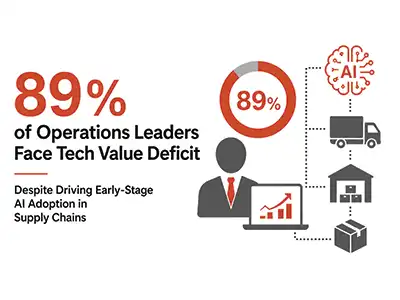
According to the report's underlying 2026 Digital Trends in Operations Survey, 85% of business leaders confidently state they are ahead of their industry competitors in digital transformation. However, true integration remains trapped in pilot phases. Only 27% of organizations have fully embedded an AI-driven strategy across their business units, and a mere 37% feel comfortable delegating end-to-end supply chain processes to autonomous AI agents.• 89% of operations leaders report technology investments have missed expected target returns.
- 44% of surveyed organizations have successfully initiated active AI pilots or proofs of concept (POCs).
- 19% potential supply chain cost reduction can be unlocked by early transformation leaders by 2030.
- 16% projected revenue gains are achievable through enterprise-wide holistic AI integration.
Critical Barriers and Sub-Function Tractions
The transition to advanced frameworks like agentic AI—which moves past static analytics toward autonomous execution—faces critical implementation hurdles. The report identifies data security concerns and budgetary constraints as universal blockers, cited by 100% of respondents pausing GenAI initiatives. This is closely followed by insufficient data quality or availability, which impacts 88% of both conventional AI and GenAI deployments.Despite these headwinds, forward-looking enterprises are mapping deployment aggressively across critical supply chain sub-functions. Organizations see the highest immediate adoption potential in supply chain risk monitoring (56% AI / 51% GenAI), automated customer-supplier communication management (53% AI / 37% GenAI), and warehousing and logistics operations (51% GenAI).
"The modern supply chain is operating in an increasingly volatile, complex, and ambiguous (VUCA) environment, driven by global trade shocks and resource constraints. While the potential of agentic AI is clear, turning that potential into measurable value requires robust foundational elements—such as a connected digital ecosystem and rigorous data governance—rather than just a top-down technology push." — Ajay Nair, Partner and Leader, Supply Chain and Operations Transformation, PwC India
Strategic Roadmap for CXOs
The report outlines clear strategic mandates for C-suite executives looking to successfully sustain this digital shift:- Build a Strong Digital Foundation: Treat data architecture as a multi-year capital commitment, actively mitigating the 87% value degradation caused by fragmented ERPs and low data quality.
- Focus on Quantifiable Impact: Mandate that every AI initiative maps directly to a defined KPI baseline, targeted uplift metric, and clear business owner accountability.
- Establish Trust at Scale: Build strict governance loops to handle real-time machine execution safely as the traditional human-in-the-loop checkpoint begins to disappear.