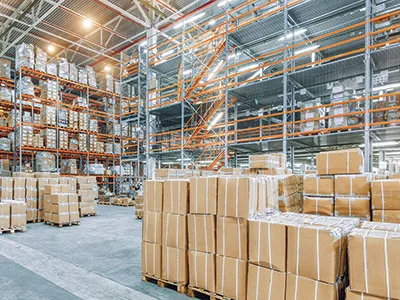
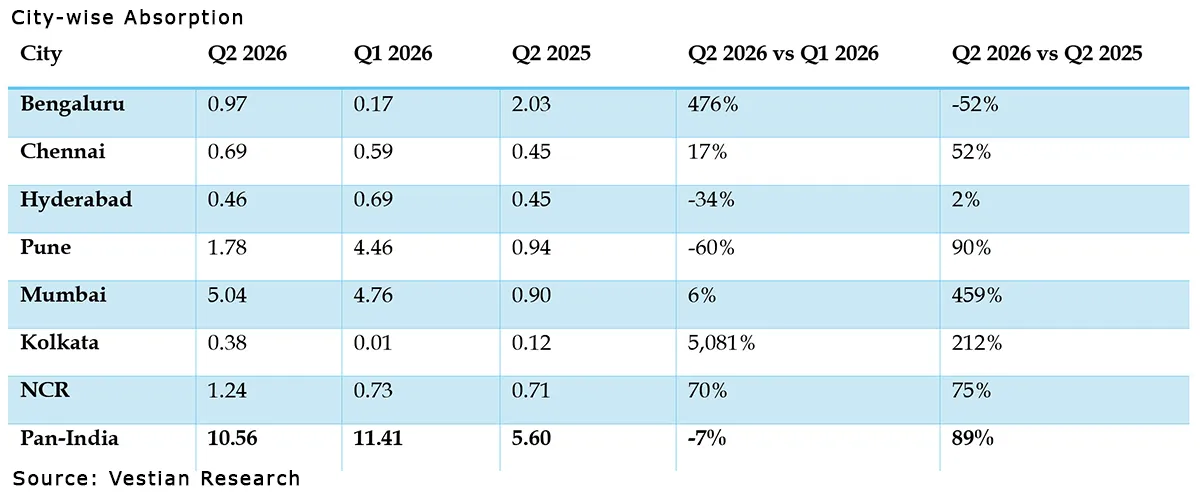
Western India remained the key growth engine during Q2 2026, with Mumbai and Pune accounting for 65% of the pan-India absorption, up from 33% a year earlier. Mumbai emerged as the largest contributor, driven by robust leasing activity in the Bhiwandi micro-market, which accounted for nearly 69% of the city's absorption. Although Pune remained the second-largest market, its share moderated to 17% from 39% in the previous quarter following strong leasing activity in Q1. Meanwhile, NCR, Bengaluru, Chennai, and Kolkata also registered healthy demand, reflecting broad-based occupier activity across major markets.
Occupier demand was mainly concentrated among core industry segments during Q2 2026. Third-party logistics (3PL) companies led leasing activity with a 41% share, followed by Consumer Goods & Services (12%) and Engineering & Manufacturing (11%). Together, these sectors accounted for nearly two-thirds (64%) of the total absorption, while Energy, Automobiles & Auto Components, and Chemicals & Petrochemicals collectively contributed another 22%.
Robust demand continued to support long-term investor interest in the sector. However, amid global uncertainty, institutional investors remained selective, with investments totalling USD 27 Mn in Q2 2026, accounting for just 1% of the total quarterly real estate investments. While investment volumes increased by 25% over the previous quarter, they remained below the level recorded a year earlier.
- Mumbai led with 5.0 Mn sq ft of absorption, registering 6% quarterly and 459% annual growth. The city has maintained a steady upward trajectory over the past four quarters, supported by sustained leasing activity in the Bhiwandi micro-market. Pune ranked second with 1.8 Mn sq ft; however, absorption declined by 60% from the previous quarter after several large transactions were concluded in Q1 2026.
- NCR recorded 1.2 Mn sq ft of absorption, increasing by 70% quarter-on-quarter and 75% year-on-year. Bengaluru also witnessed a strong recovery, with leasing rising to 1.0 Mn sq ft—the highest since Q2 2025—following a subdued previous quarter.
- Chennai continued its positive momentum, with absorption rising 17% sequentially and 52% annually to 0.7 Mn sq ft. Hyderabad, in contrast, recorded 0.5 Mn sq ft, declining 34% over the previous quarter while remaining broadly stable year-on-year.
- Kolkata rebounded strongly during the quarter, with absorption increasing to 0.4 Mn sq ft from a negligible level in Q1 2026 and registering 212% annual growth.
Shrinivas Rao, FRICS, CEO, Vestian, said, "India's warehousing sector is undergoing a structural transformation, evolving beyond traditional priorities such as supply chain optimisation, operational efficiency, and proximity to demand centres. Sustainability has emerged as a key differentiator, with occupiers increasingly seeking Grade A green warehouses that align with their ESG commitments and long-term business objectives. Backed by supportive government policies and sustained infrastructure development, this transition is expected to accelerate further, reinforcing the sector's appeal to both global occupiers and long-term institutional investors."
Going forward, demand from 3PL, Engineering & Manufacturing, and Consumer Goods & Services is expected to remain the primary driver of leasing activity. Continued investments in multimodal infrastructure, technology-enabled warehousing, and supply chain modernisation are likely to sustain occupier demand while gradually strengthening institutional investor confidence in the sector.