
Supply Chain Digitalization: What's Working, What's Not, and What's Next
India's infrastructure ambition sits on a supply chain that appears only half-digital. The paperwork has moved online. Much of the buying still seems to travel on WhatsApp and email. The distance between the two may well be the story of the last five years, and perhaps it explains both the confidence and the caution one hears in this sector today. There is reason for the confidence. The DPIIT-NCAER assessment now places India's logistics cost at 7.97 percent of GDP for FY 2023-24, a striking shift from the 13 to 14 percent long cited as a structural drag. PM Gati Shakti has onboarded 57 ministries and departments, with more than 1,700 data layers integrated into the National Master Plan. Twenty-seven states have notified logistics policies. Under the Bharatmala and Sagarmala assets that took a decade to build, digital rails now exist as well. The question worth sitting with is what this progress has actually unlocked, and where it has quietly stopped."A resilient supply chain is never built on a single route, a single country, or a single supplier. True resilience lies in diversification, optionality, and the ability to continuously adapt to an evolving world."
Rahul Garg, Founder and CEO, Moglix

What seems to be working
Three shifts appear to have taken hold.The first is procurement digitization at the transaction layer. Indents, RFQs, quote comparisons, and approvals now tend to move through single systems. Cycle times, in categories one can observe closely, seem to have compressed by 30 to 50 percent.
The second is catalogue-led buying for MRO and long-tail items. What used to take two weeks of phone calls can now take an hour of browsing.
The third is embedded finance. Supplier discounting and buyer-side credit lines appear to have shortened cash conversion for both sides of the transaction.
The productivity gains are visible enough. Maverick spend seems to have narrowed. Vendor bases have consolidated. GST input credit leakage appears to have reduced. The interesting question is whether these are lasting shifts, or the easy part of a much longer road.
What may not be working
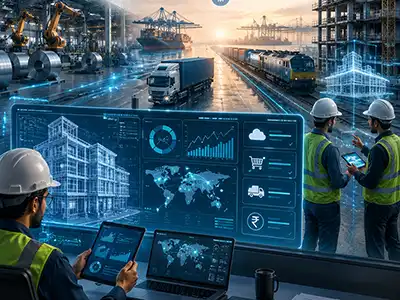
The first is data. Most infrastructure companies still seem to run on fragmented item masters. Vendor records duplicate across sites. Specifications often live in PDFs. Without clean data, one wonders how trustworthy any dashboard can be, or how useful any AI model built on top of it.
The second is the supplier side. Tier-2 and Tier-3 suppliers, who produce much of what large projects consume, still appear to operate on paper and phone. Portals built for large enterprises may not translate well to small factories. It is worth asking whether digitalization that stops at the buyer's ERP is really digitalization at all.
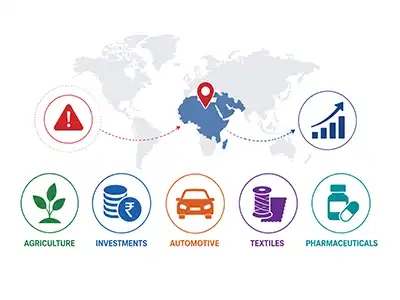
The third is external shock, and here the last eighteen months have offered a hard set of lessons. Red Sea shipping is only now testing a cautious return under naval escort after two years of Cape rerouting. The Strait of Hormuz, through which nearly a third of global seaborne crude passes, remains a live risk. US Section 232 tariffs on steel and aluminium have doubled to 50 percent. The Nexperia standoff between the Netherlands and China rippled through automotive chip supply in late 2025, before a partial de-escalation. India's own critical minerals position, with 100 percent import dependency on lithium, cobalt, and nickel, sits underneath every renewable, EV, and data centre build in the country.
A few questions may be worth carrying forward. Should any serious supply chain sit on a single route, a single country, or a single supplier? Is concentration the real vulnerability that recent shocks have exposed? Might diversification, optionality, and the willingness to keep adapting be the actual meaning of resilience, rather than a project that can ever be marked complete?
What one might foresee
If the current signals hold, a few things may become clearer over the next three to five years.Procurement may move from being a back-office function to a boardroom conversation. When a chip standoff, a tariff proclamation, or a shipping lane closure can change the economics of an entire project quarter, the head of procurement may increasingly sit next to the CFO rather than under them.
The definition of a good supplier may shift. Price and quality will remain non-negotiable, but geography, ownership structure, and jurisdictional exposure may become part of the scorecard. Companies may start asking questions of their vendors that they have historically asked only of their auditors.
India's own manufacturing story may quietly become a supply chain story. As global buyers look for the next node beyond China, the country's ability to offer not just capacity but digitally visible, financially transparent, and geopolitically stable supply may matter more than the headline PLI number.
Small suppliers may leapfrog. WhatsApp, UPI, and mobile-first catalogue apps may do for Tier-3 factories what enterprise software never quite managed. The digitalization curve for small manufacturers may look less like a slow climb and more like a sudden step.
What could come next
Data before AI. Companies that invest in clean item masters, unified vendor records, and structured specifications may see disproportionate value from every tool that follows. A useful starting point may be a six-month audit of item and vendor masters before any AI pilot is even discussed.
Supplier enablement as a first-class problem. Perhaps digitalization should be measured by how many Tier-2 and Tier-3 vendors can transact digitally, not by how sophisticated the buyer's ERP has become. A practical test may be whether a small factory in a Tier-3 town can raise an invoice, receive payment, and access credit without leaving its phone.
AI in the judgement layer. Should-cost engines, demand sensing, geopolitical risk scoring, and specification standardization may be where AI earns its keep. Digital-twin and BIM mandates now appearing in public tenders could push this further. The point to watch may be whether AI is used to replace the intern or to sharpen the category manager.
Financing as core plumbing. Every purchase order carries a financing implication. Supply chain finance may be better treated as a utility than as a product. The question worth asking is whether every PO in the system carries an embedded credit and cash-flow view, or none of them do.
A closing observation
Infrastructure delivery in India runs on thousands of small decisions made every day by people at sites, in category teams, and inside supplier factories. The last decade seems to have helped these decisions become faster. The next decade may need to help them become better, and that is a different problem altogether.If one had to leave three thoughts on the table, they might be these. The winners of the next cycle may be the companies that treat data hygiene as strategy, not as housekeeping. The most valuable supply chain investment may turn out to be the one made in the smallest supplier. And resilience, in the end, may prove to be less about technology and more about the discipline of never depending on any single thing.
Published on:
29 July 2026
Share:
We Value Your Comment