Over the past five to six years, the market has expanded significantly in terms of asset classes, geographic presence and investor base. India now has five office REITs, one retail REIT and one industrial & warehousing InvIT, highlighting the growing maturity and scalability of these investment platforms.
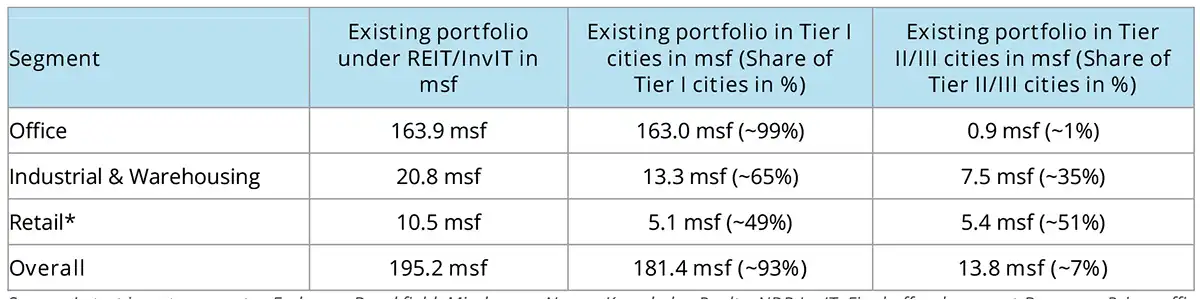
As of March 2026, the combined operational portfolio of listed REITs and InvITs has crossed 195 million sq ft, with an additional 37 million sq ft in the development pipeline. Office assets continue to dominate, accounting for 84% of the total operational portfolio, while retail and industrial & warehousing segments are steadily gaining traction.
Existing REIT/InvIT portfolio in India: Primary asset break-up
Source: Latest investor reports - Embassy, Brookfield, Mindspace, Nexus, Knowledge Realty,
NDR InvIT, Final offer document-Bagmane Prime office REIT, Colliers
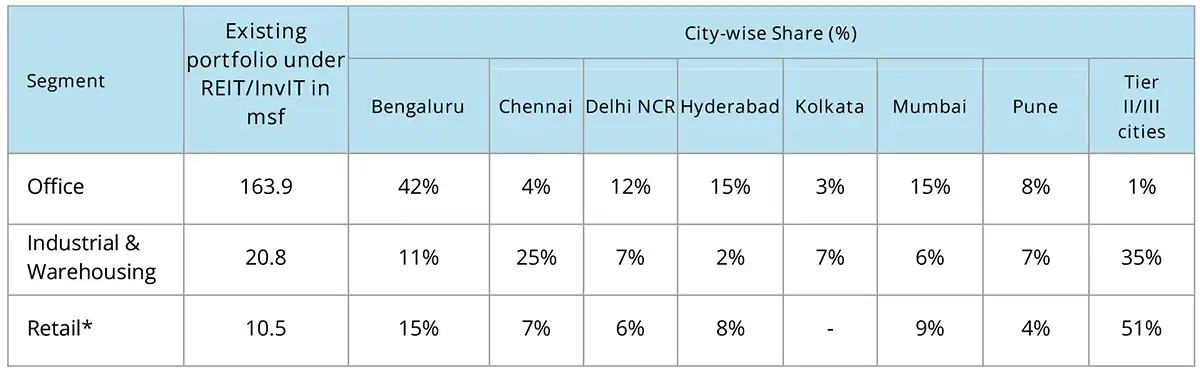
The office REIT portfolio remains heavily concentrated in Tier I cities, where institutional-grade supply and occupier demand are strongest. Of the nearly 164 million sq ft of office assets under REITs, Bengaluru accounts for 42%, followed by Hyderabad, Mumbai and Delhi NCR, each contributing 12-15%.
City-wise break-up of operational asset mix in existing REIT/InvIT
Source: Latest investor reports - Embassy, Brookfield, Mindspace, Nexus, Knowledge Realty, NDR InvIT,
Final offer document-Bagmane Prime office REIT, Colliers.
In contrast, retail and industrial & warehousing REIT/InvIT assets show greater geographic diversification. Tier II and Tier III cities currently account for 35% of industrial & warehousing InvIT assets and 51% of retail REIT assets, reflecting the emergence of new consumption and logistics hubs across the country.
Office REIT Portfolio Doubles in Five Years
Operational assets under office REITs have more than doubled over the last five years, increasing from 72 million sq ft in 2021 to nearly 164 million sq ft by March 2026. As a result, office REIT penetration—the share of Grade A office stock listed under REITs—has increased from 11% to 19% during the same period.Among the major office markets, Bengaluru has the highest REIT penetration at around 30%, followed by Hyderabad, Mumbai and Pune, where REIT penetration ranges between 15% and 20%. More than two-thirds of the office space held by existing REITs is located in Secondary Business Districts (SBDs).
India office REIT snapshot (Tier I cities)

Source: Colliers
According to Colliers, nearly 370 million sq ft of existing Grade A office stock across Tier I cities has the potential to be listed under future REITs, providing a strong pipeline for market expansion.
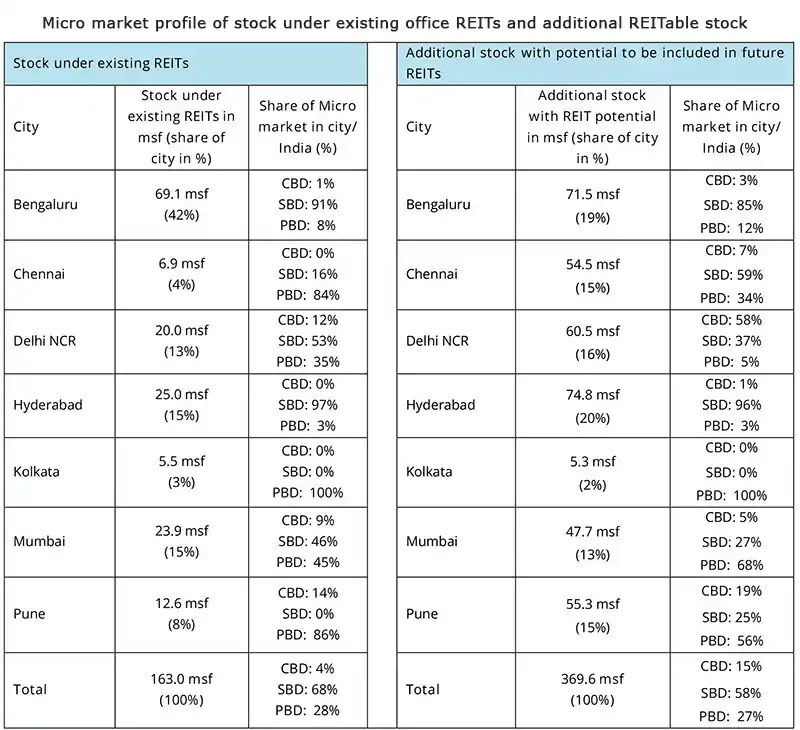
Source: Colliers
"With another major developer recently listing its portfolio, India now has five office REITs. Operational office assets under REITs have grown from around 72 million sq ft in 2021 to over 160 million sq ft today. Nearly one-fifth of India's Grade A office stock across the top seven cities is now under REITs, reflecting rising institutionalisation and growing investor confidence. With an additional 370 million sq ft of REIT-worthy office space available, office REIT penetration could increase to around 30% by 2030, supported by quality green-certified assets, healthy occupier demand and sustained investor interest."
Leasing Remains Strong
Office REITs have recorded more than 60 million sq ft of gross leasing since 2021, driven by strong demand for Grade A office space. In the first quarter of 2026 alone, leasing touched around 5 million sq ft, nearly double the average quarterly leasing recorded since 2021. Occupancy across listed office REITs remains above 90%, while rentals have increased by 4-8% year-on-year.Technology companies continue to be the largest occupiers, accounting for nearly one-third of leased space, followed by the BFSI sector. Global Capability Centres (GCCs) have emerged as a major demand driver, contributing 40-60% of leasing activity across REIT assets.
REIT and InvIT Penetration to Rise Further
Colliers expects REIT and InvIT penetration to increase across office, retail and industrial & warehousing assets as institutional-quality supply expands and the market becomes more organised. By 2030, office REIT penetration is expected to rise from the current 19% to 25-30%, while industrial & warehousing InvIT penetration is projected to increase from 4-5% to 7-10%.Vimal Nadar, National Director & Head of Research, Colliers India, said, "The seven listed REITs and InvITs backed by real estate assets now have a combined market capitalisation of over ₹2,100 billion, compared with around ₹600-650 billion in 2022, when only three REITs were listed. During the same period, the number of unitholders has increased more than fivefold, highlighting growing investor confidence and the increasing democratisation of real estate investment in India."
Colliers believes that strong occupier demand, expanding institutional-grade supply, increasing participation from institutional and retail investors, supportive regulations and greater adoption of technology will drive the next phase of REIT and InvIT growth. The report also expects Tier II and Tier III cities to play a larger role in future expansion, supported by improving infrastructure, rising economic activity and growing demand for quality commercial assets.