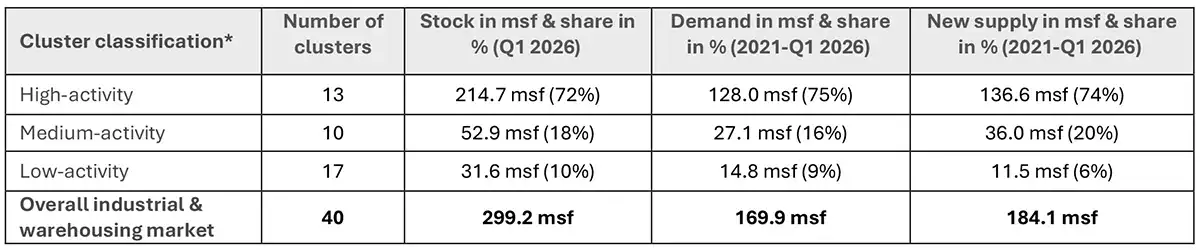
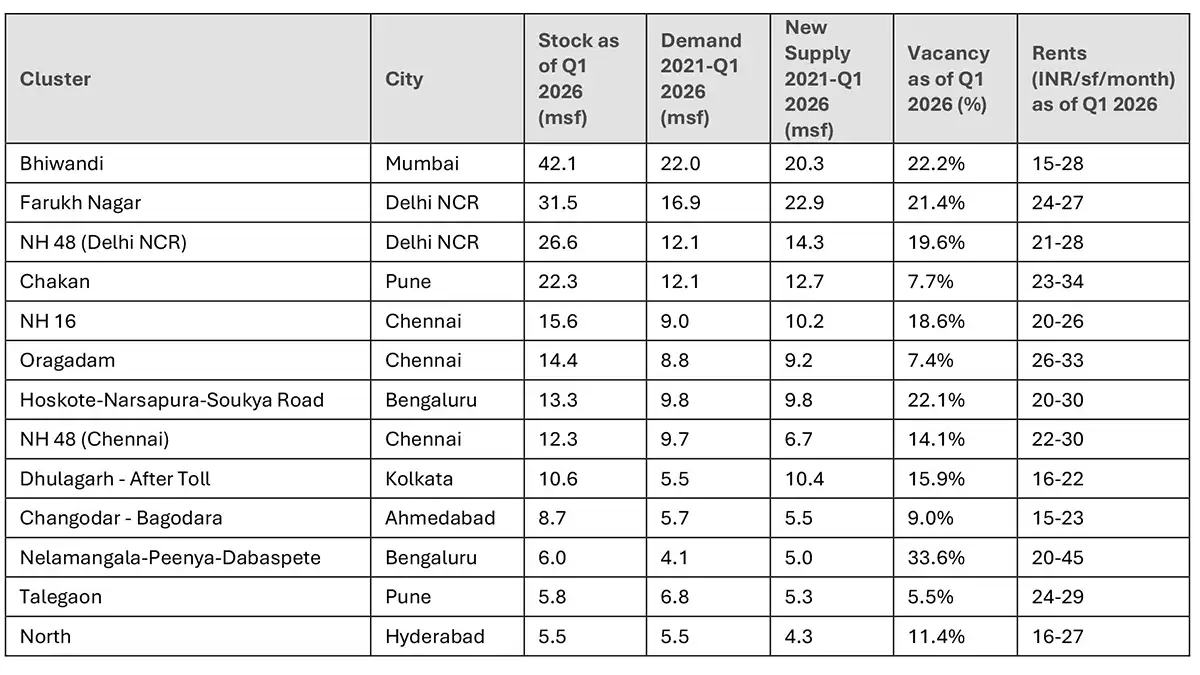
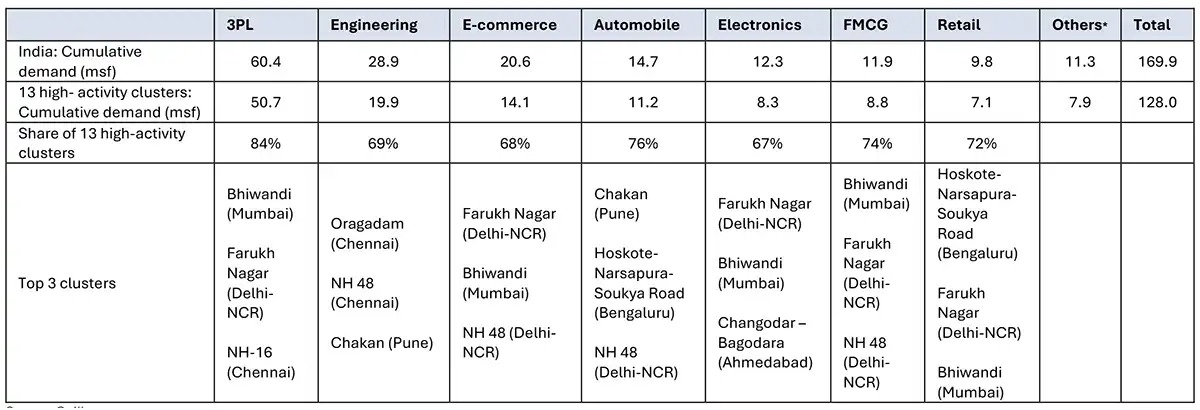
India's industrial and warehousing sector is expected to be led by 13 high-activity clusters that are likely to account for 70–80% of the country's industrial and warehousing activity in the coming years, according to Colliers India. Over the last five years, these clusters have contributed nearly 75% of the country's leasing activity and new supply. Chennai leads with three high-activity clusters, followed by Delhi NCR, Pune and Bengaluru with two each. While Bhiwandi continues to drive demand from the third-party logistics (3PL) sector, Oragadam has emerged as the preferred destination for engineering companies and Farukh Nagar for e-commerce occupiers. Average rentals across most of these high-activity clusters are also expected to increase by 5–10% annually in the coming years.
Industrial & warehousing clusters: A snapshot
Source: Colliers
India’s industrial and warehousing market has emerged as one of the country's best-performing real estate asset classes, driven by rising scale and Grade A stock, which has reached nearly 300 million sq. ft.—almost double the inventory recorded in 2021. The post-pandemic period has also witnessed a marked improvement in asset quality and growing institutional investment. This expansion has been largely driven by 13 high-activity clusters, identified from a wider universe of 40 industrial and warehousing clusters across the country.
13 high-activity industrial & warehousing clusters across India's top 8 cities
Source: Colliers
Note: Data for warehousing / industrial sheds pertains to Grade A buildings | Absorption does not include lease renewals, pre-commitments and deals where only a Letter of Intent has been signed | Data pertains to the top 8 cities – Ahmedabad, Bengaluru, Chennai, Delhi NCR, Hyderabad, Kolkata, Mumbai and Pune | Rents are on built up area and do not include common area maintenance (CAM) or taxes.
These high-activity clusters have each recorded more than 4 million sq. ft. of cumulative leasing and fresh supply since 2021. Collectively, they account for nearly 75% of India's cumulative demand and new supply during the period and currently house around 215 million sq. ft. of Grade A stock. Geographically, the clusters are well distributed across the country's major consumption centres, with three located in Chennai, two each in Delhi NCR, Bengaluru and Pune, and one each in Mumbai, Kolkata, Ahmedabad and Hyderabad.
Top clusters across demand segments (2021-Q1 2026)
Source: Colliers
High-Activity Clusters Benefit from Infrastructure-Led Growth
According to Colliers, the strong performance of these clusters is supported by improved infrastructure, better connectivity and enhanced logistics linkages.Bhiwandi, in the Mumbai Metropolitan Region, remains India's largest industrial and warehousing cluster, with approximately 42 million sq. ft. of Grade A stock. Its strategic location near Jawaharlal Nehru Port and direct access to the Mumbai-Ahmedabad and Mumbai-Nashik Expressways have made it the country's leading logistics hub. Notably, Bhiwandi's Grade A inventory alone exceeds the total warehousing stock of Hyderabad, Ahmedabad, Kolkata, Bengaluru and Pune.
Similarly, Farukh Nagar and NH 48 in Delhi NCR continue to attract strong warehousing demand due to their proximity to North India's industrial hubs and improved connectivity through the Western and Eastern Dedicated Freight Corridors, the Kundli-Manesar-Palwal Expressway and the Delhi-Mumbai Expressway.
In South India, NH 16, NH 48 and Oragadam in Chennai, along with Hoskote-Narsapura-Soukya Road in Bengaluru, continue to benefit from improved regional connectivity through the Bengaluru-Chennai Expressway. Demand across these clusters is being driven by third-party logistics (3PL), engineering, e-commerce and automobile companies. Chennai's industrial ecosystem also benefits from the presence of an international seaport, further strengthening demand for industrial and warehousing space.