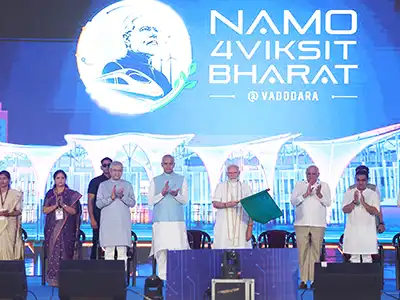
A key highlight of the event was the completion of the 2,800-km Dedicated Freight Corridor (DFC), comprising the Eastern and Western Dedicated Freight Corridors. Modi said the completion marks a major milestone for India’s logistics infrastructure and will strengthen the country’s freight movement network.
The DFC network is enabling freight and passenger traffic to operate separately, allowing more than 430 cargo trains to run daily. The dedicated freight network is also expected to reduce travel time for goods movement, with truck journeys that previously took around 30 hours being reduced to around 10-12 hours on comparable freight movements.
The Prime Minister said the corridors will help reduce fuel consumption and freight costs while lowering the environmental impact of goods transportation. The improved logistics network is also expected to benefit farmers by enabling faster movement of perishable agricultural products such as flowers, fruits and vegetables to markets and mandis.
A double-stack container freight train from JNPT Port to Vadodara was also highlighted as an example of the corridor’s freight capacity. According to Modi, a single such train can carry cargo equivalent to more than 250 trucks.
The Prime Minister also highlighted the expansion of railway connectivity into previously underserved regions of Gujarat, Madhya Pradesh and Maharashtra. A newly launched train service connecting areas including Chhota Udepur and Alirajpur is expected to improve mobility for residents of these regions.
Modi said large-scale infrastructure spending on railways, roads, metros, airports and gas pipelines is creating employment while stimulating economic activity around new infrastructure assets. He cited the railway budget of more than Rs 2.75 lakh crore as an important driver of investment and job creation.
On manufacturing, Modi highlighted Vadodara’s industrial development and its emergence as an MSME hub. He also pointed to the city’s role in India’s aerospace manufacturing ecosystem, including the production of the C-295 military transport aircraft.
He said India has significantly expanded domestic manufacturing of railway equipment since 2014, with around 50,000 modern coaches produced and nearly 2.5 lakh wagons added to the railway network.
The Prime Minister also highlighted the growth of domestic solar manufacturing and renewable energy. He referred to the Kadana Dam floating solar project and the PM Surya Ghar Muft Bijli Yojana, which, according to him, has enabled 55 lakh families across the country, including 11 lakh in Gujarat, to become electricity producers.
He said strengthening the electricity ecosystem will be critical for emerging technologies such as data centres and artificial intelligence. The government is also working to secure access to uranium, critical minerals and rare earth elements to support the country’s future energy and technology requirements.
Modi further emphasised the importance of skill development and continuous reskilling as the nature of employment changes. He said the National Education Policy is focused on strengthening skills and adapting education and training systems to evolving economic requirements.
He also announced an initiative to provide free coaching for competitive examinations, aimed at reducing the financial burden on poor and middle-class families and supporting young people preparing for careers.
The Prime Minister outlined plans for a national campaign to make young people proficient in artificial intelligence, with applications spanning agriculture, healthcare, robotics and manufacturing. He said AI capabilities could support productivity, innovation and the growth of new startups.
Modi said these infrastructure, manufacturing, energy, education and technology initiatives are part of the broader effort to accelerate India’s development and achieve the vision of a developed India by 2047.