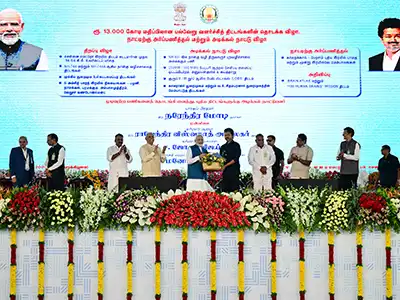

The framework was released in the presence of Prof. Abhay Karandikar, Member, NITI Aayog; Anurag Jain, CEO, NITI Aayog; Debjani Ghosh, Distinguished Fellow, NITI Aayog; representatives from the Ministry of Power, the Ministry of Electronics and Information Technology (MeitY) and the Department for Promotion of Industry and Internal Trade (DPIIT), along with industry and media representatives.
Developed with inputs from industry and government departments, the framework comes as India's data-centre capacity expands to meet rising demand for artificial intelligence (AI), cloud computing, high-performance computing and data-intensive digital applications. India's data-centre capacity has grown from approximately 375 MW in 2020 to around 1.5 GW currently.
As data centres become critical infrastructure for India's digital economy, their growing scale is increasing demand for electricity, water, land, connectivity and supporting local infrastructure. The framework encourages States to move beyond attracting investments and assess whether proposed projects can be supported by adequate resources and infrastructure over the long term.
The Government of India has also introduced measures to encourage data-centre investments, including a tax holiday until 2047 for eligible foreign cloud service providers using India-based data-centre infrastructure. As investments increase, State-level planning and investment readiness are expected to play an important role in supporting the sector's sustainable expansion.
Speaking at the launch, Prof. Abhay Karandikar highlighted the opportunity to use data-centre investments to strengthen India's technological capabilities. He emphasised domestic research and development, industry–academia collaboration and greater Indian participation across the data-centre technology value chain. He also identified advanced cooling, energy efficiency and resource-efficient computing as areas where India could develop innovative solutions.
Anurag Jain stressed the need to shift from investment attraction to investment readiness. He said States should assess infrastructure availability, resource requirements and potential economic benefits before committing support to data-centre projects. The framework is intended to help governments make informed decisions, anticipate constraints and facilitate faster, more predictable project execution without introducing an additional layer of regulation.
Debjani Ghosh said data centres were becoming critical strategic infrastructure as AI reshaped the global economy. She emphasised that India’s objective should extend beyond attracting investment to building sustainable capacity that strengthens competitiveness and delivers long-term economic value. The framework, she added, would help States identify suitable locations, plan infrastructure ahead of demand and ensure investments create measurable public value.
The framework is structured around five pillars: Power and Energy; Water and Cooling; Siting and Environmental Sustainability; Economic and Strategic Value; and Policy, Governance and Implementation.
Under the Power and Energy pillar, recommendations include assessing grid readiness and net grid draw, promoting renewable energy and storage-backed power, and evaluating the implications of additional electricity demand. For water management, the framework calls for assessing basin-level water stress and impacts on public water supplies, alongside measures such as rainwater harvesting, on-site water treatment and storage.
The framework also recommends lifecycle management plans for electronic waste, batteries and other hazardous waste. To maximise economic and strategic value, it proposes identifying suitable data-centre zones, distinguishing colocation facilities from active computing services, linking State incentives to measurable outcomes and promoting Make in India across information technology and non-IT infrastructure.
Time-bound approvals, clear accountability and monitoring of project commitments are also among the measures intended to improve implementation and investment certainty.
The framework will serve as a decision-support tool for State governments to evaluate proposals against infrastructure availability, environmental sustainability, economic value and implementation readiness. By identifying potential constraints early and clarifying project requirements, it aims to reduce implementation risks and support sustainable growth of India's data-centre ecosystem.