
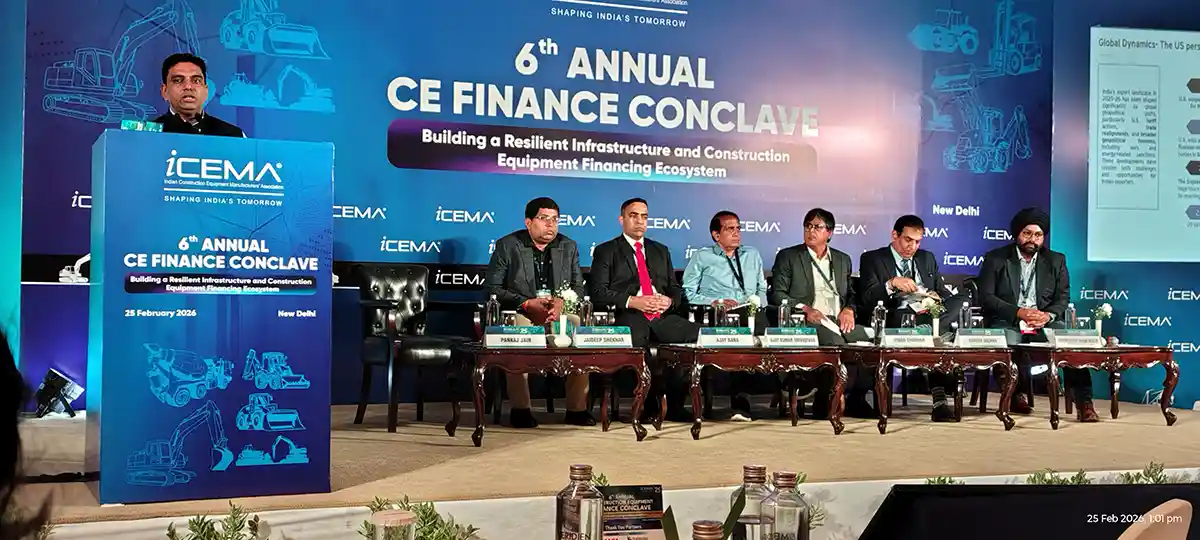
The Hon’ble Minister of Heavy Industries and Steel, Government of India, Shri H.D. Kumaraswamy, graced the occasion as Chief Guest. He stated that India today stands as the world’s fourth-largest economy, with a GDP of USD 4.18 trillion. “We are firmly on course to become the third-largest economy in the coming years. This growth trajectory is powered by infrastructure expansion, manufacturing depth, and capital investment. Under the visionary leadership of our Hon’ble Prime Minister, we are building not just roads and bridges, but the foundation of Viksit Bharat 2047.”
“The Union Budget 2026–27 has reaffirmed this commitment with a historic public capital expenditure allocation of Rs. 12.2 lakh crore. This sustained and strategic capex reflects a multi-year structural commitment to highways, railways, logistics corridors, ports, renewable energy infrastructure, urban expansion, and industrial clusters.”
The Minister added, “We are creating an ecosystem where domestic manufacturers can scale with confidence, innovate with security, and compete globally. A resilient construction equipment financing ecosystem will not only strengthen manufacturers; it will also empower contractors, MSMEs, logistics operators, and infrastructure developers across the country.”
Vimal Anand, Joint Secretary, Ministry of Commerce & Industry, stated: “Over the past two decades, India’s construction equipment exports have undergone a significant shift. New growth markets such as the Middle East, Africa, and SAARC countries have driven expansion, while traditional markets have witnessed a relative decline. Over the past seven years, exports have grown materially faster than domestic production, resulting in more than a threefold increase in their contribution to total output. This reflects a structural transformation in the industry, with incremental capacity increasingly oriented toward international markets.”
“The Indian construction equipment ecosystem, supported by progressive government policy formulation, is performing well and is poised to take India to greater heights. The strong export momentum further strengthens the sector’s position, enabling it to efficiently respond to the anticipated surge in construction equipment demand. These achievements reflect growing global confidence in India’s economic resilience and align with the nation’s vision of Viksit Bharat 2047.”
“However, financial and market volatility remain key challenges for the CE industry. High interest rates and tighter trade conditions increase borrowing costs, restricting private infrastructure capex. The lack of CE-specific financing solutions for MSMEs further limits smaller contractors from acquiring essential equipment, thereby constraining their operational capacity. Additionally, bottlenecks in contracting and governance — particularly delayed payments and low-margin bids — impede CE acquisitions, reduce operational efficiency, and slow project execution.”
“The sector also faces significant logistics constraints, including elevated freight costs, port delays, and quality-related issues, all of which increase expenses and hamper timely equipment deliveries. Other major challenges include geopolitical uncertainties, supply chain disruptions, scarcity of skilled labour, and fragmentation across the value chain. These factors contribute to higher input costs, project delays, reduced operational efficiency, and constraints on both domestic production and exports.”
“To address persistent financing constraints faced by CE exporters and to support long-term global expansion, the government has introduced initiatives such as the Advance Authorization Scheme and the Duty Drawback Scheme, which provide targeted incentives for exporters. The government continues to support the growth of India’s CE industry through increased infrastructure allocation, enhanced export and credit guarantees via Exim Bank and ECGC, and dedicated credit lines for CE OEMs, thereby creating an enabling environment for both domestic expansion and global competitiveness.”
“Complementing these broader support measures, the government also provides duty and GST relief on equipment and components, along with SEZ and EOU incentives. These initiatives enable CE manufacturers to enhance production efficiency and expand their export footprint. Initiatives aimed at improving market access, harmonizing regulatory standards, and reducing non-tariff barriers through Free Trade Agreements (FTAs), along with continuous engagement with various countries, are helping Indian CE manufacturers expand into new markets, streamline cross-border trade, and strengthen global competitiveness.
“The Department of Commerce remains steadfast in its commitment to supporting the growth of India’s CE industry and safeguarding its interests. The government is also committed to pursuing dynamic trade policies, robust export promotion measures, and investor-friendly reforms to further strengthen the CE industry’s growth and enhance its global competitiveness.”
Deepak Shetty, President, ICEMA, and CEO & Managing Director, JCB India, stated that the sector is a strong contributor to infrastructure development and overall economic growth. In the next phase of growth, the industry aims to strengthen domestic manufacturing capabilities, enhance technology adoption, and increase localization levels to around 80% over the next five years.
He highlighted that a critical enabler for this growth will be access to adequate and low-cost finance, given that the construction equipment sector is highly capital-intensive. Manufacturing facilities require significant investments in plant and machinery, technology upgrades, tooling, testing infrastructure, and compliance systems.
He pointed out that a large share of the supply chain comprises MSMEs, including component manufacturers, fabrication units, precision engineering firms, and hydraulics and electronics suppliers. For these enterprises, access to timely and affordable finance is essential for survival, modernization, and scale. On the demand side, he added that more than 90% of construction equipment sold in India is financed, making structured, affordable, and flexible financing solutions crucial for accelerating technology adoption and project execution.
ICEMA also thanked the Government for the recently announced Construction and Infrastructure Equipment (CIE) incentive programme and the allocation of ₹12.2 lakh crore for infrastructure, which will encourage investment in the construction equipment sector and help expand domestic manufacturing capacity in India. The scheme is both timely and strategic. It reflects the Government’s clear vision that India must not only scale up production but also deepen its technological capabilities, enhance localization, strengthen global competitiveness, and integrate more effectively into global value chains.
Deepak Garg, Convener, ICEMA Financial Ecosystem Panel and Vice Chairman & Managing Director, SANY Heavy Industry India, emphasized that the construction equipment sector plays a foundational role in nation-building and that financing remains a critical enabler, as a significant proportion of equipment purchases are funded through banks, NBFCs, financial institutions, and private financiers. He noted that strengthening the financing ecosystem will be essential to ensure timely project execution and faster adoption of advanced technologies aligned with the Government’s vision of Viksit Bharat.
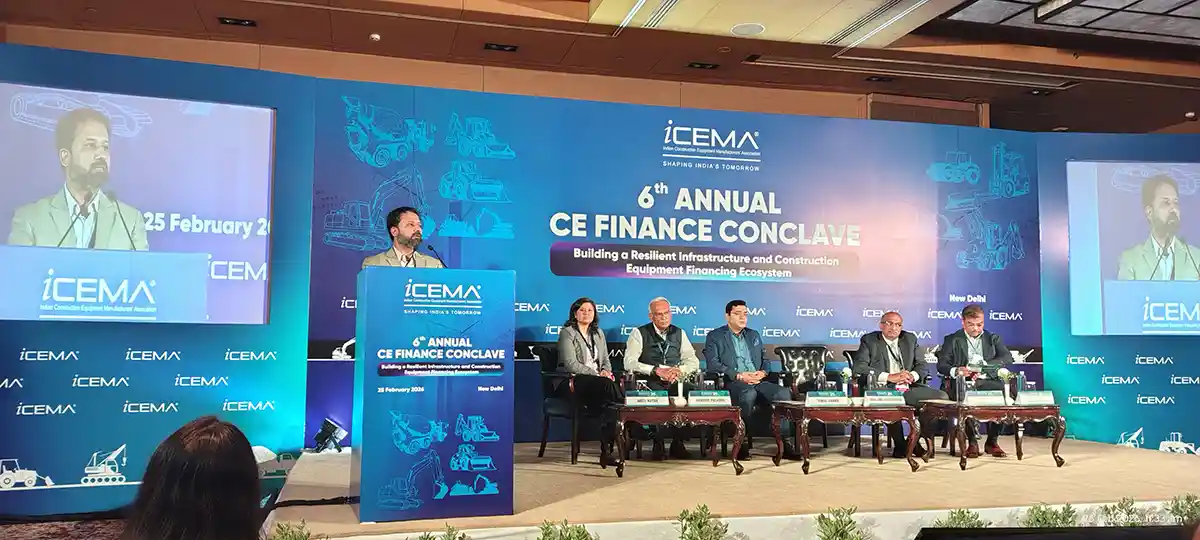
Shalabh Chaturvedi, Vice President, ICEMA, and Managing Director – India & SAARC, Case Construction Equipment India, observed that India is at the cusp of tremendous growth, comparable to the transformation witnessed in the United States three decades ago and in China about 15 years ago. He stated that India is poised for a dramatic shift in the construction equipment industry, with exports expected to play a pivotal role.
He noted that the Government has taken conscious steps to upgrade emission standards and safety norms to align Indian equipment with global benchmarks, enabling manufacturers to compete effectively in international markets. He emphasized that the financial ecosystem is a key enabler not only for domestic sales, where nearly 90% of equipment is financed, but also for exports. Access to appropriate credit lines and effective risk-sharing mechanisms between OEMs, buyers, and financiers, will be essential for sustained growth.
Umesh Revankar, Co-Convener, ICEMA Financial Ecosystem Panel and Executive Vice Chairman, Shriram Finance, highlighted that, from a lender’s perspective, construction equipment financing has moderated in recent quarters due to slower infrastructure spending and execution delays. However, he expressed confidence that as capex momentum builds and project awards accelerate, credit growth will strengthen in line with improved cash flow visibility and faster execution.
He added that the transition to CEV Stage V and higher-technology equipment requires structured, longer-tenure, and well-priced financing solutions. Financiers remain committed to supporting OEMs, contractors, and MSMEs through calibrated risk assessment and disciplined credit frameworks.
The sessions also deliberated on the imperatives for achieving the construction equipment industry’s vision of tripling exports by 2030. Discussions covered export finance policy and risk mitigation, infrastructure financing, green financing, digital solutions, and SME financing, as key focus areas.