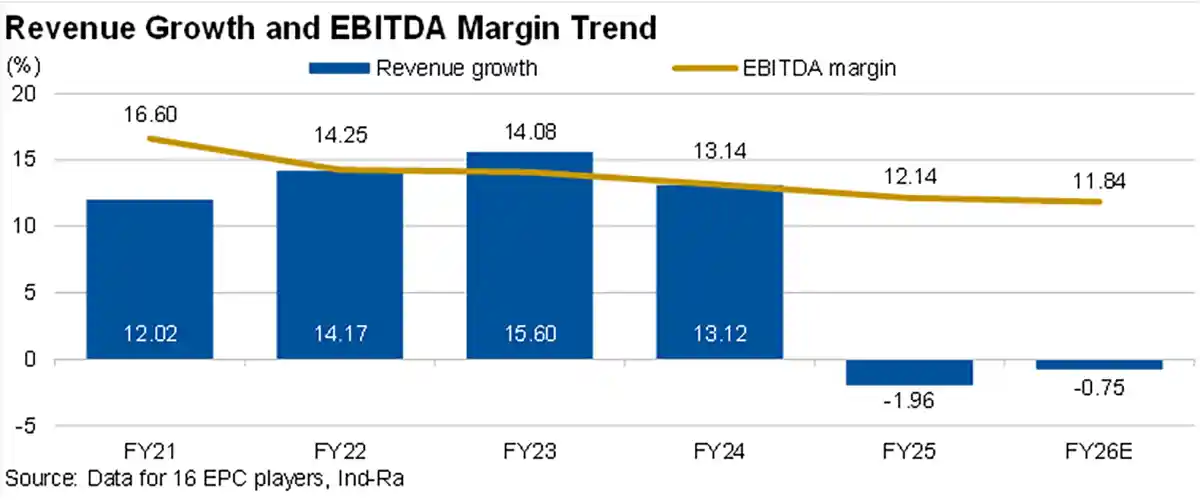
Moreover, the sector is likely to witness a higher number of build-operate-transfer (BOT) projects both on center and state levels, necessitating increased private capital. Ind-Ra projects modest 6% to 8% yoy revenue growth for the overall engineering, procurement and construction (EPC) sector in FY26, largely due to flat-to-negative growth in the highways sector, after a significant revenue decline in FY25. Margins are expected to bottom out in FY26, after decreasing about 500bp over FY21-FY26. However, working capital cycles may start rising, as the project mix shifts towards more state awards.
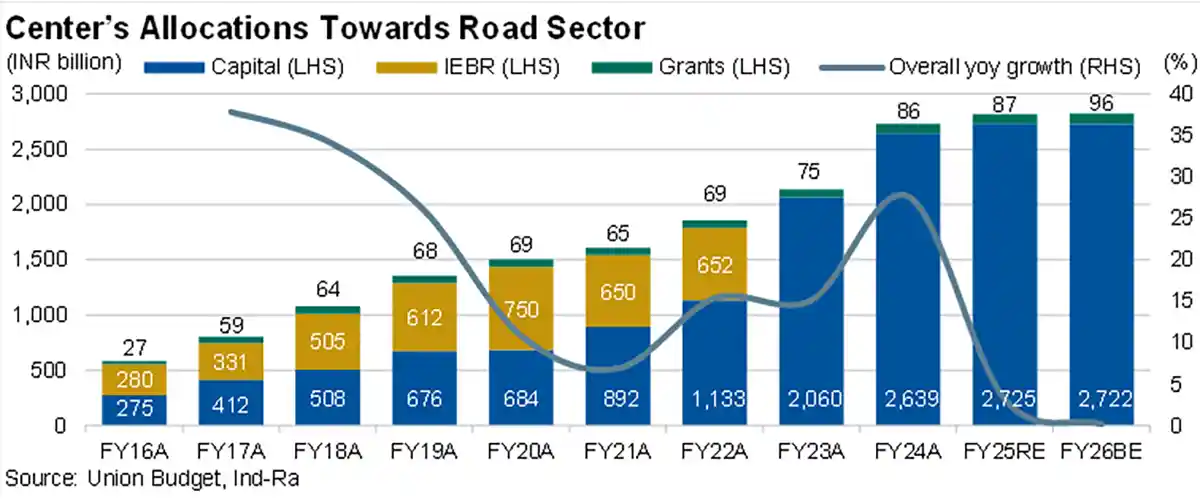
Lull in Central Awards Likely to be End; Continued Stiff Competition: Ind-Ra expects national highways construction of 9,000-9,500km in FY26, down 10%-15% yoy (FY25: 10,660km, FY24: 12,349km, FY23: 10,331km), marking the lowest level since FY18. This decline is driven by a flat capex allocation of INR2.72 trillion for FY26, after just a 3% yoy increase in FY25. This is a marked slowdown from a robust 19% CAGR during FY21–FY24. Internal and Extra Budgetary Resources (IEBR) has fallen to negligible levels recently as National Highway Authority of India (NHAI; ‘IND AAA’/Stable) focuses on debt reduction, shifting towards budget-supported capex and monetisation.
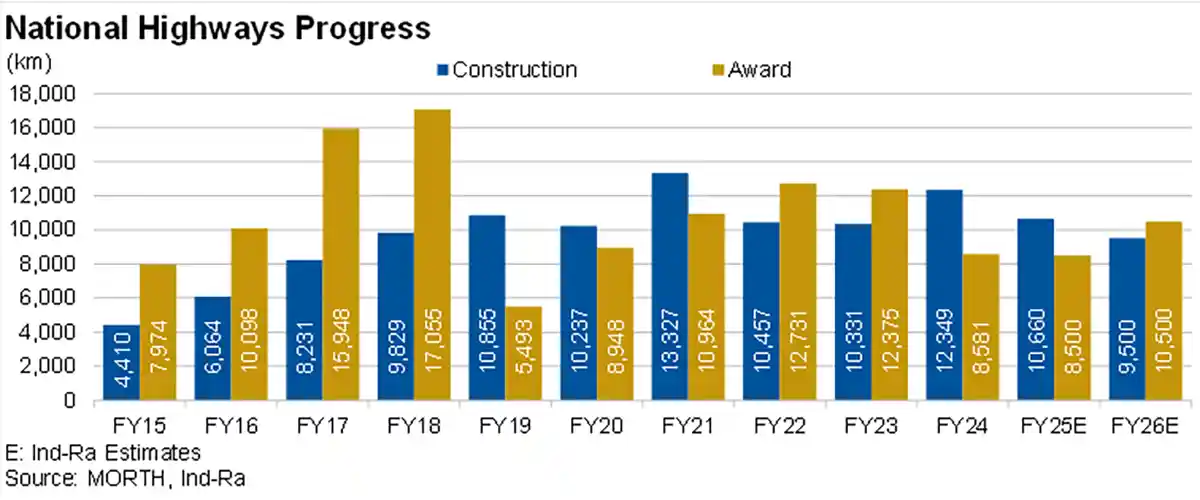
Awarding activity has remained weak since FY24, with annual awards stagnating at 8,500km per year, compared to construction activity exceeding 10,500km, leading to reduced order backlogs. The Ministry of Road Transport and Highway (MoRTH) and NHAI have changed focus to corridor-based development and more access-controlled highways and expressways, planning 11,000km by FY27 and 15,000km by FY32, up from nearly 3,000km currently, moving away from the Bharatmala project. Ind-Ra expects ordering activity to revive in FY26, in view of the likely 10,500-11,000km awards from the central government. Project awards from MoRTH/NHAI have not yet picked up, although there has been some activity resumption with NHAI disclosing clearance status for projects worth INR1.15 trillion, where bids have been invited. Earlier, NHAI announced a project pipeline worth INR3.5 trillion to be awarded in FY26, indicating significant awarding potential.
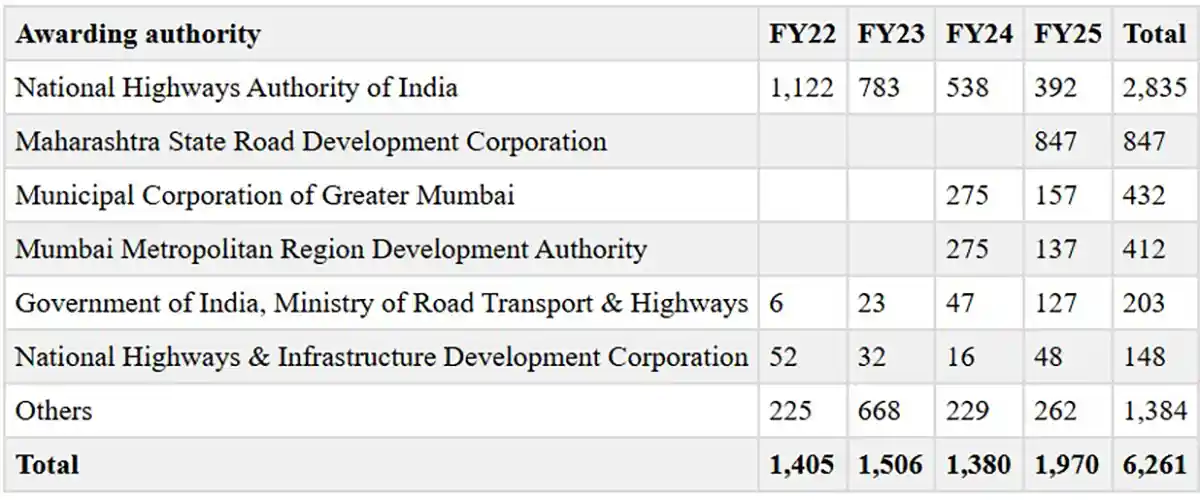
State Awards to the Rescue: Ind-Ra expects continued momentum in state awards in FY26, after a significant spike in FY25, led by Maharashtra state projects worth over INR1.1 trillion, which bolstered EPC companies’ order books. In fact, prior to FY15, state road construction activity consistently outpaced central road activity, a trend expected to return in the coming years. State highway activity is likely to remain strong across states of Maharashtra, Uttar Pradesh, Bihar, Gujarat, Karnataka, Andhra Pradesh, Telangana, Punjab, and West Bengal, where several projects have been announced and awarded, with states increasingly opting for hybrid annuity model (HAM)/BOT model. Yet, the appetite of EPC players for state BOT projects remains uncertain, as recent projects have attracted a muted response.
Award Mix Excluding Toll-Operate-Transfer (ToT) Projects (INR billion)
Source: Project today, Ind-Ra
Margins Likely to Bottom-out and Stagnate in FY26: Ind-Ra expects the highway sector’s margins to bottom out in FY26, after plunging about 500bp during recent years. This is driven by rising competition due to relaxed bidding norms, operational issues from right-of-way and supply chain disruptions, weather shocks, subdued award activity, and liquidity pressures at the sponsor level.
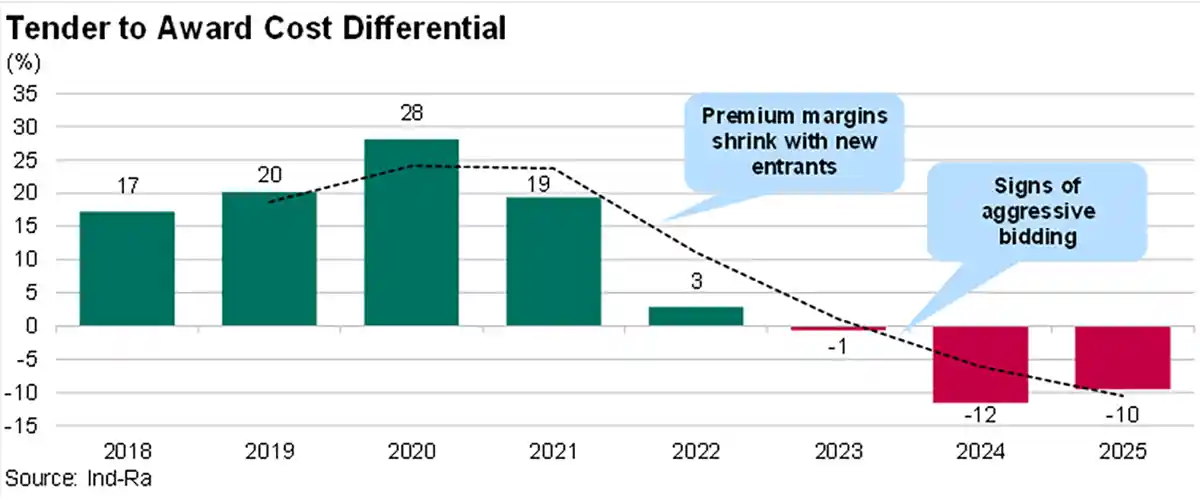
Ind-Ra has analysed 372 HAM projects awarded by NHAI between 2018 and 2025, spanning nearly 14,750km with an aggregate bid project cost of over INR3.8 trillion. The award slowdown has intensified competition for available projects, resulting in aggressive bidding. Figure 4 on tender‑to‑award cost differentials highlights increasing competitive intensity. After years of positive differentials, the trend turned negative in 2023-2025, with bids consistently below authority estimates. While this trend helps sponsors secure projects in a tight pipeline, it raises concerns around financial viability and execution quality, especially for newer entrants with limited equity buffers.
As per the ministry, around 574 projects worth INR3.6 trillion have breached their construction schedule in the past five years. Nearly 275 projects have faced delays of over one year. Furthermore, 133 road projects worth INR1 trillion are awaiting appointed date.
Significant Measures to Boost Quality and Enhance Execution: In view of the rising backlog of delayed projects and increased competition post the relaxation of bidding norms during the Covid period, MoRTH has implemented several measures to curb unhealthy competition with a focus on increasing execution:
Tightening of eligibility criteria for HAM and EPC projects: Major changes being:
- Net worth: The minimum available net worth threshold for HAM projects increased to 20% of the estimated project cost from 15% earlier. The net worth will be calculated after deducting 20% of the balance value of the existing public-private partnership projects undertaken by the developer. Each consortium member shall have minimum available net worth of 10% of the estimated project cost vs earlier 7.5%. For EPC projects, the minimum net worth criteria has been raised to 10% from 5% of the project cost, with the average annual turnover of 20% of the project cost versus 15% earlier.
- To have completed work equivalent to 35% of the estimated project cost of one similar project or 25% of two similar projects, versus the previous requirement of 20% of one similar project
- Tightening criteria for structure-based specialised projects with bridge/ROB/flyover/tunnel
- Removal of 3% cap: APS can now scale significantly for low bids.
- Bid 10%–20% below cost: APS rises by 0.1% for every percentage point below 10%.
- Bid ≥20% below cost: APS rises by 0.2% per percentage point below 20%, plus an initial 1% on bid price.
Road Asset Monetisation (INR billion)
Tightening Request for Proposal (RFP) provisions: Major changes include: 1) ‘Similar Work’ shall refer exclusively to completed highway projects, and not just minor/peripheral work, 2) any unauthorised sub-contracting and subcontracting beyond permissible limits will be classified as ‘Undesirable Practice’, thereby attracting penalties on par with fraudulent practices, and 3) disallowing third-party bid and performance securities.
MoRTH establishes milestones for land acquisition and environmental clearances from 1 June 2025. More than 90% of the project's RoW length must be obtained prior to bids being received.
Cap of 10 projects per project engineer. Enhanced scrutiny of DPRs post Kerala road incidents.
These tougher norms favour large firms with strong balance sheets and proven track records, making it difficult for smaller contractors to compete, boding well for margin stability.
More Private Capital; Monetisation Environment Robust: With the flatlining of central capex as well as reduced fiscal capacity of states, the focus is on attracting more private capital through BOT and ToT models. With the mushrooming of InvITs, the monetisation environment remains robust, both on government and private sides.
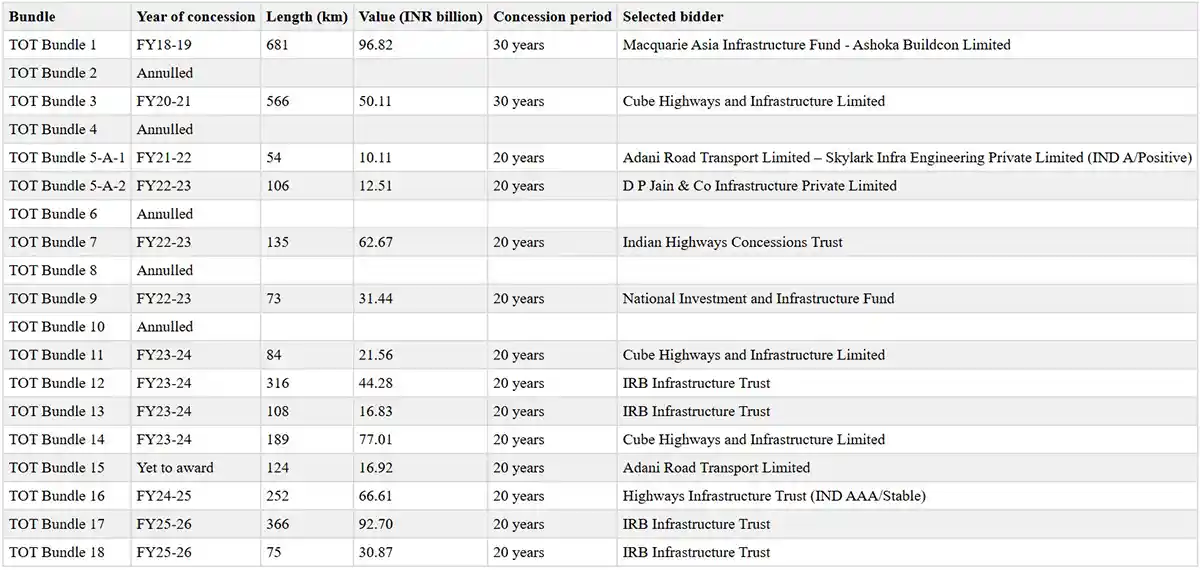
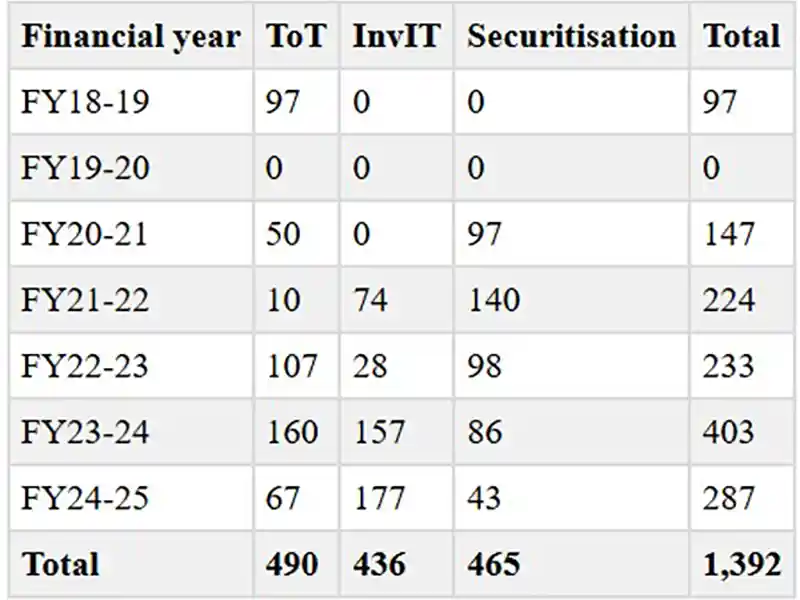
NHAI has raised its monetisation target to INR400 billion for FY26 from INR300 billion earlier (FY25: INR287 billion). Half of it is likely to be contributed by private and newly launched public InvIT (Raajmarg Infra Investment Trust (RIIT)), while the other half is likely to be through the ToT model. Till date in FY26, NHAI has awarded two ToT (Bundle-17 & 18) for a total upfront concession fee of about INR123.6 billion, with bidding open for four more bundles exceeding 770km. The next two to three months may see additional closures. Over FY26-FY30, the highway ministry has set a monetisation target of INR4 trillion versus around INR1.4 trillion collected over FY21-25.
NHAI published a list of identified stretched in February 2025, which consists of 24 stretches with total length of 1,472km having a toll revenue of INR18.6 billion in FY24. Based on the average multiple of 11.6x (concession fee over first year revenue) of past nine ToT bundles having 20 years of concession, Ind-Ra expects the identified assets to have monetisation value of INR216 billion.
Financing conditions remain supportive, especially for large well-capitalized EPC players who also have established in-house InvITs or partnered with InvIT partners for asset recycling. However, lenders demand higher upfront equity requirements from weak or new players in equity-funded projects. In particular, financial capacity for equity requirement is critical, as double leveraging at holding companies poses risks, especially in case of execution delays, and monetisation issues, and squeezed project profitability. Large sponsors may navigate this environment through portfolio monetisation, but newer entrants may struggle as low-spread bids fail to attract premium valuations once projects reach provisional commercial operations date.
Road Projects Monetised by NHAI Through ToT