
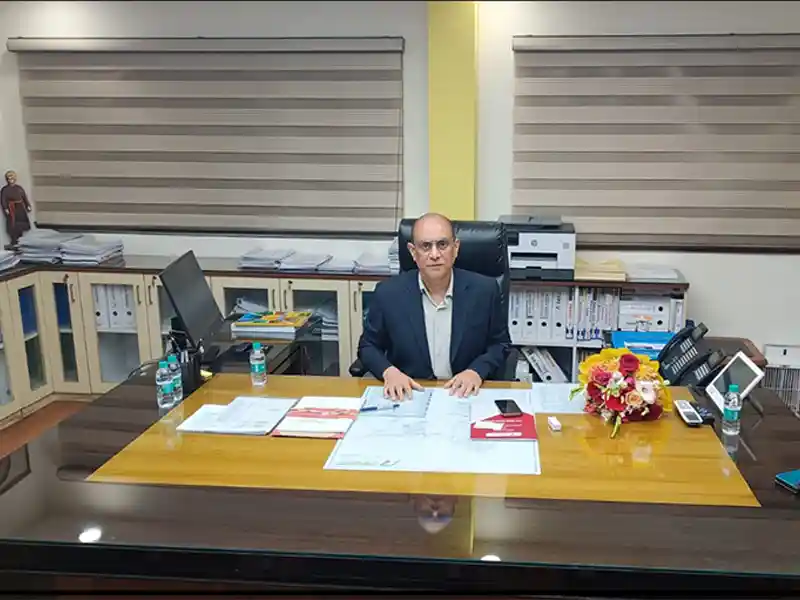
CMD RVNL Shri Saleem Ahmad Reviews Progress of Rishikesh–Karnaprayag Rail Project
The 125-km Rishikesh–Karnaprayag New Broad Gauge Rail Link Project, being executed by Navratna CPSU Rail Vikas Nigam Limited (RVNL) for Indian Railways in Uttarakhand, is one of India’s most ambitious and strategically important rail infrastructure initiatives in the Himalayan region.
On the first day of his visit, the CMD chaired a marathon review meeting with senior project officials, engineers, contractors, and international and national tunnelling experts associated with various packages of the project.
Detailed deliberations were held on construction progress, complex geological challenges, tunnelling milestones, safety measures, and time-bound execution. Shri Ahmad categorically directed that the project must be commissioned positively in 2028, without compromising on quality or safety.
The CMD underscored that the Rishikesh–Karnaprayag Rail Project, is not only a landmark engineering initiative but also a transformational infrastructure corridor that will redefine mobility in the Garhwal Himalayan region by providing all-weather, landslide-resilient rail connectivity to remote hinterlands.
During discussions, the possibility of developing road tunnels alongside railway tunnels was also explored, which could significantly enhance road connectivity, safety, and travel convenience for local population in the hilly terrain, thereby maximizing infrastructure utility.
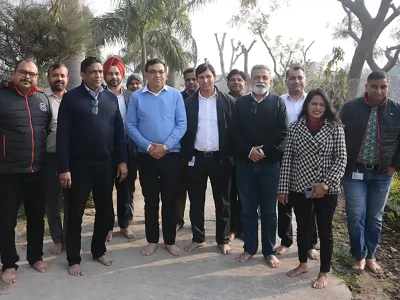
On second day of visit, Shri Ahmad also conducted on-site inspections of ongoing tunnelling works, bridges, and station locations, where he reviewed safety practices, construction quality, and environmental safeguards.
He interacted with workers and technical teams at site and thanked workforce for their dedication and contribution in executing the project under extremely challenging Himalayan conditions.
He emphasized that environmental impact caused during construction would be systematically mitigated through green area development and extensive plantation, ensuring a balance between infrastructure growth and ecological conservation.
Reiterating RVNL’s development philosophy, the CMD gave a clear execution mantras focusing on:
- Speed with discipline and timelines
- Quality and structural durability
- Safety of workforce and assets
- Environmental sustainability and ecological protection
- Use of advanced technology and mechanisation
- Workforce welfare and social responsibility
Shri Saleem Ahmad, Chairman & Managing Director, RVNL, stated, “This Railway line project based mostly on tunnelling has the potential to become true game changers for the country’s overall development. He said that this corridor is not merely an infrastructure asset but a transformational lifeline for the Himalayan region. He emphasised that RVNL is executing the project under extremely challenging geological and climatic conditions, with an uncompromising focus on quality, safety, speed, and adherence to timelines. This assignment showcases RVNL’s ability to execute complex infrastructure project in challenging terrains through disciplined planning and coordinated execution and will serve as a benchmark for future railway corridors in mountainous regions.”
Project Background and Key Salient Features
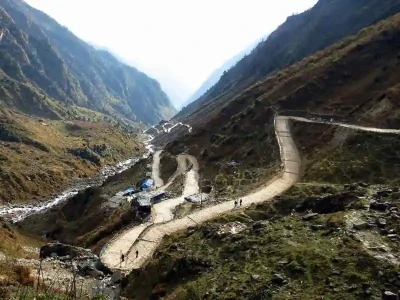
The project aims to provide safe, reliable, and all-weather rail connectivity to the Garhwal Himalayas, reducing dependence on fragile road networks that are frequently disrupted by landslides, extreme weather, and natural disasters.The corridor will directly serve five districts of Uttarakhand —Dehradun, Tehri Garhwal, Pauri Garhwal, Rudraprayag, and Chamoli, connecting remote hill towns to the national rail network for the first time. Once operational, it will significantly enhance regional mobility, disaster resilience, and economic integration.
From an engineering standpoint, the project represents a major leap in railway construction in mountainous terrain, with approximately 104 km (83%) of the alignment passing through tunnels, including 16 main tunnels, 12 escape tunnels, multiple cross passages, and 19 major plus 31 minor bridges across deep valleys and Himalayan rivers.
A defining achievement is the completion of Tunnel-8, a 14.58-km twin-tube railway tunnel, the longest transportation tunnel in India, executed using Tunnel Boring Machines (TBMs) in young, fragile, and tectonically active Himalayan geology, including the Main Boundary Thrust (MBT) zone. This milestone establishes a national benchmark in mechanised Himalayan tunnelling and reflects India’s growing capability to execute complex underground infrastructure safely and efficiently.
The project incorporates seismic-resistant designs, advanced drainage and dewatering systems, emergency escape arrangements, and modern electrical and signalling systems, ensuring high standards of safety, durability, and long-term operational reliability.
On completion, the rail link will reduce travel time between Rishikesh and Karnaprayag from about 7 hours to nearly 2.5 hours, boost tourism and pilgrimage traffic, improve logistics and trade efficiency, generate large-scale employment, and act as a potential feeder corridor for future Char Dham rail connectivity, making it a transformative infrastructure project for Uttarakhand.
Stations Planned
Twelve railway stations are planned on this route, excluding the already existing Virbhadra Station, the commissioned Yog Nagari Rishikesh and upcoming stations at Shivpuri, Byasi, Devprayag, Janasu, Maletha, Srinagar, Dhar Devi Ji, Tilani, Gholtir, Gauchar and Karnaprayag.Key Milestones & Progress
- 5.7-km first block section (Virbhadra–Yog Nagri Rishikesh) commissioned in 2020
- 13 of 16 main tunnels excavated (98 km, 95%)
- 40/46 tunnel drives broken through; 130.6 km final lining completed
- 8/19 major rail bridges completed, including Bridge-8 (3×90m) & Bridge-9 (15×30.5m composite) over River Alaknanda
- Track-laying in active progress
- Electrical (E&M/OHE) & S&T works to commence Oct 2026
- Station buildings at Shivpuri & Byasi started in Dec 2025; remaining from May 2026
Published on:
05 February 2026
Share:
We Value Your Comment