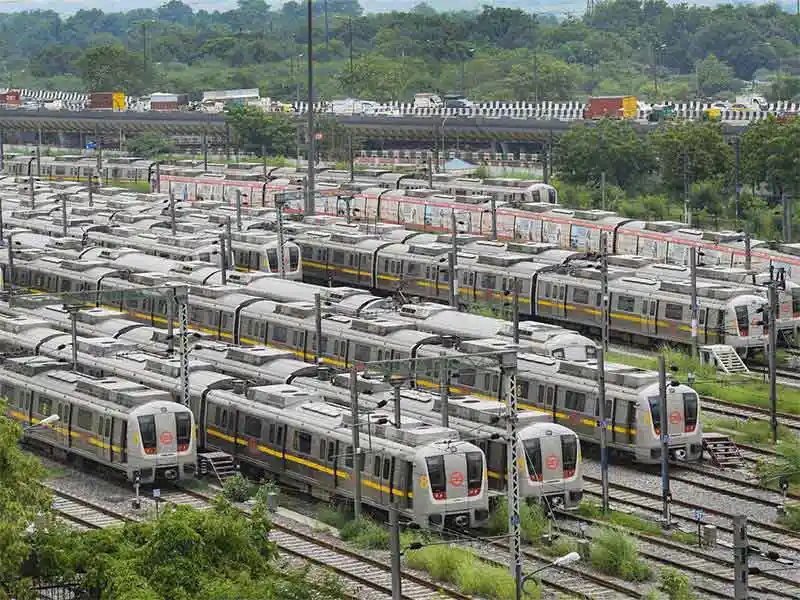
Amidst the Delhi Metro Rail Corporation's (DMRC) growing monetization challenge, a parliamentary panel has suggested leasing of assets with increasing focus on property development as a way out of the financial stress.
DMRC's financial stress is now very evident following the Covid pandemic. The Delhi Metro that has faced complete closure since the Covid triggered lockdown from March 22, has suffered losses to the tune of Rs 1500 crore (at Rs. 10 crore a day) in revenue over the last five months. Income from leasing of about 400 retail outlets at stations has got a hit as owners of these outlets have expressed their inability to pay rent due to the lockdown.
In order to contain the financial stress, DMRC is resorting to deferment of non-essential expenditure and reducing perks and allowances of its employees by 50% from August. Buckling under the financial strain, it has asked the Centre to defer payment for its loan installment for the year 2020-21. In this financial year, it owes JICA (from which it has taken a loan of Rs 35198 crore - Rs 1242.83 in principal and interest payments.
Metro lines are highly capital-intensive projects, requiring huge operational expenditure. DMRC, with 40% funding from the Centre and States in equal proportion and the rest through multilateral debt, will be requiring expenditure of Rs 300000 crores for the next five years. It will be requiring incremental budgetary support of Rs 120000 crore from the Centre and States and debt funding of Rs 180000 crore. High fixed expenses especially during initial years result in operational losses which in turn impact debt serviceability. In 2018-19, DMRC could earn a revenue of just Rs 6462 crore, with traffic operations earning amounting to Rs 3583 crore. Hence, funding of future cash losses and repayment of debt obligation is a challenge.
Currently, the DMRC network consists of 11 colour codes regular lines serving 285 stations with a total length of 389 km. While globally, most MRTS projects are undertaken as public funded facilities, in India, due to constrained budgetary resources, innovative funding mechanism and leveraging of private investment is a necessity. Also, to reduce dependence on budgetary support and multilateral debt, public-private partnership (PPP) is one option. But in India, this option has not worked.
The parliamentary panel has observed that DMRC operations reflect inefficient utilization of financial/human resources and available capital base where negligible private investment has been leveraged. Also, significant manpower is deployed for day-to-day operations, resulting in sub-optimal utilization of available technical/intellectual capacity as well as creation of permanent /long-term liability structures. The panel also thinks that the available real estate and property development rights have barely been exploited with annual non-fare box revenue (in-train advertising & advertising in metro stations, property leasing, consultancy) comprising only 15% of the total traffic revenue as against 30-40% for global MRTS systems.
In order to tackle this financial challenge confronting DMRC, the parliamentary committee has suggested leasing of existing assets viz. track infra and rolling stock, with rights to lease/license station area and real estate development. Under the 50-year concession period model, it is suggested to raise revenue through leasing of commercial spaces at stations, develop and lease property in other areas, user fare, parking, advertisement fee, license, lease rental at stations, and lease income from commercial property. Under the 99-year Concession Period Model, apart from these sources of revenue, revenue generation from residential property development has been suggested.
At the end of the concession period, all the assets including rolling stock procured and properties developed shall be transferred back to the Authority. The key features of concession agreement are performance indicators with corresponding incentives and penalties, monitoring, inspection mechanism and detailed mechanism of termination payment in the event of default by either party.
Several grounds have been cited to justify this model of monetization. Upfront accruals for DMRC are estimated at around Rs 39000-80000 crore. The Corporation will have the flexibility to utilize such cash flows for pre-payment of existing bilateral debt obligation or for undertaking new phases, which will not only nullify the contingent liability from government but also significantly minimize the budgetary requirement for future expansion. Further, this shall result in reduction of regular operational expenditure for DMRC viz. expenditure towards stores/spaces, manpower outsourcing, electricity etc. At the same time, DMRC may earn additional revenue annually in the form of pre-specified revenue share. This in turn ensures higher profitability as well as lower permanent/long-term liability of DMRC.
Monetization of existing lines shall allow DMRC to exclusively focus on future expansion/greenfield projects, which is its core competence, instead of deploying dedicated resources for operation and maintenance of existing projects. All this shall lead to the creation of a leaner organization structure with high customer value. The panel is also of the opinion that private participation in the operation of metro services and property development will ensure superior quality of service, modernization of rolling stock, efficient utilization of resources, and professionalism.
Under the proposed revenue generation model, to start with, it is suggested that one of the operational lines with reasonably attractive valuation should be monetized.
The writer is Editor, PropTOQ, a real estate monthly