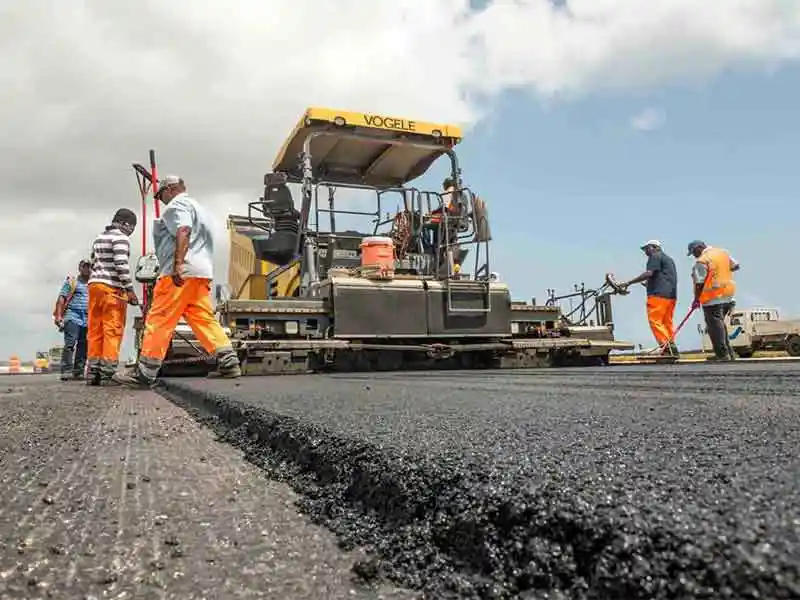
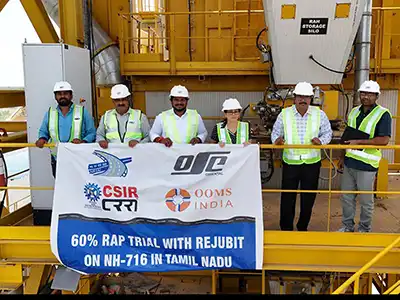
This trial section represents an important benchmark in advancing high-RAP recycling under actual highway construction conditions. The occasion was graced by senior officials from the National Highways Authority of India (NHAI) and the Government of Tamil Nadu, along with representatives from leading highway infrastructure companies, technical experts and industry stakeholders.
The programme was designed as a live technology demonstration of the complete high-RAP recycling process. Participants witnessed production, laying and compaction of the 60% RAP DBM mix, visited the Hot Mix Plant to understand the production process, and experienced a dedicated Experience Centre showcasing the journey of reclaimed asphalt — from recovery and processing to characterisation, rejuvenation, mixing and reuse.
Technical presentations by OSEPL, CSIR-CRRI and Ooms India covered high-RAP mix design, rejuvenation technology, quality control, plant production, field execution and the wider potential of pavement recycling in India. The 60% RAP mix was developed through collaborative technical work involving OSEPL and CSIR-CRRI and incorporates REJUBIT, an indigenous RAP rejuvenator jointly developed by CSIR-CRRI and Ooms India.
60% RAP Matters for India
India is rapidly expanding and upgrading its highway network while generating increasing quantities of reclaimed pavement material through rehabilitation and resurfacing works. RAP contains valuable aggregate and aged bitumen that can be recovered, characterised, rejuvenated and reused. Higher RAP utilisation can therefore reduce the requirement for freshly quarried aggregates and virgin bitumen while making productive use of materials already available within the existing road network.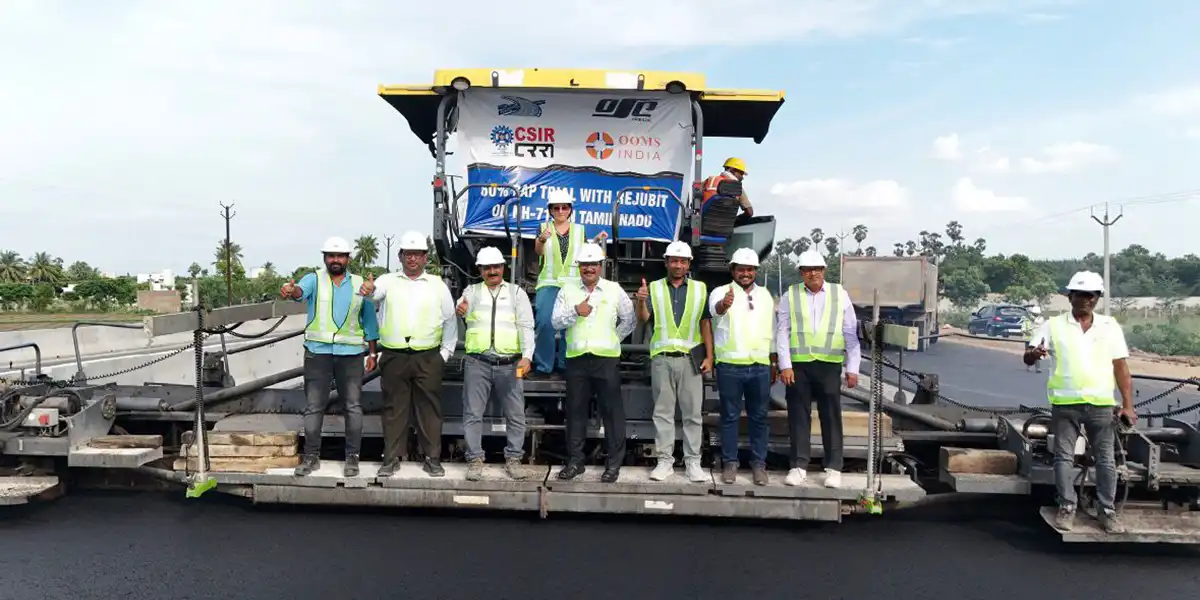
At 60% RAP utilisation, a major proportion of the material required for a new asphalt mix comes from the existing pavement itself. For India, this has the potential to support resource conservation, reduced dependence on imported raw materials, lower consumption of non-renewable resources and a reduced environmental footprint. The demonstration therefore represents an important step towards viewing India’s existing highways as a resource bank for the roads of tomorrow and creating a more circular and resource-efficient model of road construction.
REJUBIT is an indigenous RAP rejuvenator jointly developed by CSIR-Central Road Research Institute and Ooms India. It is designed to restore key properties of aged bitumen present in reclaimed asphalt, helping enable a greater proportion of existing pavement material to be incorporated into new asphalt mixes. Its use in the NH-716 demonstration represents the progression of an Indian research-led technology from laboratory development towards field-scale implementation.
Statement from National Highways Authority of India
Ravindra Rao, Project Director, PIU CHENNAI 2
“The 60% RAP field demonstration is highly relevant to the needs of the present time, given the growing demand and limited availability of bitumen and aggregates.
Reusing materials from existing pavements can significantly reduce our dependence on virgin resources and make road construction more resource-efficient.
This field trial will provide valuable confidence and technical evidence for higher RAP utilisation in highway construction.
We look forward to appropriate policy and technical guidelines that enable the wider use of high RAP percentages in suitable road projects.
This is an important step towards sustainable and circular highway development.”
Statement from Oriental Structural Engineers Private Limited
Nagaraj, Sr. CPM (Project Head), OSEPL, said:
“For an EPC contractor, the true test of an innovative pavement technology is its ability to move from laboratory design to plant production and finally to execution on the highway under actual field conditions.
The 60% RAP trial on NH-716 allows us to evaluate high-RAP construction at field scale while maintaining the required quality-control framework. Through initiatives such as this, we are exploring practical ways to recycle existing pavement materials, conserve natural resources and reduce the requirement for virgin materials.
Collaboration between contractors, research institutions and technology providers will be critical in taking sustainable pavement solutions from trials to wider implementation.”
Statement from CSIR-Central Road Research Institute
Dr. Chalumuri Ravi Sekhar, Director, CSIR-CRRI, said:
“This field demonstration marks an important step towards advancing sustainable and circular road construction in India. RAP should not be viewed merely as waste; it is an engineering resource containing valuable aggregate and bitumen that can be scientifically recovered, rejuvenated and reused.
The 60% RAP demonstration brings together the complete process — RAP recovery, material characterisation, scientific mix design, rejuvenation, hot-mix production, laying and compaction under actual field conditions.
Such demonstrations are important for generating field knowledge, building confidence and creating a scientific pathway towards greater utilisation of reclaimed materials in Indian road construction.”
Statement from CSIR-Central Road Research Institute
Dr. Ambika Behl (F.I.E.), Senior Principal Scientist, CSIR-CRRI and Project Leader for the 60% RAP Field Demonstration, said:
“RAP is black gold for the road sector. It contains two valuable non-renewable resources — aggregate and bitumen — which already exist within our road network and can be brought back into productive use.
At 60% RAP utilisation, a substantial proportion of the material required for a new asphalt mix comes from the existing pavement itself. This allows us to begin looking at our roads as a resource bank for future construction.
The significance of this demonstration lies in showing how higher levels of recycling can be approached scientifically through RAP characterisation, evaluation of the aged binder, mix design, appropriate rejuvenation and rigorous quality control.
Through the use of REJUBIT, jointly developed by CSIR-CRRI and Ooms India, this initiative demonstrates a practical pathway towards greater reuse of existing road materials, lower consumption of virgin bitumen and aggregates, and a more circular approach to highway construction.”
Statement from Ooms India
Palash Kathal, Director, Ooms India, said:
“The future of highway construction will increasingly depend on our ability to do more with the resources we already have. Higher RAP utilisation allows us to extract greater value from the aggregate and bitumen already present in existing pavements while reducing dependence on virgin materials.
As RAP percentages increase, understanding and managing the aged, oxidised binder becomes critical. Through REJUBIT, our focus has been on developing a rejuvenation solution that helps restore key properties of the aged binder and enables recycled mixes to meet the required volumetric and performance criteria.
Taking a 60% RAP mix from laboratory evaluation to plant production and live highway laying is a significant technical milestone. This collaboration demonstrates what is possible when execution capability, scientific research and specialised material technology come together.
The chief guest of the event Sh. Er. A Venkatachalam, Director Highway Research Station Chennai, congratulated the team for the 60% RAP field demonstration and stated it an important milestone for Tamil Nadu towards more sustainable and resource-efficient road construction.
Tamil Nadu has an extensive road network, and recycling materials from existing pavements can significantly reduce the demand for virgin aggregates and bitumen while reducing construction waste. This demonstration provides valuable field experience and confidence for wider adoption of high-RAP recycling in suitable road projects across Tamil Nadu.
He congratulated NHAI, CSIR-CRRI, Oriental and Ooms for this collaborative initiative and their efforts towards building greener and more resource-efficient roads for Tamil Nadu.