
DFCCIL: Pushes the Pace of Project Execution

Could you please tell us the current status of Western and Eastern Dedicated Freight Corridors, their coverage routes and the targeted dates for commissioning?
The Current status of projects on EDFC and WDFC include:
The DFC project has gained momentum and is moving at faster pace for the last 15 months. Since then, DFC has excelled in all sphere of activities whether it is award of contracts, land acquisition or physical progress of work.
- Contracts worth Rs.24,000 crores have been awarded/signed during 2015-16 as against contracts worth Rs.13,000 crore was finalized in the last 6 years. Further, during last 3 months of 2016-17, contracts worth Rs.4000 crores have been awarded.
- There has been a Five-fold increase in progress of Earthwork & Concreting in Rewari-Iqbalgarh section of WDFC as well as in Khurja-Kanpur section of EDFC.
- There has been threefold increase in Capital expenditure during 2015-16 as compared to last year, i.e., 2014-15. During 2015-16, capex has been Rs.8516 crores compared to capax of Rs.2885 crores during 2014-15.
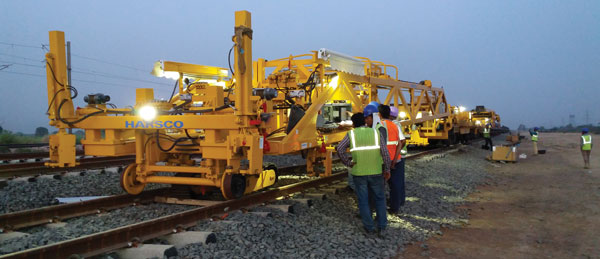
- Track Laying with fully Mechanised Method new Track Construction (NTC) has been taken up by 4 Machines. This is being done for the first time in India.
a. Award of contracts
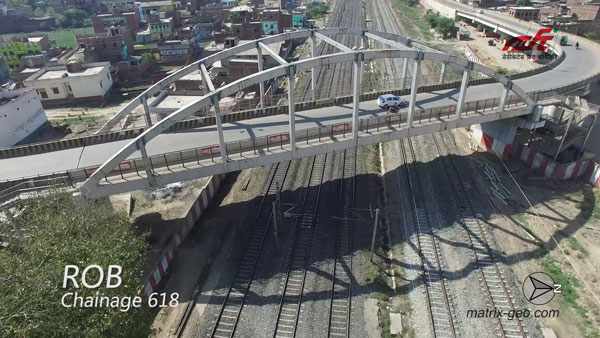
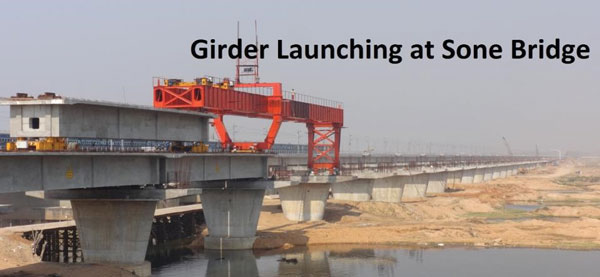
EDFC: Civil contracts for 83% length have already been awarded and work is in progress on Khurja-Kanpur (343km), Kanpur-Mughalsarai (402 km) and Mughalsarai –Sasaram Section (126 km). The work of Bridges and Embankment is progressing at faster pace and work of mechanised laying track with NTC machine has been taken up at Bhadan, Maitha, and Daudkhan simultaneously.
Electrical, Signalling and telecommunication Contract (ESTC) for Khurja-Kanpur section has also been awarded and design work is in progress. ESTC for Kanpur-Mughalsarai section was awarded in June, this year. All the balance contracts worth Rs.4464 crores in Eastern Corridor will be awarded by the end of the current financial year.
WDFC: Civil contracts for 84% length have already been awarded and work is in progress on Rewari-Iqbalgarh (639 km), Iqbalgarh-Vadodara (308 km) and Vadodara –Vaitarna (322 km). Work of mechanised laying track with the NTC machine has started in Bhagega.
ESTC for 92% length i.e. Rewari-Vadodara section (950 km) & Vadodara-JNPT (430 km) has already been awarded and design work is in progress.
Remaining contracts worth Rs.5900 Crores in WDFC will be awarded hopefully in July, this year.
The work in the awarded sections has been taken up and it is progressing at accelerated speed in both the corridors.
Both the Corridors are targeted to be completed by December, 2019. Phase commissioning has been planned and 75% of the Corridor is planned to be completed by March, 2019.
What is the estimated cost of each project and their funding & financing arrangement? Please brief us about the multilateral agencies involved in funding these projects.
The completion cost including cost of land is Rs.81,459/- crs. Debt Equity ratio is 2:1. The project is being funded by World Bank (EDFC) and JICA (WDFC) with equity from Indian Railways. The funding from JICA (Rs.38,722 cr) and World Bank (Rs.13,625 cr.) have already been approved.
What are the contracting strategies and bidding methodologies as per the requirements of the funding agencies?
Contracting Strategy: Through Design and Build Lump-Sum contracts as per FIDIC Yellow Book Framework by competitive bidding process.
Tendering Strategy
Pre-Qualification of Bidders
Pre-Qualification of Bidders Applications for Pre-Qualification are invited from prospective bidders for each Contract Package. Based on the eligibility and qualification criteria given in the Pre-Qualification Document, Pre-Bid Conference is arranged with prospective Bidders to clarify issues, if any, and thereafter reply to pre-Bid querries is furnished after getting approval of lending agencies. A shortlist of prospective Bidders is finalized in consultation with the Lending Agencies, viz., World Bank/JICA. The Bid Document is issued to shortlisted bidders.
Bidding for Works Contract
For works contract, single stage, two packet system of contracting has been adopted on Western DFC Project. In this system, the first packet consists of credentials and technical bids. The second packet consists of financial bid. First the credentials and technical bids are evaluated. The second packet (financial bid) of only those bidder are opened, whose credentials and technical bids are found in order. The lowest eligible bidder gets the contract.
On Eastern Corridor, two stage bidding has been adopted for works contracts. In this system, in the first stage, technical proposals are submitted by the bidder. In the second stage, financial bid for technical compliant bidders are invited. The lowest eligible bidder gets the contract.
The Lending Agencies, viz., World Bank/JICA are consulted at Technical bid stage as well as Financial bid stage.
How confident are you to complete both the projects on time? Is there any hurdle in the way of smooth execution and implementation of these projects?
There are 3 major factors in mega Infra Project to deliver it in time, viz., availability of land, arrangement of funds and availability of best Executing Agency. We have been able to acquire more than 90% land, funds have been fully tied up and best Agencies by international competitive bidding process have been selected. The speed of fixing of contracts has been exemplary and the progress of work at site has been boosted manifold in last one year.
With the constant help and guidance of Ministry of Railways and cooperation of various State Governments, DFCC is confident to commission both the corridors by December 2019.
There are however few concerns regarding acquisition of land. The project is spread over a length of 3350 kms with more than 3 lakhs Project Affected Persons (PAPs). The land acquisition for such a linear project is a mammoth task as it involves lengthy procedures and there are few pockets of resistance from land losers. DFCC has taken adequate care in the resettlement & rehabilitation (R&R) of the PAPs by providing them due compensation and R&R benefits and is also providing multi-skilling training for facilitating in job opportunities. With the concerted efforts and help from State Governments, DFCC has been able to acquire 90.5% of the land, excluding Sonnagar-Dankuni section. However, there are 167 patches of land affecting acquisition of 71 kms in Western Corridor and 89 patches of land affecting acquisition of 156 kms of land in Eastern Corridor for which matter is being pursued with different State Governments.
To complete such a mammoth project on time, there would be requirement of best technologies whether for earthwork, constructing bridges or track laying. Would you like to elaborate on the deployment of advanced technologies and equipment at the project sites?
Dedicated Freight Corridor Corporation of India Ltd. will build its two corridors with appropriate technology that will enable Railways to regain its market share of freight transport by creating additional capacity and guaranteeing efficient, reliable, safe, and cheaper options for mobility to its customers. To achieve these objectives, DFCC is encouraging use of latest technological innovations in the area of track, electrification, signaling and train operations. Items have been identified wherein new technologies shall be permitted in each of these areas for
Civil Engineering
- 32.5 tonne axle load
- Use of 260 metre Long Rails
- Use of canted turnouts
- Thick Web Switches have been identified as new technologies to be permitted/adopted on DFC Corridors.
- Completely mechanized laying of Track by NTC.
- improved OHE design for 2x25KV system including high power density upto 1MVA per km, superior composition and profile of contact and catenary wire with improved regulation of tension,
- modular OHE fittings,
- traction transformers with latest design and state-of-the-art protection and sub-system monitoring,
- electronic interlocking with interface for local operation,
- automatic block signal,
- AFTCs with direct interface to interlocking and diagnostic system,
- on board train protection warning system,
- SDH based OFC network and GSM-R are new technologies which shall be adopted on DFC network.
Earthwork - 350 million cubic metre
Stone Ballast - 20 million cubic metre
RCC - 7.8 million Cubic metre
Steel Reinforcement - 1.6 million Ton
Cement - 2.7 million Ton
Concrete Sleepers - 11 million
Rails - 1 million Ton (for 7000 track kms)
Bridges - 7000
ROBs/RUBs - 1000
Wire (Copper/Cop.alloy) - 6000 kms
Alluminium - 6000 kms
Insulators - 3 lakhs
Structural steel for 1 lakh OHE masts & Switching Stations
600 Auto Transformers & 81 Traction Transformers
OFC & Quad Cables - 6000 kms
Mechanized laying of Track by NTC is being done for the first time in India and 4 such Machines have already been deployed by Contractors and 2 more will be mobilized in near future.
A word about DFCCIL proposal to set up Logistic Parks, their business model, and rail connectivity and related logistics arrangements to serve the needs of diverse industries.
DFC is planning to develop Multimodal Logistic Parks along the DFC alignment. The Logistics Parks are planned to be developed at five locations – three on the Western Corridor – NCR of Delhi, Rewari & near Ahmedabad and two on the Eastern Corridor at Kanpur and Ludhiana. These terminals will be set up as one stop-shop for all value-added services like warehousing, packaging, custom bonding etc.
DFCCIL is encouraging private players to set up their Freight Terminals and Policy for Private Freight Terminals has been finalized and placed on the website.
Once completed how these projects would help create additional rail infrastructure, increase rail share in freight market for the railways and provide customized logistic support to reduce unit cost of transportation and speed up operations?
DFC will be a game changer in the freight Transport sector in the country. The golden Quadrilateral and its diagonals constitute 16% of route length of India Railway network but carry 58% of the total freight traffic. The Eastern & Western Dedicated Freight Corridors constitute 22% of Total IR traffic and these routes are fully saturated. Line capacity utilisation has reached more than 125% & due to serious capacity constraint, average speed of Goods Train has dropped to 25 kmph.
The average speed of trains on DFC route will be 70 kmph leading to guaranteed transit times. The length of trains will be increased from 700 m to 1500 m and carrying capacity will increase from 5000 ton to 13,000 ton/train. The structures on Western Corridors are designed to carry double Stack Containers. The unit cost of transport is also expected to reduce by 40%. DFC routes are constructed with the double line and it is also provided with automatic signalling thereby more than 150 trains can be run in each direction. Initially, it is planned to divert 70% of the freight traffic running on the parallel routes of Indian Railways and during the course of time, the road traffic will also get diverted to rail as DFCC will provide very efficient, economical, safe and faster mode of transport. This will help in improvement of Railway share from 36% to 45%. Most freight between Delhi to Mumbai or Delhi to Kolkata, which takes two to three days to reach its destination now will take less than 24 hours when the DFCs come online. It will also equate to savings of 470 million tonnes of CO2 and hence is an environment-friendly transport system.
Once the freight traffic from Indian Railways is transferred to DFC, lot of capacity will be released for introduction of additional Mail/Express train services on Indian Railways.
What is the status of other Dedicated Freight Corridors which are in pipelines?
During Railway Budget 2016-2017, 3 Corridors viz East-West Corridor, North-South Corridor & East Coast Corridor have been announced by Hon’ble Minister.
| Corridor | Kms | Projected Traffic in 2041-42 (MT) | Construction Cost (in Crores) |
FIRR | EIRR | Status |
| East – West Corridor (Kolkata–Mumbai) | 2328 Kms | 1410 | 87,031 | 24.4% | 27.7% | Final PETS report submitted to Railway Board in March'16. |
| North-South Corridor (Delhi-Chennai) | 2327 Kms | 962 | 90,330 | 19.5% | 20.4% | |
| East Coast Corridor (Kharagpur-Vijayawada) | 1114 Kms | 1192 | 40,419 | 32.9% | 33.7% | Draft final report submitted to Railway Board on 08.10.2015. |
| Total | 5769 | 3564 | 2,17,780 | |||
The new Corridors will be taken up after clearances from NITI Aayog and Cabinet approval.
Published on:
12 July 2016
Published in: NBM&CW July 2016
Share:
We Value Your Comment