
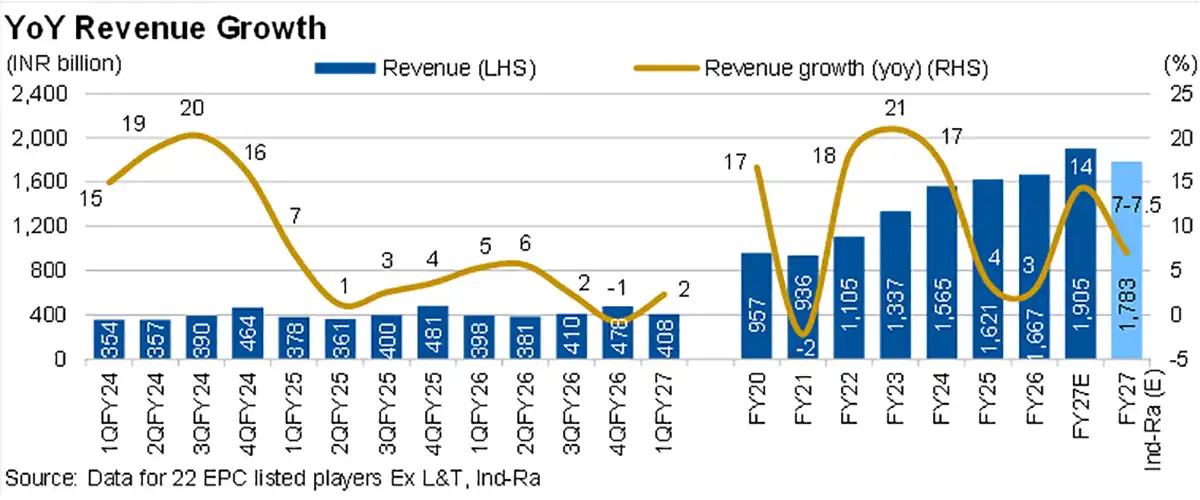
“Sector revenues grew only 2% yoy in 1QFY27, marking the ninth consecutive quarter of a single-digit percentage growth, while EBITDA margins declined to a multi-quarter low of 9.5%, highlighting the continued impact of execution bottlenecks, competitive intensity, and cost pressures. Performance divergence across companies remained pronounced, underscoring the importance of project selection, execution capability, and balance-sheet strength. Positively, the order book cover improved to 3.1x, supported by robust awarding activity in the power/T&D, metro, marine, and overseas markets, increasing private-sector participation, and a healthy medium-term project pipeline.
While liquidity remains comfortable and funding avenues have broadened, elevated working-capital lock-up and weak cash conversion continue to weigh on the sector credit metrics. After a seasonal uptick in working capital in 1H, credit metrics improvement is contingent on the extent of unlocking in 2H. The sector’s working capital cycle was elongated over FY25-FY26, with a significantly lower conversion of EBITDA to cash flow from operations (CFO) at around 30% vs the historical level of 55%-65% until FY24. Ind-Ra expects modest improvements by the end of FY27, given the undemanding base and likely recoveries in specific segments, such as water and metro projects. Overall liquidity conditions are healthy, with increased diversification in funding sources for both fund and non-fund requirements,” said Neha Gourwani, Senior Analyst.
Ind-Ra took 23 rating actions between April and mid-August, with a mixed trend: seven downgrades or adverse outlook changes vs 16 upgrades or favourable outlook changes. The sector has seen significant working capital lock-up over the past two years due to water/irrigation/metro projects, which has impacted cash flows. Moreover, heightened competition in the highways sector due to scarcity of awards impacted the overall sector margins over FY25-FY26, with companies unable to diversify exhibiting limited order visibilities.
The highways sector witnessed several positive developments recently, including the revised build-operate-transfer (BOT) (Toll) Model Concession Agreement, a project pipeline exceeding INR4 trillion (vs. INR3.5 trillion in FY26), and regulatory changes permitting institutional investors to directly participate in BOT project bidding. All of these measures lift hopes of a recovery in road projects after a lull since FY24. Like in roads, the railways sector is also looking to attract private capital in the proposed INR2.8 trillion East West Dedicated Freight Corridor via the hybrid annuity model. The National Highway Authority of India (debt rated at ‘IND AAA’/Stable) is taking cautious measures to tighten the bidding norms. In the water sector, Jal Jeevan Mission (JJM) recoveries remain elusive, but payments are likely in the next few quarters. The power/T&D sector continues to remain a bright spot, with robust ordering, execution, and margins. However, supply-chain and commodity-price risks are likely to sustain over the medium term.
Ninth Quarter of Single-digit Revenue Growth: The EPC sector’s revenue grew 2% yoy in 1QFY27 across 22 listed entities, marking the ninth consecutive quarter of a single-digit percentage revenue growth. Operational supply-chain challenges led by the Middle East conflict, labour shortages due to state elections, and continued payment issues in water projects impacted performance. While the companies guide for around 14% yoy revenue growth in FY27, it hinges on a recovery in 2HFY27 and the continuation of a normalising business environment. The 1QFY27 revenue growth was led by buildings & factories-focused players (15% yoy) on a low base (1QFY26: negative 5%) and continued momentum in the T&D/power segment (7% yoy). Revenues of the road sector-focused players dropped by 4% yoy in 1QFY27, continuing a period of decline since 1QFY25. Other segments such as heavy civil also reported revenue declines due to company-specific underperformance.
Margins at Multi-quarter Lows: Sector EBITDA margins fell to a multi-quarter low of 9.5% in 1QFY27, driven by adverse operating leverage, incomplete pass through of costs driven by a surge in specific input prices, rising fixed-price contracts, increased labour costs, and heightened competitive environment. The companies guide for yoy flat margins in FY27 (10.2%-10.3%), indicating a recovery in the next few quarters. Margin deterioration was across segments, with only six out of 22 companies reporting yoy margin improvements in 1QFY27.
Order Book Cover Improves to 3.1; Tendering Activity Resilient: The sector order book grew 18% yoy in 1QFY27, faster than the 2% yoy revenue growth, leading to a higher order book cover of 3.1x vs 2.7x in 1QFY26. The ordering activity was led by T&D/power, marine/ports, metro, and overseas tendering, while it was sluggish in the highways sector. Only six companies reported an improved order book coverage. T&D/power ordering activity is likely to remain robust with Kalpataru Projects International Limited (KPIL; debt rated at ‘IND AA+’/Stable)/KEC International Limited (KEC; debt rated at ‘IND A1+’) indicating increased tender pipeline of over INR2 trillion in 1QFY27, equally split between domestic and international. The uptick in transmission/power segment awards is likely to sustain over the next 4-5 years. Afcons Infrastructure Limited (Afcons; debt rated at ‘IND A1+’) has a INR1.5 trillion pipeline for the next nine months and around INR4 trillion for the next two years. L&T’s aggregate prospect pipeline increased marginally to INR15.1 trillion in 1QFY27 (1QFY26: INR14.8 trillion), led by the infrastructure & utilities segment. Notably, private sector’s share in the order book increased to 40% in 1QFY27 vs 27% in 4QFY26, led by the thermal, residential and commercial, metals, and heavy civil segments.
Interest Coverage Ratio Dips on Working Capital Lock-up; Liquidity Conditions Benign: The sectoral credit metrics as reflected in the interest coverage ratio slipped to 2.9x in 1QFY27 (4QFY26 and 1QFY26: 3.2). Moreover, interest costs as a percentage of sales declined to 3.3% in 1QFY27 (1QFY26: 3.4%). Liquidity conditions are comfortable with the fund-based/non-fund based (NFB) exposure of the construction sector rising 19.6% yoy in FY26. Surety bond adoption has accelerated in central government projects with INR500-600 billion outstanding, accounting for 17% of the overall NFB exposure. Furthermore, the sector companies indicate that the Power Grid Corporation of India Limited has started offering interest-free mobilisation advances.
Equity-funded projects are likely to continue growth with the government’s proposed public private partnership pipeline worth INR17 trillion over FY26-FY28. The monetisation environment is steady, with increased incidence of pre-construction tie-ups. A recovery in JJM receivables is a key monitorable, which not only continues to elevate the working capital but also hurts the execution pace. The sector is likely to see increased capex over the medium term, led by players expanding in the metro, T&D, and mining segments, while the highway players have muted guidance.