
Ind-Ra believes balancing debt upsizing with adequate maintenance provisions is essential to mitigate credit risks, especially in cases of limited maintenance track records and already aggressively bid projects. In projects where the increase in leverage aligns with inflation during the construction phase, the coverage ratios remain consistent with those at financial closure. However, for projects with a significant increase in leverage post operationalisation, the DSCR headroom available at financial closure diminishes rapidly, thereby increasing credit risks.
Ind-Ra believes India's robust InvIT ecosystem facilitates efficient capital release for sponsors through regulated monetisation pathways, with assets under management (AUM) of road InvITs reaching INR3,168 billion as of March 2026. The agency expects an increase in the share of hybrid annuity model (HAM) assets within InvITs, potentially reaching INR1,000 billion by FY30, as more assets become operational. Ind-Ra believes that the next phase of growth in NHAI’s HAM ecosystem will be defined by a combination of improving bidding discipline, increasing reliance on InvIT-led capital recycling, and rising execution risks in under-construction projects.
Ind-Ra’s analysis of 199 projects under execution indicates that more than 50% of these projects, with a total award cost of nearly INR900 billion are likely to be delayed by more than 12 months, according to recent information from the NHAI data lake portal.
With over half of the projects under execution likely to witness delays of over 12 months and leverage levels rising through top-up borrowings in some assets, maintaining adequate debt service coverage and operational resilience will remain key rating sensitivities.
"We anticipate that over 50% of projects, with an award cost of approximately INR900 billion, currently under execution, will face delays exceeding 12 months. Despite NHAI's timely intervention to mitigate bitumen price risk amid the Middle East tensions, tight domestic supply has marginally impacted national highway construction in 1QFY27. Implementing an effective monetisation strategy for operational assets, without increasing credit risk, is critical", says Suryanarayanan S, Senior Analyst, Infrastructure & Project Finance Group, Ind-Ra.
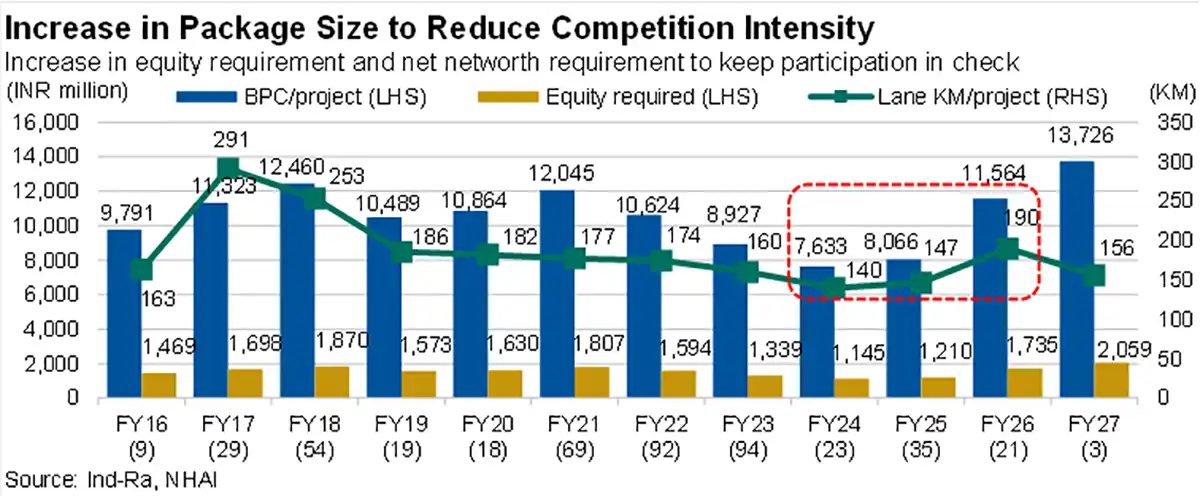
Larger HAM Packages Likely to Restore Competitive Discipline: Ind-Ra anticipates that larger package sizes, combined with stricter net worth requirements, will help reduce competition intensity. The higher equity investment requirement for larger packages naturally limits participation by entities with lower net worth. Additionally, this approach discourages sponsors from bidding for multiple packages, a strategy often employed by developers to achieve economies of scale. A more rational competitive landscape should support healthier project economics and lower execution stress over the medium term.
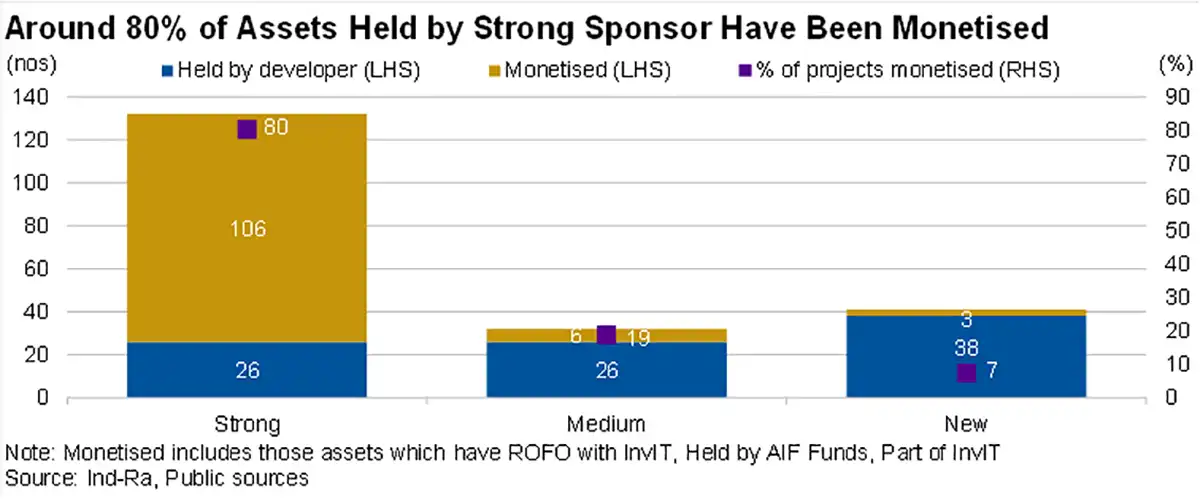
Strong Developers – Prefer InvIT Route to Free Up Capital: Ind-Ra believes India’s strong InvIT ecosystem provides a scalable mechanism for releasing sponsor capital from operational HAM assets. Road InvIT AUM reached INR3,168 billion as of March 2026 and HAM assets within InvIT platforms could reach INR1,000 billion by FY30. Strong sponsors have already monetised nearly 80% of completed portfolios, demonstrating effective capital recycling while regulatory leverage safeguards provide comfort to lenders.
Aggressive Leverage Can Erode Benefits of Ring-Fenced Structures: Ind-Ra has observed that in projects with significant increases in leverage, concessionaires typically enter into fixed-price operations and maintenance (O&M) agreements with sponsors at costs significantly lower than Ind-Ra's O&M estimates or those of the earlier management. Ind-Ra believes that managing leverage will remain a key determinant of credit quality. While top-up debt can release sponsor capital, excessive debt can weaken DSCRs and reduce financial flexibility. Highly leveraged projects often rely on low-cost sponsor O&M arrangements and reserve income, increasing vulnerability to sponsor credit deterioration and constraining ratings.
Prudent GST Compensation Management will Remain Critical: Ind-Ra has observed that GST is typically paid in a timely manner in projects alongside annuity payments. Although the finalisation process for GST change in law (CIL) compensation has been broadly streamlined, the payment process often takes time, with GST CIL payments on annuities generally commencing from the third annuity payment. The input credit available with the project special purpose vehicle (SPV) would be generally sufficient to discharge GST liabilities. Furthermore, in a few projects, Ind-Ra noted that the authority, upon request from the issuer, releases a portion of the GST CIL payment on annuity upfront as a lumpsum. It is critical that this upfront portion is retained in the project SPV to discharge the GST liability on annuity. Otherwise, it could impact future coverage, as the GST liability will have to be discharged from project cash flows, thereby constraining the rating.