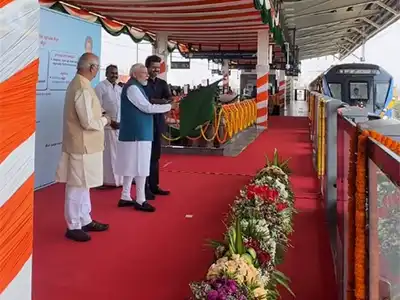
The newly inaugurated section forms part of Corridor 4 of Phase II and comprises 11 elevated stations. The stretch includes Poonamallee Bypass, Poonamallee Bus Stand, Poonamallee Government Hospital, Karayanchavadi, Kumananchavadi, Kattupakkam, Iyappanthangal, Thelliyaragaram, Porur Bypass, Porur Junction and Vadapalani.
The corridor features a 3.7-km double-decker structure and advanced signalling systems designed to support driverless train operations. The new stretch is expected to reduce travel time and improve connectivity between Chennai’s western suburbs and the city centre.
Passenger services commenced at 4 pm on Sunday and operated until 9 pm. From October 12, services are scheduled to run from 7 am to 9 pm in both directions, with the last trains departing from Poonamallee Bypass and Vadapalani stations at 9 pm.
The Metro inauguration forms part of a wider development programme worth more than Rs 13,000 crore across Tamil Nadu, covering highway, railway, port and industrial infrastructure.
Highway projects worth around Rs 3,700 crore include the four-laning of the 36-km Vadugapatti–Therkuvenganallur section of NH-744 and the 30-km Madurai Ring Road section of NH-744A. The programme also includes the foundation stone for the four-lane Thiruvarur Bypass on NH-83.
Railway projects include the Karaikal–Peralam railway line, three rail flyovers in and around Coimbatore, and the inauguration of five redeveloped stations under the Amrit Bharat Station Scheme: Palani, Vellore Cantonment, Ambasamudram, Paramakkudi and Namakkal.
Port-related initiatives include new storage and export-import facilities, an upgraded cruise terminal and a Seafarers Club at Chennai Port, alongside projects at V.O. Chidambaranar Port and Kamarajar Port.
The programme also includes the foundation stone for a Rs 1,620-crore Lube Oil Base Stocks project at Chennai Petroleum Corporation Limited’s Manali refinery. The facility is planned to have a capacity of 270,000 tonnes per annum and will produce base stocks used in premium lubricants.
At IIT Madras, Modi is also scheduled to dedicate the Sudha Gopalakrishnan Brain Centre and launch a scientific mission to develop three-dimensional brain atlases at cellular resolution. The programme includes the release of C-STROKE, an atlas containing more than 1,000 annotated microscopic sections from a stroke-affected brain.