
ICRA: Improved affordability supports recovery in housing demand with YoY sales decline getting limited to 7% in Q3 FY2021; sustainability of the trend is key to continued recovery
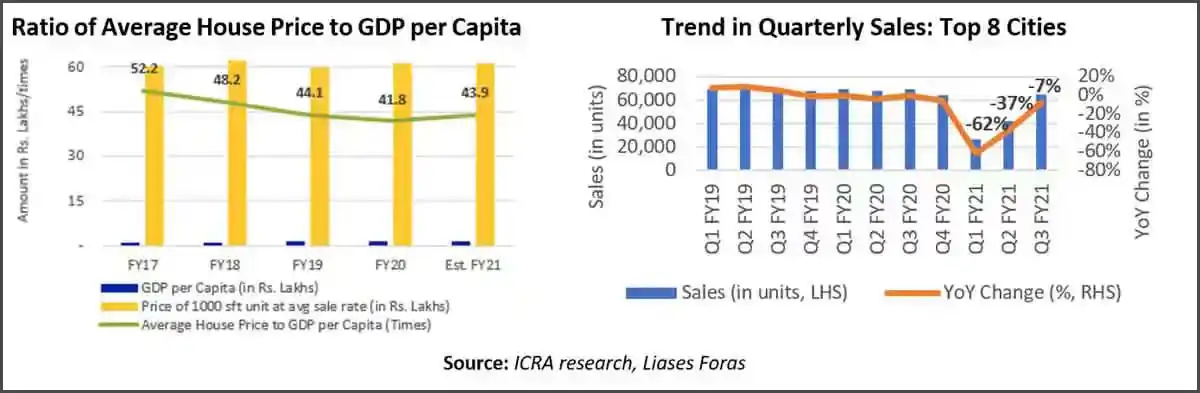
Shubham Jain, Senior VP and Group Head at ICRA, said, “While the increase in GDP per capita has outstripped the increase in housing prices, which has resulted in some improvement in affordability over the years, overall affordability remains low, with an average house estimated to cost around 44 times the GDP per capita in FY2021. In recent quarters though, reduced home loan rates, attractive payment schemes/discounts and reduction of stamp duties in certain key states on the back of Covid-19, has brought down housing costs and stimulated housing demand. While the housing sales volume witnessed a YoY decline of 62% in Q1 FY2021 across the top eight cities of the country, sales bounced back considerably in subsequent quarters, with a QoQ growth of 60% in Q2 FY2021 and further QoQ growth of 53% in Q3 FY2021, limiting the YoY contraction to 7% in Q3 FY2021.”
Repo-linked lending rate (RLLR) for home loans have touched a historical low, with the rates dropping below 7%. Banks are also offering discounts on processing fees etc. Given the prevailing economic uncertainties, repo rates are likely to remain low over the near-to-medium term, and thus home buyers may continue to benefit from the same into FY2022. Developers have also recognised the liquidity issues being faced by home buyers, and have thus offered deferred payment schemes and/or discounts in various forms, such as freebies, GST waivers etc. Further, weakness in the rupee has also supported affordability for the NRIs, and stimulated demand from that segment. Certain states, i.e. – Maharashtra and Karnataka, which contain the key housing markets of Mumbai and Bangalore, have extended 2-3% reductions in stamp duty for a limited time, which has spurred housing registrations to reach all-time highs in some areas. The Central Government is encouraging other states to extend similar reductions, and effective implementation of the same would continue to boost housing sales in FY2022. The Maharashtra Government has also reduced construction premiums for developers by 50% up till December 2021, and in turn, has required the developers availing of this scheme to pay stamp duty on behalf of the buyers, which would further boost demand in the region. Mumbai has amongst the highest construction premium levies in the country, with such premiums typically amounting to around 10-15% of the selling price. As per ICRA estimates, even after payment of stamp duty on behalf of the buyers, the developer would still gain by up to 4.5% of the selling price, which would result in improved project viability. Additional pass on of some this benefit to the consumers would further improve affordability and demand.

“A focused attempt to address affordability through reduced housing costs for the home-buyer would allow for the recent demand uptick to continue, and thereby enable the recovery of housing demand to pre-Covid levels within FY2022. Continued measures by the Central and state Governments would go a long way in ensuring this. With the stamp duty reduction having been brought into effect only by Maharashtra and Karnataka thus far though, other regions may also need to implement similar incentives for housing demand to recover nationwide. The upcoming Budget may also add a stimulus by increasing income tax deductions and relaxing some of the caps currently applied. Notably, larger, established developers, with a track record of timely and quality delivery, would be the primary beneficiaries of the demand recovery, resulting in acceleration in the ongoing trend of market consolidation. Overall, reasonably-priced inventory at advanced stages of construction is likely to be preferred, although attractive payment schemes by developers would also underpin demand for under-construction inventory. Going forward, developers would need to focus on aligning products with market demand, especially in terms of price,” added Jain.
Published on:
19 January 2021
Share:
We Value Your Comment