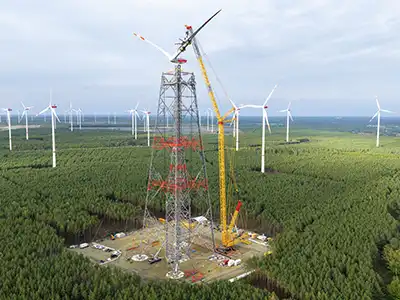
The turbine's rotor blades were fitted before an integrated system telescoped the inner tower of the truss structure upwards, bringing the installation to its full height. The structure, located between Berlin and Dresden, is now Germany's second-tallest structure after the Berlin TV Tower.
Developed by technology company GICON, the high-altitude wind tower is designed to explore new possibilities for the commercial exploitation of onshore wind energy. Its rotor has a diameter of approximately 126 metres and is intended to harness the stronger and more consistent winds available at higher altitudes to generate electricity.
The project represents an approach to wind energy development that seeks to access wind resources beyond the heights typically reached by conventional onshore turbines.
Moved with a 375-tonne load
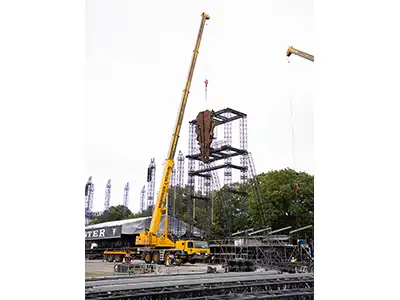
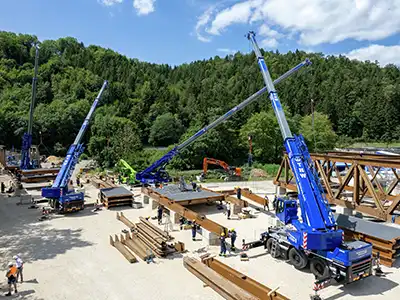
The large-scale steel lattice tower, fitted with its 3.8-megawatt wind turbine, was erected in an existing wind farm by a large Liebherr crawler crane. The LR 11350 had been in operation on this major project since spring 2025 and – with the exception of the rotor blade installation – was equipped with the PowerBoom parallel boom system. This enabled even particularly heavy loads to be lifted and installed reliably. The largest and heaviest component was a section of the turbine tower measuring approximately 40 x 40 x 40 metres, with a gross weight of 375 tonnes. With a reach of around 44 metres, the crane placed the load onto the 50-metre-high base structure. This also required the crawler crane to travel along a specially constructed track made of steel plates and bongossi timber.In parallel with the construction of the outer steel structure, the upper section of the tower – which would later be telescopic – was fabricated inside. Until the provisional tower height of around 160 metres was reached, the crawler crane was equipped with the PowerBoom and a jib tip up to 84 metres long. In addition, a total ballast load of up to 850 tonnes was applied to the crane and on the ballast platform of the derrick jib.
Crane conversion in just six days
The crane then had to be converted for the installation of the rotor blades. Thanks to the LR 11350’s rapid set-up concept and a sufficient number of skilled personnel, the switch from the PowerBoom configuration to the 104-metre-long lattice boom was completed in just six days. Together with the 84-metre luffing jib, the crawler crane achieved a roller head height of 200 metres. The subsequent blade installations required a sufficiently long time window with the lowest possible wind speeds. After several days of waiting, the teams involved finally took advantage of suitable weather conditions and installed the three rotor blades at a height of around 170 metres within twelve hours, partly at night.“During its approximately 18-month period of operation, my LR 11350 performed with absolute reliability and without any faults,” confirmed crane operator Fabian Ueck once the work was completed. In addition to the large crane, several other Liebherr mobile cranes were deployed during the implementation of this extraordinary pilot project. As well as setting up and ballasting the crawler crane, they were primarily responsible for work on the base structure and the pre-assembly of the individual segments of the massive lattice tower.
The high-altitude wind tower was developed and built by GICON-Großmann Ingenieur Consult GmbH from Dresden. Founded in 1994, the owner-managed company is part of the internationally active GICON Group and has its own department for research and technological development. The pilot plant in Lusatia is an example of this technology-oriented approach.