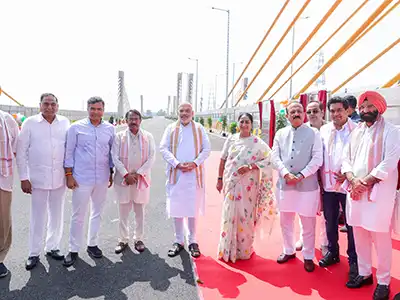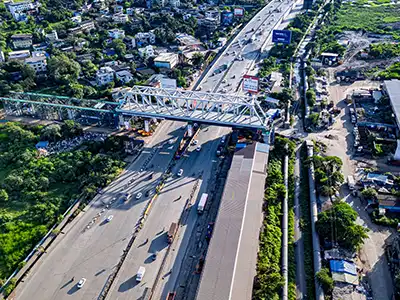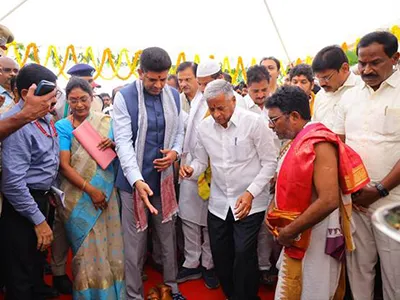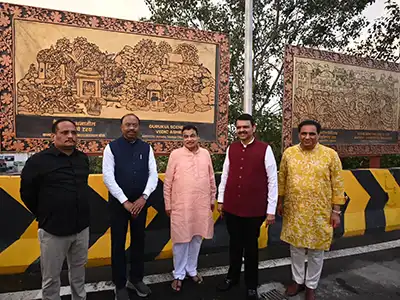
Union Minister of Railways Ashwini Vaishnaw inspected the under-construction bridge on October 31, 2026, during his visit to Varanasi. During the visit, he announced that the bridge would be named Namo Setu and directed the executing agency to complete the project within 36 months, against the original schedule of 48 months.
RVNL Chairman and Managing Director Saleem Ahmad, Director (Operations) M.P. Singh, Varanasi Project Implementation Unit Chief Project Manager Vikas Chandra and Northern Railway Chief Administrative Officer (Construction) Shyam Singh were present at the site to brief the Minister.
The new bridge is being constructed to address capacity constraints on the existing Malviya Bridge, also known as Dufferin Bridge. Built in 1887, the approximately 1,048.5-metre-long bridge has a double railway line on its lower deck and a two-lane road on its upper deck. The Varanasi–Pt. Deen Dayal Upadhyaya (DDU) section currently operates at around 163% of its line capacity, highlighting the need for additional infrastructure.
To address this constraint, the Union Cabinet approved the Varanasi–Pt. Deen Dayal Upadhyaya Multitracking Project on October 16, 2024, at an estimated cost of Rs 2,642 crore. The project includes the construction of a new rail-cum-road bridge over the Ganga and the development of the third and fourth railway lines between Varanasi and DDU.
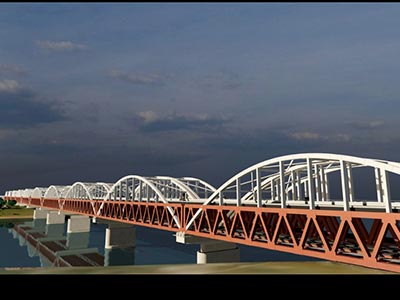
The 2.5-km-long Namo Setu, including its approaches, is a key component of the project. RVNL, in association with GPT Infraprojects Limited, is executing the work at a contract value of Rs 1,201.35 crore. The foundation works under Schedule G1, involving twin-D well foundations, have been entrusted to Afcons Infrastructure Limited as a subcontractor. The bridge is being built approximately 50 metres downstream of the existing Malviya Bridge, near Kashi Railway Station, across Varanasi and Chandauli districts.
The bridge will have eight open-web steel girder spans of 108.5 metres each and two spans of 103.3 metres each, with an aggregate span length of approximately 1,075 metres. Its river section will use specialised twin-D well foundations. The overall structure will extend approximately 2.5 km, including the approaches.
The project scope covers the construction of the substructure and superstructure, railway and road approaches, overhead electrification (OHE) and general electrical works, in accordance with the approved General Arrangement Drawing (GAD). The design is intended to meet transportation requirements over the coming decades, with the Railway Minister emphasising the need to make the infrastructure future-ready for the next 100 years.
The bridge is expected to add 27.83 million tonnes per annum (MTPA) of transportation capacity, supporting freight movement and strengthening connectivity towards Bihar, West Bengal and the northeastern states. It will also improve access to Kashi Railway Station, Kashi Vishwanath Temple and Namo Ghat, benefiting pilgrims, tourists and local commuters.
Construction is expected to generate approximately 10 lakh human-days of direct employment, besides creating wider socio-economic opportunities. The project is part of the PM Gati Shakti National Master Plan and is being executed on an Engineering, Procurement and Construction (EPC) basis.
Construction activities have commenced, with fabrication of the cutting edge for the well foundation beginning on October 31, 2026. Following his review of the project, the Railway Minister directed the executing agency to accelerate construction and complete the bridge within the revised 36-month timeframe.