
Astec Machines Help in Developing Sustainable Flexible Pavements

Many global construction equipment makers have been very aggressive on the Indian infra and construction sector and they have already set up shop in the country. However, Astec is a somewhat late entrant. What prompted you to enter India and form a licensing agreement with TIL India?
Astec has been quite keen to enter the Indian market and had, in fact, initiated negotiations with TIL India way back in 2007-08; the technical collaboration was finally formalized in 2008-09. India is currently the fastest growing economy, and to add to this, is the government's resolve to build the huge infra deficit in segments like rail, port, waterways, smart cities, and an ambitious drive for poverty alleviation. All these initiatives have opened up big business opportunities for construction equipment makers and infra builders of various hues. TIL India, as a local progressive partner, and well-entrenched in the official corridors and local markets, will help Astec make the most out of the emerging business opportunities in the country's construction and infrastructure market.
Given the fact that Indian customers are very price conscious and they largely opt for less pricier products over hi-tech equipment, what are your strategies to tackle this?
The company, along with its local partner, has initiated multiple measures to resolve such issues. Moreover, the company will offer hi-tech and cost effective products that give more mileage and value for money. The perception of price consciousness is also changing and there are enough examples to prove that local customers are increasingly going in for quality products to enable them to execute world-class projects within the given timelines. No matter that we are new in the Indian market amidst stiff competition from equipment makers from around the globe, but TIL is a well-established player. Together, we will roll out products that meet the aspirations of the local price-conscious customers. Keeping all this in mind, Astec thinks that it is the right time to mark its entry into the Indian market.
Please elaborate on the construction equipment that the company is currently manufacturing at its local manufacturing units and what is the ratio of localization in these products?
Currently, the company is manufacturing track crushers and hot mix asphalt plants, among others, especially for the Indian road and highway sector. We are also importing a few machines from our parent plants in America, but after a period of time Astec will manufacture them in the local manufacturing units with 90% localization. In the next 20 years or so, Astec aims to be one the largest equipment makers on Indian shores.
Use of Recycle Asphalt Pavement (RAP) in India is at a nascent stage though many companies are trying to promote it in big way. Are your plants equipped to support RAP?
Astec was among the first to start talking about RAP in India and in disseminating the benefits of RAP since we entered the Indian market in collaboration with TIL India. We have been apprising NHAI and MoRTH as well. Road construction consumes a substantial quantity of natural resources, and depleting natural resources necessitates adoption of technologies such as RAP. Our plants can use RAP up to 50%, and can help contractors save on energy cost, along with reduced cost of construction, conservation of aggregates and binders, and most importantly, preservation of the environment. RAP is truly one of the most sustainable products in the infrastructure industry.
What are the capacities and operational economies of Astec hot mix asphalt plants in India?
The company is manufacturing continuous asphalt batching plants for the highway sector in 120, 200 to 300 tonnage capacities. It will go all out to counter its rivals with regard to quality and cost effectiveness as the company strongly believes in making products that exactly match Indian requirements. Moreover, our plants are affordable, portable, and are easier to assemble and dissemble when shifting them from one project site to another. In North America, Astec has captured over 70% of the market in the hot mix plant segment, and it aims to be similarly positioned in India in the next 20 years or so.
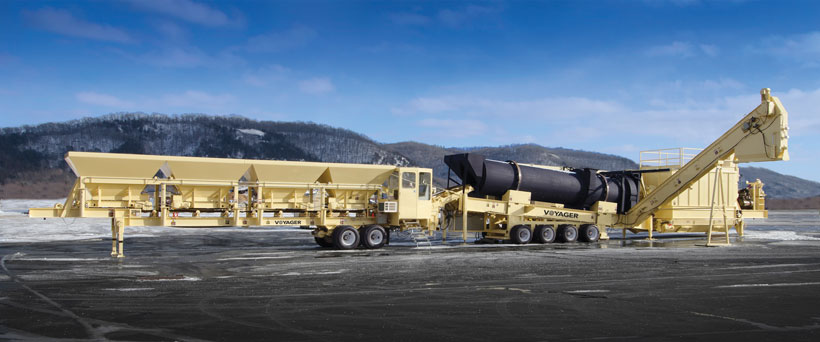
Tell us about your Voyager 120 and double barrel hot mix asphalt plant manufactured in India.
Voyager is one of the most suitable plants for the Indian road sector as it offers a compact, and highly portable design. The whole plant is on wheels and can be set up or dismantled in the shortest possible time. It can run up to 30% RAP which is best in its class and is backed by the best service support in the industry. Its counter flow drum featuring ASTEC v-Flight brings greater uniformity during the drying process, resulting in better heat transfer, and therefore, low fuel consumption per ton, and greater productivity.
Our double barrel hot mix asphalt plants comes in 200, 300, and 400 tph capacity and has huge cost saving on transportation, dismantling and installation due its unique portable design. Double Barrel is Astec's patented technology for aggregate drying, heating and mixing. A co-axial drum for drying and heating in the inner drum and mixing of RAP, bitumen and filler material in the outer drum (in that order) to carry out sequential and homogenous mix, results in lower fuel consumption per ton of hot-mix. The Astec Double Barrel can meet and even exceed expectations by effectively and efficiently producing hot mix using high percentages of RAP of up to 50%. The Double Barrel hot mix asphalt plants are suitable for Recycled Asphalt Pavement (RAP), are cost and energy efficient, and they emit less carbon gases, which makes them environment friendly as well.
In India, there is a general perception that aggregates are largely more impure and dusty as compared to aggregates in developed countries. What would be your remedy to overcome this?
Astec makes counter-flow asphalt plant or continuous plant. It largely depends on the kind and quality of the prevailing infrastructure in India, and what type of infrastructure the government wants to build. As far as the impurity in aggregates is concerned, we have faced a similar problem in American and European countries. However, this problem can be easily rectified by incorporating value-added products.
Published on:
16 January 2017
Published in: NBM&CW January 2017
Share:
We Value Your Comment