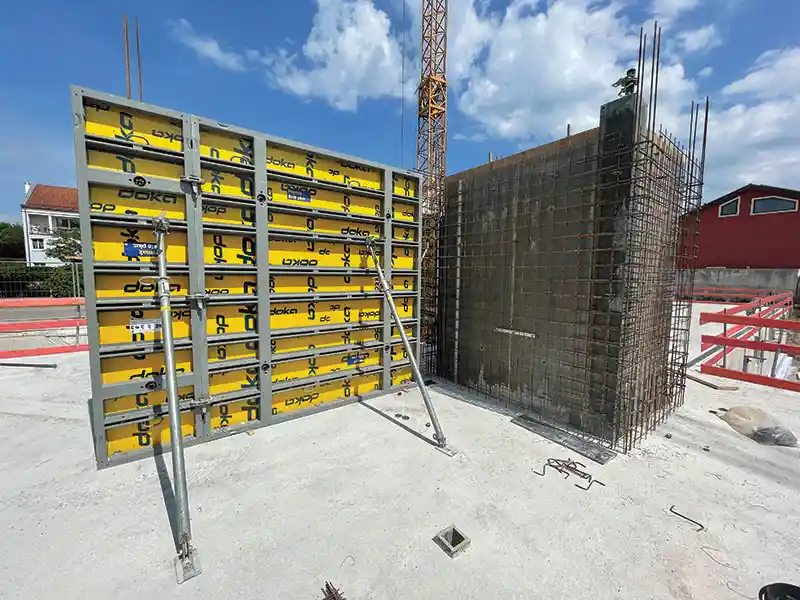
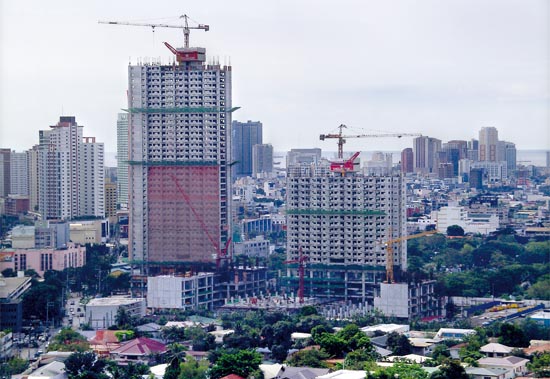
Manila, Philippines: The Jazz Residences built by contractor Megawide consist of four residential towers up to 45 floors high. Shopping centers and parking levels on the ground connect the towers with each other. Every six working days another slab per tower is poured and so are the partition walls of a floor. They are poured in six cycles using a total of 110 m3 of concrete. 450 m2 of wall formwork used per cycle.
A new method using MEVA's wall formwork AluFix saves time and money
MEVA Formwork Systems has supplied formwork systems for highrise and residential projects to contractors all over the world for many years. The Burj Khalifa in Dubai, the world's tallest building, and the Palais Royale in Mumbai are just two of the many highrise buildings that have been built using MEVA formwork. Apart from luxury highrise buildings, modern homes are generally in increasing demand by the growing middle class in South East Asia and the Middle East. Building residential highrises and housing blocks fast and efficiently without compromising quality or safety is a major challenge to local contractors in many Asian countries. The solution to the challenge is fast tracking the partition walls inside the buildings. MEVA's crane-independent wall formwork system AluFix is extensively used for fast tracking because its panels can be carried manually and are ideally geared to the heights of partition walls.
Fast-tracking partition walls eases the building process
How does fast-tracking work? First, the structural walls of a floor are erected, but no partition walls. Then, large panel areas of slab formwork are set up. This is done much faster than usually because there are no hindering inside walls. After pouring the slab and stripping the slab formwork, the partition walls on that floor are poured.Sizes to fit any wall size
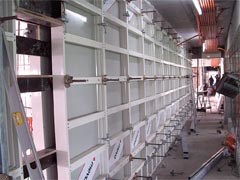
A typical partition wall inside Jazz Residences that is poured using AluFix wall formwork. The 2.40 m high walls resting on beams are poured with horizontal panels that have filling nozzles. The 2.90 m high walls are poured using vertical panels and the concrete is poured through holes in the slab.